

DeepSeek V4 has just been released, and it's an open-source AI model that directly competes with Anthropic's Opus 4.6 while costing seven times less and running on Chinese chips. This launch comes 484 days after the original "DeepSeek moment," and it promises to reshape the landscape of foundational AI models.
The new model is available in two versions: Pro and Flash. Both are massive in scale, with the Pro version boasting 1.6 trillion parameters (49 billion active) and the Flash version containing 248 billion parameters (13 billion active). This makes Flash unusually large for a lightweight model, signaling DeepSeek's ambition to dominate both high-end and efficient AI segments.
Find Original Home Decor sparking conversation at Grand Goldman Shop.

DeepSeek V4 Architecture: Mixture-of-Experts for Efficiency
DeepSeek V4 uses a Mixture-of-Experts (MoE) architecture, which activates only a fraction of its parameters during each inference. This drastically reduces computational cost and makes the model more accessible for widespread use.
Both versions support a context window of one million tokens, a significant jump from the 128,000 tokens in V3. This allows users to input entire novels or large datasets at once, opening up new possibilities for long-form content analysis and generation.
Compared to its predecessor, DeepSeek V3.2, the new model is far more efficient: it requires only 27% of the operations per token and 10% of the KV cache. This efficiency gain is crucial for reducing operational costs and enabling deployment on less powerful hardware, including Chinese-made chips.
Performance Benchmarks: Promising Results
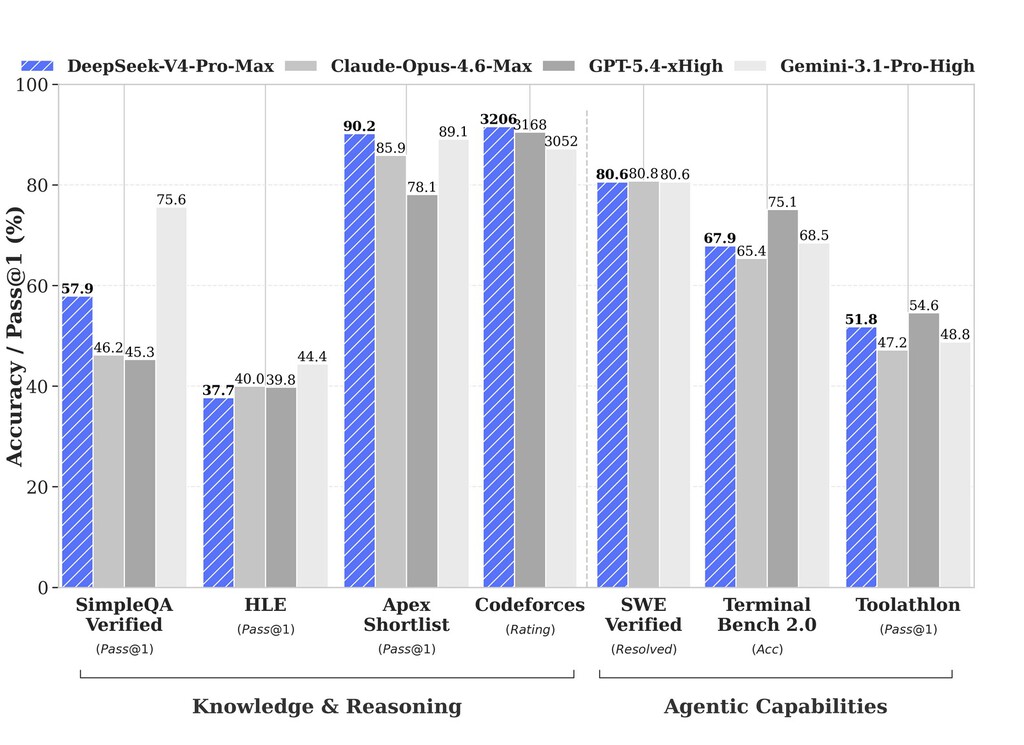
DeepSeek's internal benchmarks show that V4 Pro-Max, the top-tier variant, delivers performance that rivals Opus 4.6. While exact figures are not yet public, the company claims significant improvements across reasoning, coding, and multilingual tasks.
These benchmarks are not independently verified, but if they hold up, DeepSeek V4 could become a serious competitor to proprietary models from Anthropic, OpenAI, and Google. The fact that it runs on Chinese chips also raises questions about the future of AI hardware and geopolitics.
Key Takeaways from DeepSeek V4 Launch
- Open-source and massive: V4 comes in Pro (1.6T parameters) and Flash (248B parameters) versions, both with open weights.
- Efficient MoE architecture: Only a fraction of parameters are active per inference, cutting computational costs.
- Huge context window: One million tokens allow processing of entire books or large datasets.
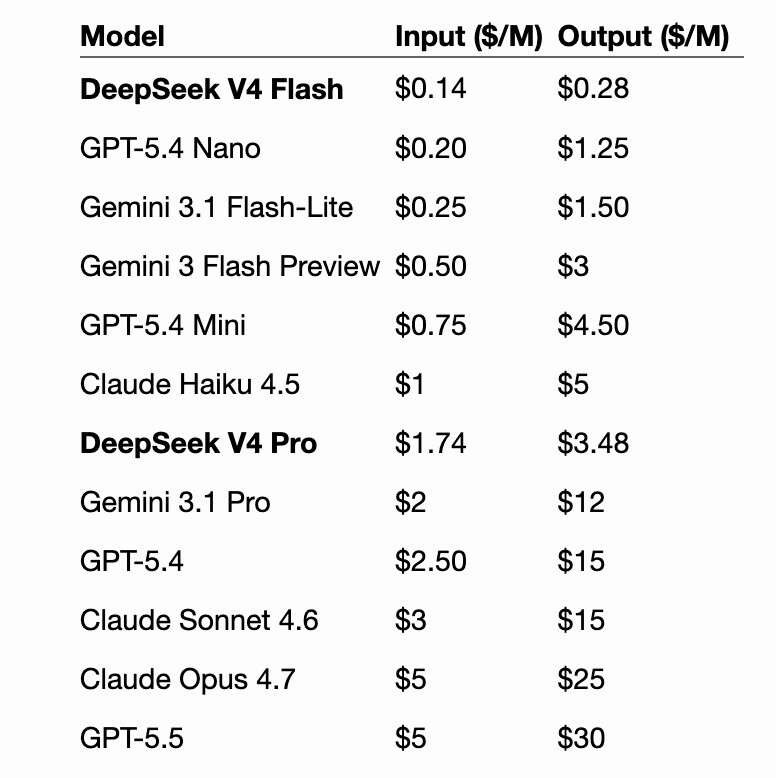
- Cost advantage: Seven times cheaper than Opus 4.6, making advanced AI more accessible.
- Chinese chip compatibility: Optimized to run on domestic hardware, reducing reliance on foreign technology.
Comparison: DeepSeek V4 vs. Opus 4.6 vs. DeepSeek V3.2
| Feature | DeepSeek V4 Pro | DeepSeek V4 Flash | Opus 4.6 | DeepSeek V3.2 |
|---|---|---|---|---|
| Parameters | 1.6T (49B active) | 248B (13B active) | Not disclosed | Not disclosed |
| Context window | 1M tokens | 1M tokens | Not disclosed | 128K tokens |
| Cost (relative) | ~1/7 of Opus 4.6 | ~1/7 of Opus 4.6 | Baseline | Higher than V4 |
| Hardware | Chinese chips | Chinese chips | NVIDIA GPUs | NVIDIA GPUs |
Why DeepSeek V4 Matters for the AI Industry
The launch of DeepSeek V4 is significant for several reasons. First, it demonstrates that open-source models can compete with the best proprietary offerings, challenging the dominance of companies like Anthropic and OpenAI. Second, its efficiency and compatibility with Chinese chips could reduce the AI industry's reliance on NVIDIA GPUs, which have been in short supply.
Third, the lower cost makes advanced AI more accessible to startups, researchers, and businesses that cannot afford expensive API calls. This could accelerate innovation and democratize access to cutting-edge AI capabilities.
However, questions remain about the model's real-world performance and safety. DeepSeek has not yet released independent evaluations, and the AI community will be watching closely to see if V4 lives up to its promises.
What to Watch Next
In the coming weeks, we can expect third-party benchmarks and user feedback on DeepSeek V4's performance. The AI community will also be keen to see how Anthropic, OpenAI, and Google respond to this new competition. The background to this story is set out in DeepSeek V4-Flash: The Cheapest AI Model on the Market Right Now. A related thread runs through Chinese AI Models Qwen3.8-Flash and DeepSeek V4-Flash Disrupt Pricing. Earlier coverage in German Search Engine Ecosia Ditches Mistral for Chinese Open-Source AI Models shows how the argument developed.
Additionally, the model's ability to run on Chinese chips could have geopolitical implications, as the U.S. continues to restrict exports of advanced semiconductors to China. If DeepSeek V4 proves successful, it could signal a shift in the global AI hardware landscape. A closer look at the same subject appears in DeepSeek V4: China's AI Leader Admits It Trails the West. Anyone following the wider picture can start with Meta's Superintelligent AI Vision: Open-Source Model for All. The same theme surfaces in Elon Musk Calls Kimi K3 'Impressive' as Open-Source AI Race Heats, which takes a different angle.
Finally, the open-source nature of V4 means that developers can fine-tune and adapt it for specific use cases, potentially leading to a wave of new applications and innovations. Context on how this played out before sits in Anthropic CEO Calls Open Source AI Dangerous, Echoing Ballmer's Linux Cancer. A companion piece, AI Future Debate: Open Source vs Safety in Silicon Valley, approaches the same subject from another angle.
FAQ
What is DeepSeek V4?
DeepSeek V4 is an open-source AI model released by DeepSeek, available in Pro and Flash versions. It competes with proprietary models like Opus 4.6 and runs efficiently on Chinese chips.
How does DeepSeek V4 compare to Opus 4.6?
DeepSeek V4 claims performance comparable to Opus 4.6 but at seven times lower cost. It also features a larger context window of one million tokens and is optimized for Chinese hardware.
What are the key features of DeepSeek V4?
Key features include a Mixture-of-Experts architecture, 1.6T parameters (Pro) or 248B (Flash), a one-million-token context window, and significant efficiency gains over V3.2.
Why is DeepSeek V4 important?
It demonstrates that open-source models can rival proprietary ones, reduces reliance on NVIDIA GPUs by running on Chinese chips, and lowers costs, making advanced AI more accessible.
Browse the Shop
 Acacia frida deluxe solid wood bed frame |
Bedroom bench |
Bed chest drawers |
Lingerie dresser |
Frame base |
Mirror with jewelry storage |
30 Bathroom Vanity |
Memory foam queen mattress |
Mattresses for back pain |
Nightstand set of 2 |
Grand Goldman Shop |
Civil Lawyer
Deutschland Trikot WM 2026







