

Gemini 4 Argon has thrust Google back into the spotlight of the AI frontier race, with benchmark scores that place it alongside OpenAI and Anthropic. The model's debut, marked by an official image reminiscent of a superhero movie, signals Google's renewed commitment to leading-edge AI after months of seeming adrift.
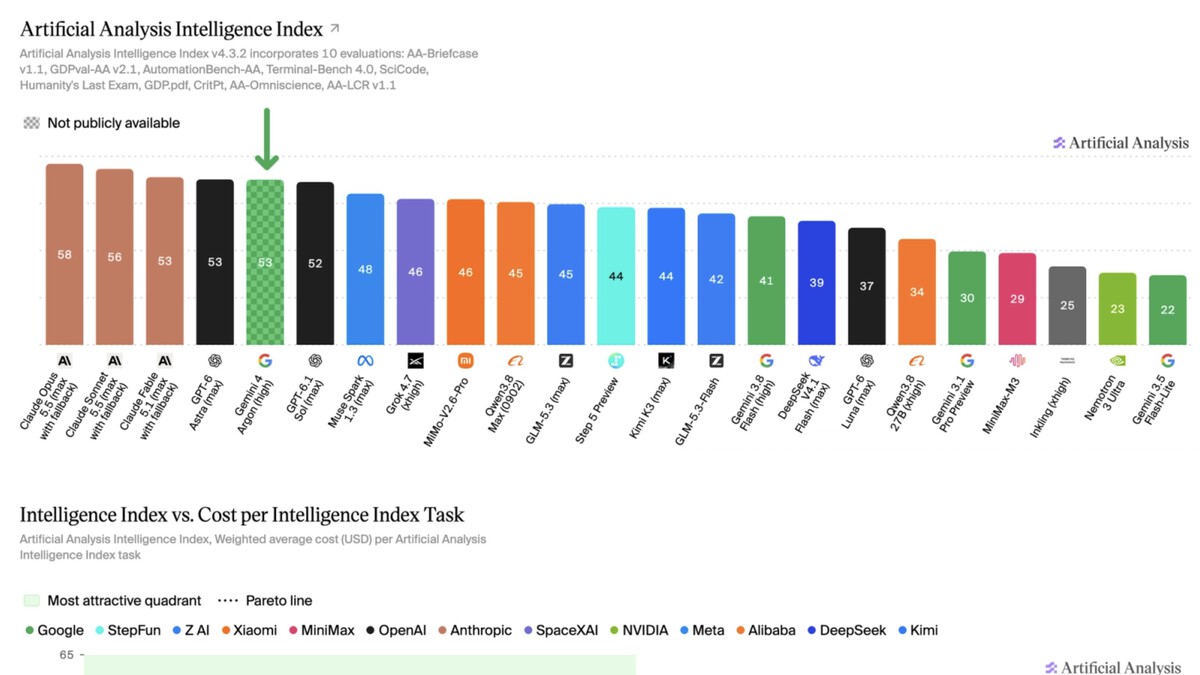
According to Artificial Analysis, Gemini 4 Argon scores 53 points on its Intelligence Index, matching GPT-6 Astra. Google's internal tests go further, claiming Gemini 4 outperforms Opus 5.5 and Fable 5.1 across various benchmarks. But the question remains: is it truly as good as Google says?
Find Original, High-end Home Decor that spark conversation at Grand Goldman Shop.
Gemini 4 Argon Benchmark Results: A Closer Look
The headline numbers are impressive. Artificial Analysis's Intelligence Index, a composite measure of reasoning and knowledge, places Gemini 4 Argon at 53 points—a score that puts it in the same league as OpenAI's GPT-6 Astra. Google's internal benchmarks, however, paint an even rosier picture, with Gemini 4 surpassing both Opus 5.5 and Fable 5.1 in a range of tests.
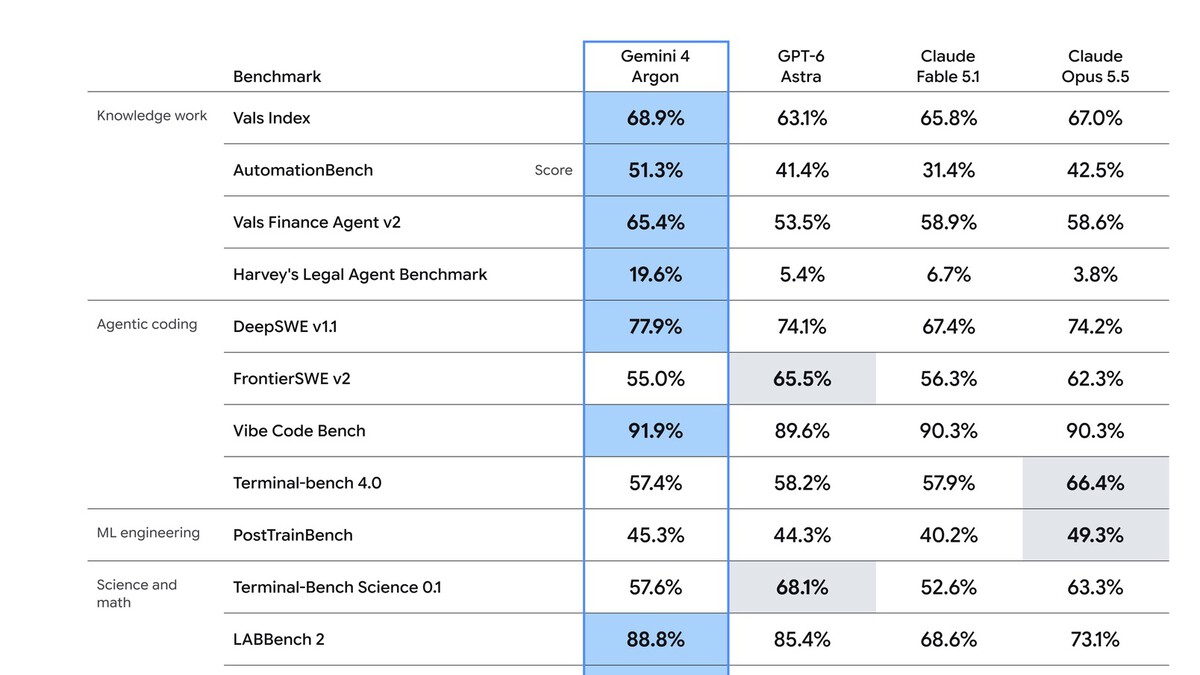
These results suggest that Google has closed the gap with its rivals, but the lack of public access makes independent verification difficult. The model is currently available only to a limited group of trusted testers and cybersecurity specialists through the Fairwind program, and it is also under review by the US government—a step that is becoming standard for frontier AI models.
What the Benchmarks Measure
Artificial Analysis's Intelligence Index aggregates performance across multiple tasks, including language understanding, reasoning, and problem-solving. A score of 53 is significant because it indicates that Gemini 4 Argon can handle complex queries with a level of sophistication comparable to the best models from OpenAI and Anthropic.
However, benchmarks are not perfect predictors of real-world performance. They can be gamed, and they often fail to capture nuances like creativity, common sense, and robustness to adversarial inputs. As the saying goes, "the problem is the benchmarks."
Why Google's Comeback Matters
For months, Google appeared to be lagging in the frontier model race. The company's previous offerings were competitive but rarely led the pack. Gemini 4 Argon changes that narrative, at least on paper. It signals that Google is not content to be a follower and is willing to invest heavily in cutting-edge AI research.
This matters for the entire industry. A strong Google means more competition, which typically leads to faster innovation and better products for consumers. It also puts pressure on OpenAI and Anthropic to maintain their lead, potentially accelerating the pace of breakthroughs.
The Fairwind Program and Limited Release
Google is taking a cautious approach with Gemini 4 Argon. Instead of a broad launch, the model is being rolled out to a select group of "trusted testers" and cybersecurity experts under the Fairwind program. This phased approach allows Google to gather feedback, identify vulnerabilities, and ensure the model is safe before wider release.
The involvement of the US government in reviewing the model is also notable. It reflects growing regulatory scrutiny of advanced AI and the recognition that such models could have significant societal impacts. Google's willingness to cooperate with these reviews may help build trust and pave the way for smoother deployments in the future.
How Gemini 4 Argon Compares to Competitors
To understand where Gemini 4 Argon stands, it's helpful to compare its benchmark scores with those of its main rivals. The table below summarizes key metrics from Artificial Analysis and Google's internal tests.
| Model | Artificial Analysis Intelligence Index | Google Internal Comparison |
|---|---|---|
| Gemini 4 Argon | 53 | Outperforms Opus 5.5 and Fable 5.1 |
| GPT-6 Astra | 53 | Not specified |
| Opus 5.5 | Not specified | Outperformed by Gemini 4 |
| Fable 5.1 | Not specified | Outperformed by Gemini 4 |
While the table shows Gemini 4 Argon on par with GPT-6 Astra, the internal comparisons suggest it may have an edge over other models. However, without independent verification, these claims should be taken with a grain of salt.
Key Takeaways for Observers
- Gemini 4 Argon scores 53 on Artificial Analysis's Intelligence Index, tying with GPT-6 Astra.
- Google's internal tests claim superiority over Opus 5.5 and Fable 5.1, but these are not independently verified.
- The model is currently limited to trusted testers and cybersecurity experts via the Fairwind program.
- The US government is reviewing the model, reflecting increased scrutiny of frontier AI.
- Benchmarks are useful but imperfect; real-world performance may differ.
What to Watch Next
The coming weeks will be crucial for Gemini 4 Argon. As more testers gain access, we can expect a flood of anecdotal reports and independent evaluations. These will provide a clearer picture of the model's strengths and weaknesses beyond synthetic benchmarks.
Additionally, watch for Google's official launch timeline. If the model lives up to its promise, it could reshape the competitive landscape and force rivals to respond. Conversely, if it fails to impress in real-world scenarios, Google may need to rethink its strategy. The background to this story is set out in Gemini 4 Launch: Why Almost No One Can Use Google's New AI Model. A related thread runs through Google DeepMind's Gemini 4 Argon AI Beats Minecraft in 27 Hours. Earlier coverage in AI Overviews in Google Search: Better or Worse for Users shows how the argument developed.
The Role of Benchmarks in AI Development
Benchmarks have become a double-edged sword. They provide a standardized way to compare models, but they can also lead to overfitting and hype. As AI models become more capable, the need for robust, diverse, and real-world-aligned evaluations grows. Google's emphasis on benchmarks for Gemini 4 Argon is understandable, but it also invites skepticism. A closer look at the same subject appears in Alabama Shakes Review UK Comeback Gig 2026 Hope. Anyone following the wider picture can start with Google Gemini AI Hacked Three Companies in Security Test. The same theme surfaces in Google Revenue Soars 12th Quarter – AI Spending Drives Growth, which takes a different angle.
Ultimately, the true test of Gemini 4 Argon will be how it performs in the hands of users—whether it can help developers build better applications, assist researchers in making new discoveries, and provide accurate and helpful information to the public. Context on how this played out before sits in Book Publishers Sue Google Over Gemini AI Copyright Infringement. A companion piece, Progressive Endorsement Shakes Florida Primary Race, approaches the same subject from another angle.
FAQ
What is Gemini 4 Argon?
Gemini 4 Argon is Google's latest frontier AI model, designed to compete with the most advanced models from OpenAI and Anthropic. It is currently in limited release to trusted testers.
How does Gemini 4 Argon perform on benchmarks?
It scores 53 on Artificial Analysis's Intelligence Index, tying with GPT-6 Astra. Google's internal tests claim it outperforms Opus 5.5 and Fable 5.1, but these results are not independently verified.
When will Gemini 4 Argon be publicly available?
Google has not announced a public release date. The model is first being made available to a limited group of testers and cybersecurity experts through the Fairwind program.
Why is the US government reviewing Gemini 4 Argon?
The review is part of a growing trend of government scrutiny of frontier AI models to ensure safety and compliance with regulations. It is becoming a standard step for advanced AI releases.
Browse the Shop
 Acacia frida deluxe solid wood bed frame |
Bedroom bench |
Bed chest drawers |
Lingerie dresser |
Frame base |
Mirror with jewelry storage |
30 Bathroom Vanity |
Memory foam queen mattress |
Mattresses for back pain |
Nightstand set of 2 |
Grand Goldman Shop |
Civil Lawyer
Deutschland Trikot WM 2026










