

Mistral Medium 3.5, the latest open-weight AI model from French startup Mistral, has arrived with much fanfare as Europe's great hope in a field dominated by the US and China. But early benchmarks suggest the model is, at best, mediocre—and that's a problem for Europe's AI ambitions.
What Mistral Medium 3.5 Brings to the Table
Mistral Medium 3.5 is a dense model with 128 billion parameters and a context window of 256,000 tokens. Unlike models using Mixture-of-Experts (MoE) architectures, which activate only a subset of parameters for efficiency, Mistral's model activates all parameters for every task.
Find Original Home Decor sparking conversation at Grand Goldman Shop.

This design makes it significantly less efficient than MoE alternatives. Theoretically, activating all parameters should boost performance, but that promise hasn't materialized.
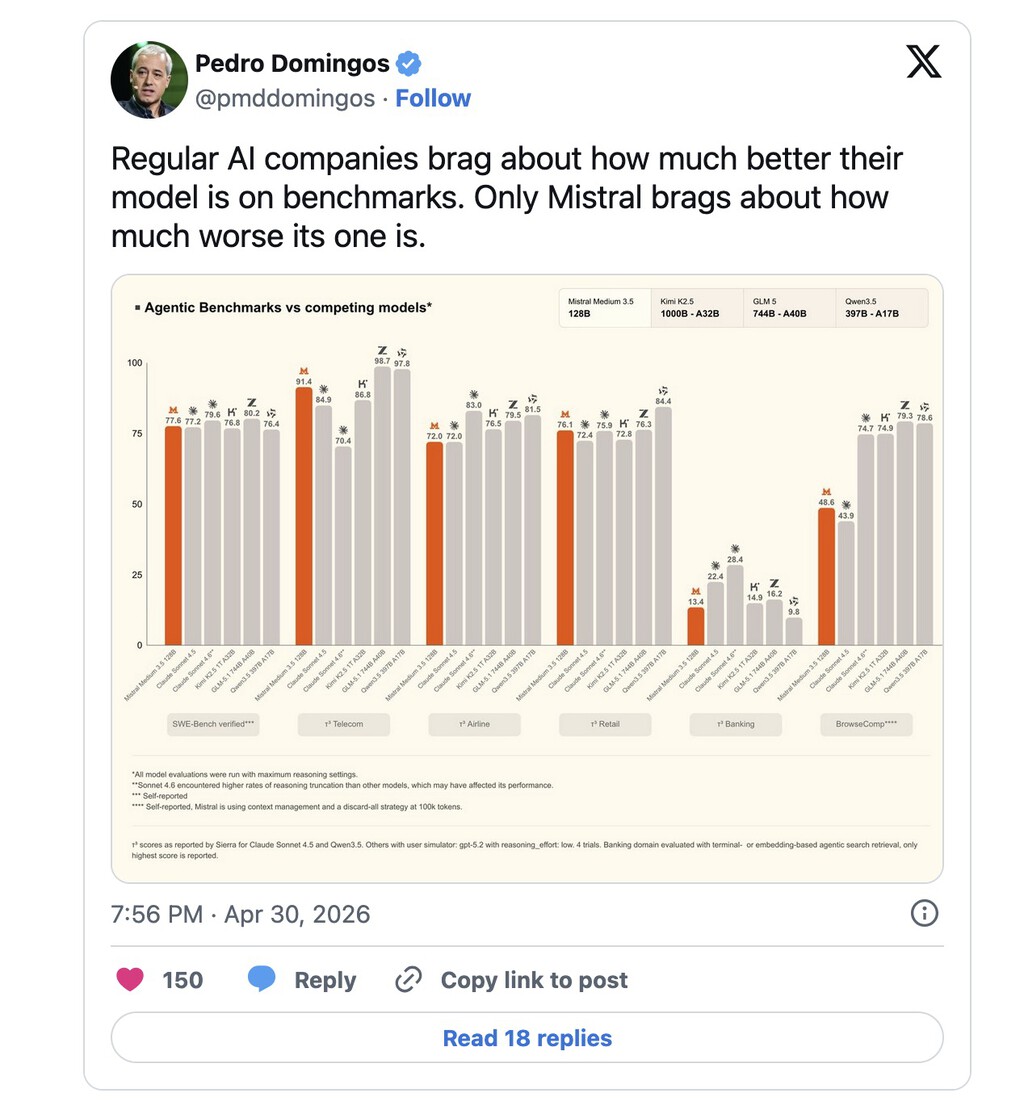
Benchmarks: The Mediocrity Is Real
Pedro Domingos, a professor of deep learning at the University of Washington, summed it up neatly: "Conventional AI companies boast about how much better their model is on benchmarks. So Mistral boasts about how much worse its model is."
While Mistral compares its model to larger models, those competitors are often cheaper and more efficient thanks to MoE architectures. Even accounting for size differences, Mistral Medium 3.5 fails to impress. Context on how this played out before sits in Mistral Medium 3.5: Europe's Open-Weight AI Model Falls Short.
Why This Matters for Europe's AI Landscape
Europe has been striving to establish itself as a credible third pole in AI, alongside the US and China. Mistral has been its flagship. If this is the best Europe can produce, the continent risks falling further behind. The background to this story is set out in Ai Video: latest articles. A related thread runs through Google's Gemini 4 Carbon Loses AI Crown to Anthropic in 13 Days.
The model does unify Mistral's previous catalog and follows the market trend of adjustable settings, but that's hardly enough to close the gap. Earlier coverage in Talkie-1930: AI Trained on Pre-1930 Texts Recommends Asbestos shows how the argument developed. A closer look at the same subject appears in Chrome's Silent AI Model Download: What It Means for You.
Key Takeaways
- Mistral Medium 3.5 is a dense 128B-parameter model with a 256K context window.
- It activates all parameters, making it less efficient than MoE models.
- Benchmarks show it underperforms compared to larger, cheaper competitors.
- Experts criticize Mistral for boasting about inferior benchmark results.
- The model's mediocrity raises concerns about Europe's AI competitiveness.
How Mistral Medium 3.5 Compares
| Model | Architecture | Parameters | Context Window | Efficiency |
|---|---|---|---|---|
| Mistral Medium 3.5 | Dense | 128B | 256K tokens | Low (activates all parameters) |
| Typical MoE Model | Mixture-of-Experts | Varies (e.g., 8x7B) | Varies | High (activates subset) |
| Larger Competitors | Often MoE | Larger | Varies | Higher, cheaper |
What to Watch Next
Mistral's future releases will reveal whether the company can innovate beyond dense architectures. For now, Mistral Medium 3.5 serves as a cautionary tale: being 100% European doesn't guarantee being 100% competitive. Anyone following the wider picture can start with Mistral CEO Warns Europe: Two Years to Build AI Infrastructure. The same theme surfaces in Mac mini M4 Clearance at MediaMarkt: Base Model Drops to €669, which takes a different angle.
FAQ
What is Mistral Medium 3.5?
What is Mistral Medium 3.5?
Mistral Medium 3.5 is an open-weight AI model from French startup Mistral. It has 128 billion parameters and a 256,000-token context window.
Why is Mistral Medium 3.5 considered mediocre?
It uses a dense architecture that activates all parameters, making it less efficient than MoE models. Benchmarks show it underperforms compared to larger, cheaper competitors.
What does this mean for Europe's AI industry?
It raises concerns that Europe may struggle to compete with the US and China in AI, as its flagship model fails to impress.
Browse the Shop
 Acacia frida deluxe solid wood bed frame |
Bedroom bench |
Bed chest drawers |
Lingerie dresser |
Frame base |
Mirror with jewelry storage |
30 Bathroom Vanity |
Memory foam queen mattress |
Mattresses for back pain |
Nightstand set of 2 |
Grand Goldman Shop |
Civil Lawyer
Deutschland Trikot WM 2026







