

The commercial viability of the electric car once seemed like a pipe dream, but a closer look at battery price trends shows why it is now a reality. Over the past 35 years, the price of lithium-ion batteries has plummeted by 99%, transforming the economics of electric vehicles.
This dramatic cost reduction is central to two essential transitions: the shift away from fossil fuels in energy and mobility. Without affordable batteries, neither transition could scale. Fortunately, the data tells a story of relentless progress.
Find Original Home Decor sparking conversation at Grand Goldman Shop.

The 99% Price Drop in Lithium-Ion Batteries
In 1991, a lithium-ion battery cost $9,210 per kilowatt-hour (in constant 2024 dollars). By 2023, that same kilowatt-hour cost just $111. That's a nearly 99% decline over three decades, according to analysis by Hannah Ritchie and Pablo Rosado of Our World in Data.
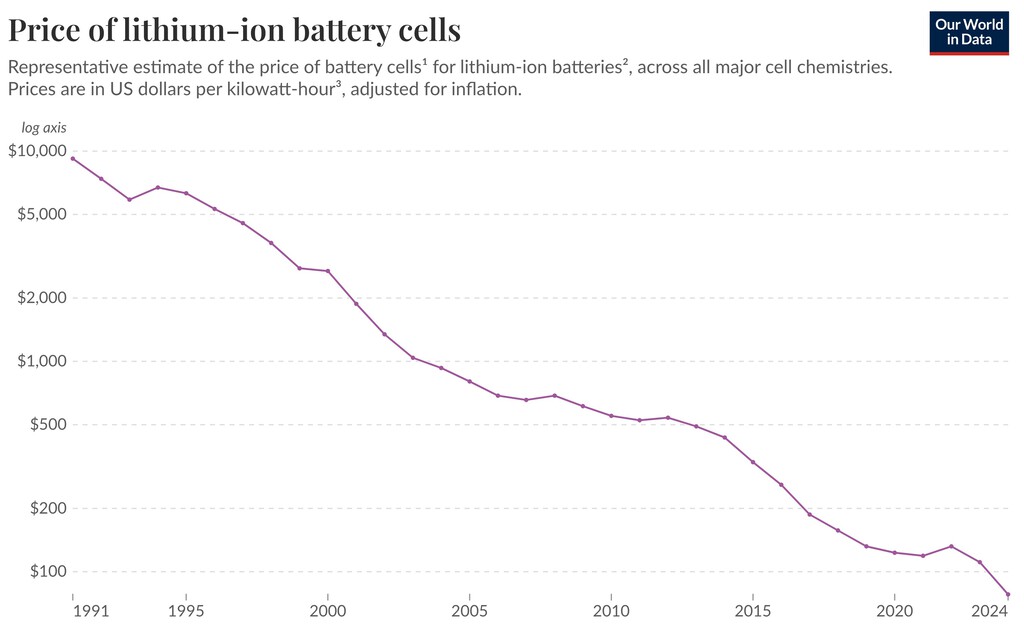
To put this in perspective, consider the battery pack of a standard electric car with a range of 350 to 400 kilometers (about 220 to 250 miles). Today, that battery costs around $5,000. A decade ago, the same component would have cost over $20,000. And in 1991, it would have been nearly $600,000.
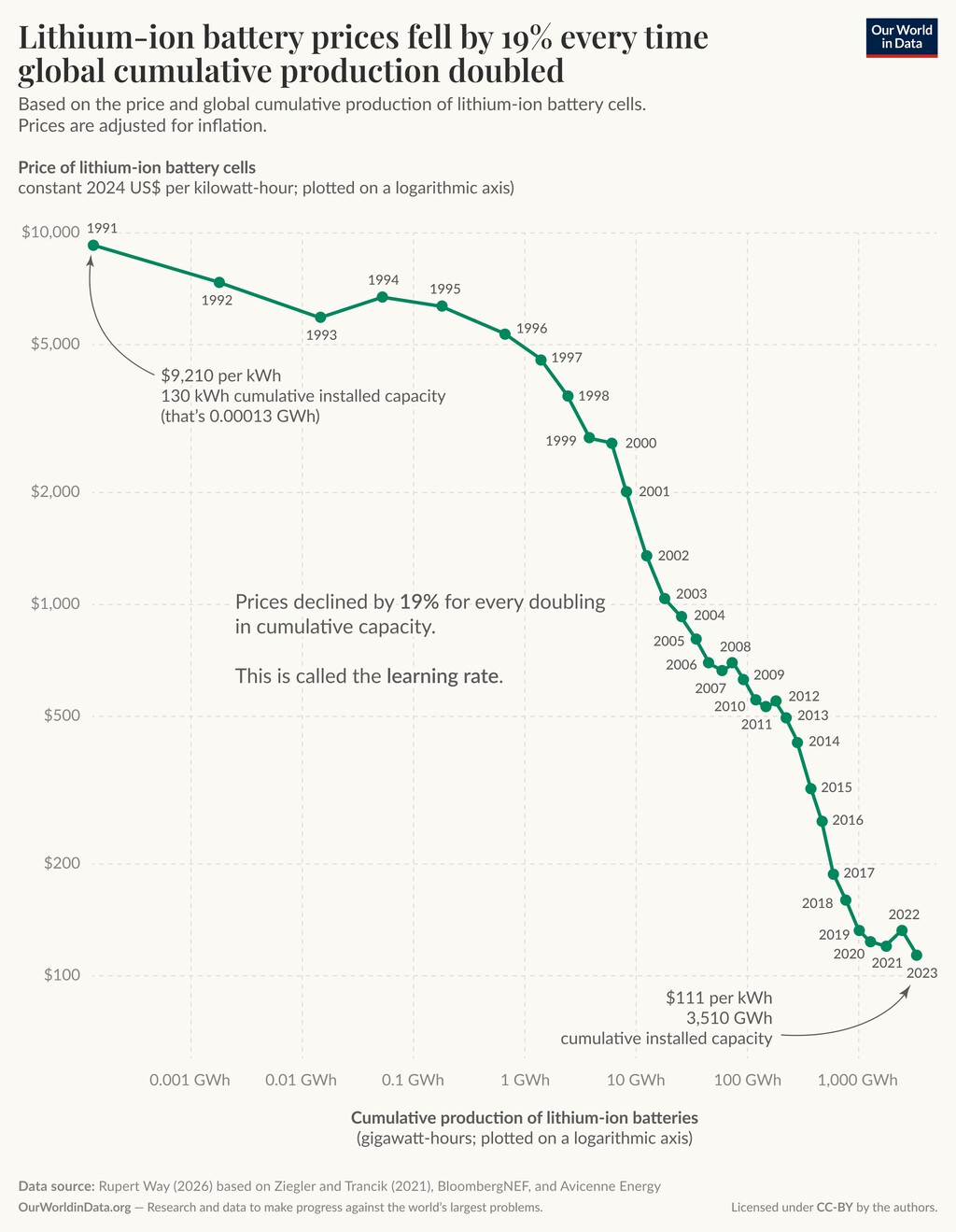
This cost trajectory has massive implications for the electric vehicle market. It means that EVs are no longer niche products for the wealthy; they are becoming accessible to mainstream consumers.
Why Battery Prices Matter for Electric Car Viability
Batteries are the single most expensive component of an electric vehicle, often accounting for a third or more of the total cost. As battery prices fall, the entire vehicle becomes more affordable. This is why the price decline is such a critical indicator of commercial viability.
Moreover, batteries play a crucial role in the energy transition beyond transportation. They store excess energy from renewable sources like wind and solar, helping to stabilize the grid. The same cost reductions that make EVs cheaper also make grid-scale storage more economically attractive.
The energy transition and the mobility transition are deeply intertwined, and batteries are the linchpin. Without continued improvements in battery technology and cost, both would stall.
The $100/kWh Threshold and Beyond
For years, industry analysts identified $100 per kilowatt-hour as the tipping point at which electric vehicles would reach cost parity with internal combustion engine (ICE) vehicles. That threshold has now been crossed: by the end of 2025, battery prices had fallen to $84 per kWh.
This milestone is not just symbolic; it signals that EVs can be produced at a cost competitive with traditional cars. As a result, automakers are accelerating their electric plans, and consumers are seeing more affordable options.
The implications extend to the used EV market as well, where lower battery costs can lead to lower replacement costs and better resale values.
Key Takeaways for the Electric Car Market
- 99% price drop: Lithium-ion batteries cost 99% less today than in 1991, adjusted for inflation.
- $100/kWh milestone: Battery prices fell below $100/kWh by late 2025, reaching $84/kWh, a historic cost parity point with ICE vehicles.
- EV affordability: A standard EV battery now costs about $5,000, down from over $20,000 a decade ago.
- Energy storage synergy: Cheap batteries also enable grid storage, supporting renewable energy integration.
- Continued innovation: Ongoing R&D promises further cost reductions and performance improvements.
Battery Price Evolution: Then vs. Now
| Year | Price per kWh (2024 USD) | Cost of a 350-400 km EV Battery |
|---|---|---|
| 1991 | $9,210 | ~$600,000 |
| 2013 (approx.) | ~$300 | ~$20,000 |
| 2023 | $111 | ~$5,000 |
| Late 2025 | $84 | ~$3,800 |
Note: The 2013 figure is an approximation based on the decade-ago cost mentioned in the source. The 2025 figure reflects the reported $84/kWh. Context on how this played out before sits in Electric Car Viability: How Battery Prices Fell 99%.
What This Means for Consumers and the Industry
For consumers, the falling battery prices translate into more affordable electric cars, lower total cost of ownership, and reduced range anxiety as technology improves. For the industry, it means that the transition to electric mobility is not just environmentally necessary but economically sound. The background to this story is set out in Energy Utilities: latest articles. A related thread runs through Spain's Cheap Energy Paradox: Why Your Electric Bill Stays High.
Governments and utilities also benefit: cheaper batteries make grid-scale storage more viable, supporting the integration of renewable energy sources. This creates a virtuous cycle where more renewables lead to more demand for storage, driving further battery innovation and cost reduction. Earlier coverage in Life in the World's Most Electrified Countries: Norway, Rwanda, China shows how the argument developed. A closer look at the same subject appears in Switzerland's 27-Meter Deep Battery Pit: A Giant Grid Storage Project.
However, challenges remain. Raw material supply chains, charging infrastructure, and consumer education are still hurdles. But the price trend is a powerful tailwind. Anyone following the wider picture can start with CATL's Lithium-Air Battery: A Gasoline-Rivaling Energy Storage Bet. The same theme surfaces in Deadly Ebike Battery Fires Surge in New York City: Safety Alert, which takes a different angle.
FAQ
How much have lithium-ion battery prices dropped?
Since 1991, lithium-ion battery prices have fallen by about 99%, from $9,210 per kWh to $111 per kWh in 2023, adjusted for inflation. By late 2025, prices reached $84 per kWh.
Why is $100 per kWh a significant threshold?
$100 per kWh is widely considered the point at which electric vehicles become cost-competitive with internal combustion engine vehicles. Crossing this threshold in 2025 marks a major milestone for EV adoption.
How does battery cost affect electric car prices?
Batteries are the most expensive component of an EV, so lower battery costs directly reduce the overall vehicle price. A standard EV battery now costs around $5,000, compared to over $20,000 a decade ago.
What role do batteries play in the energy transition?
Batteries store excess energy from renewable sources like wind and solar, helping to balance the grid. Affordable batteries make grid-scale storage more feasible, supporting the shift to clean energy.
Browse the Shop
 Acacia frida deluxe solid wood bed frame |
Bedroom bench |
Bed chest drawers |
Lingerie dresser |
Frame base |
Mirror with jewelry storage |
30 Bathroom Vanity |
Memory foam queen mattress |
Mattresses for back pain |
Nightstand set of 2 |
Grand Goldman Shop |
Civil Lawyer
Deutschland Trikot WM 2026







