

The James Webb Space Telescope has achieved a groundbreaking first: it has directly analyzed the heat emitted by the surface of an exoplanet, LHS 3844b. This marks a new method for studying distant worlds and provides unprecedented insights into their composition and atmosphere.
Most telescopes that study exoplanets can analyze their atmospheres, but Webb went further by measuring the thermal emission from the planet's surface. This is a significant leap in exoplanet science, offering a new way to understand rocky planets beyond our solar system.
Find Original Home Decor sparking conversation at Grand Goldman Shop.

What Is LHS 3844b?
LHS 3844b is an exoplanet located about 50 light-years from Earth. It is approximately 30% larger than our planet and is classified as a rocky world. According to Webb's analysis, it is dark, hot, arid, and lacks an atmosphere, making it quite similar to Mercury.
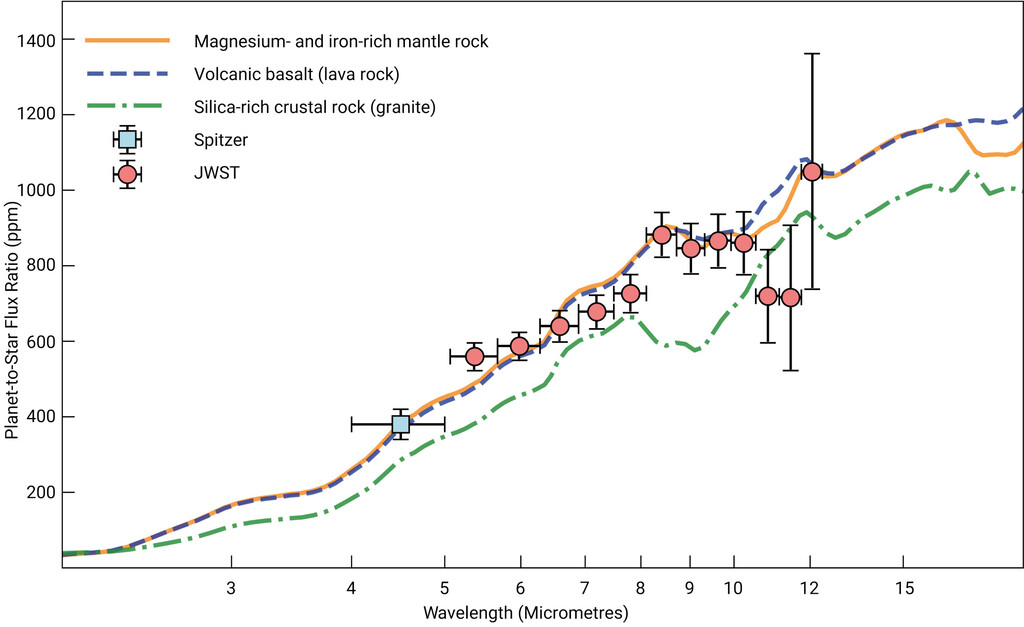
This planet is also tidally locked, meaning it takes the same time to rotate on its axis as it does to orbit its star. As a result, one side permanently faces the star, while the other side is in perpetual darkness. The dayside can reach extremely high temperatures, making it an ideal target for study.
Why Is This Observation Revolutionary?
Observing the heat emitted directly from an exoplanet's surface is a first. Previously, most studies focused on analyzing atmospheres through transmission spectroscopy, which requires the planet to pass in front of its star. However, LHS 3844b does not transit, so traditional methods wouldn't work.
Instead, Webb used its Mid-Infrared Instrument (MIRI) to detect the thermal emission from the planet's dayside. MIRI is exceptionally sensitive to infrared light, making it perfect for this task. This direct measurement provides clues about the planet's surface composition and temperature.
- First direct surface heat measurement of an exoplanet, opening a new field of study.
- LHS 3844b is rocky and airless, resembling Mercury, with extreme temperature differences between its day and night sides.
- MIRI's infrared sensitivity was crucial for detecting the faint heat signal from the planet.
- Tidally locked planets are prime targets for this method because their permanent daysides emit consistent heat.
- This technique can be applied to other non-transiting exoplanets, expanding our understanding of planetary diversity.
How Does This Compare to Previous Methods?
Traditional exoplanet atmosphere studies rely on watching a planet pass in front of its star, which allows starlight to filter through the atmosphere and reveal its composition. But this only works for transiting planets. LHS 3844b does not transit, so astronomers had to find another way.
By measuring the thermal emission, Webb can determine the temperature of the planet's surface and infer its properties. This method is particularly useful for planets that are too close to their stars to transit or for those with tight orbits. It complements existing techniques and provides a more complete picture of exoplanetary systems.
| Method | What It Measures | Requires Transit? | Example Target |
|---|---|---|---|
| Transmission Spectroscopy | Atmospheric composition | Yes | HD 209458b |
| Thermal Emission (Direct) | Surface temperature and composition | No | LHS 3844b |
| Direct Imaging | Reflected light, atmospheric features | No | HR 8799b |
What Does This Mean for Future Exoplanet Studies?
This observation demonstrates that Webb can study the surfaces of rocky exoplanets that are not transiting. It opens up a new avenue for characterizing planets that were previously difficult to analyze. With this technique, astronomers can measure the temperatures and thermal properties of many more worlds.
Moreover, the data can help identify planets with or without atmospheres. For LHS 3844b, the lack of atmosphere is evident from the extreme temperature contrast between the dayside and nightside. Future observations of similar planets could reveal whether they have thin atmospheres or none at all.
The success with LHS 3844b also validates MIRI's capabilities for exoplanet science. MIRI was designed to detect infrared light from faint, distant objects, and its performance here proves its value. Upcoming studies will likely target other tidally locked planets to build a statistical understanding of their surface conditions.
What's Next for the James Webb Telescope?
Webb will continue to observe exoplanets, both transiting and non-transiting, to uncover their secrets. The team behind this study is already planning follow-up observations of LHS 3844b and similar planets. These efforts will refine our understanding of rocky planet formation and evolution. The background to this story is set out in NASA's PRIMA Telescope to Fill James Webb's Far-Infrared Gap. A related thread runs through Harvard Scientists Find Key Life Clue on Exoplanet LHS 1140b. Earlier coverage in Earth-Like Exoplanet with Atmosphere Found 49 Light Years Away shows how the argument developed.
Additionally, this method could be used to study planets around different types of stars, including M dwarfs, which are the most common stars in our galaxy. By comparing thermal emissions from various planets, scientists can learn about the diversity of surface materials and atmospheres. A closer look at the same subject appears in Earth-Like Exoplanet Found with Atmosphere in Habitable Zone. Anyone following the wider picture can start with James Webb Telescope Detects Mysterious Signal in Fornax. The same theme surfaces in James Webb Space Telescope Maps 164,000 Galaxies in Epic Cosmic Survey, which takes a different angle.
The James Webb Space Telescope is revolutionizing exoplanet science, and this latest achievement is just the beginning. As the telescope continues its mission, we can expect more groundbreaking discoveries that reshape our view of the cosmos. Context on how this played out before sits in Supermassive Black Holes May Hinder Habitable Exoplanet Search. A companion piece, Exoplanet TOI-2535 b Vanishes from Telescopes: What Happened, approaches the same subject from another angle.
FAQ
What is LHS 3844b?
LHS 3844b is a rocky exoplanet about 50 light-years away, 30% larger than Earth. It is tidally locked, with one side permanently facing its star, and lacks an atmosphere, resembling Mercury.
Why is the James Webb observation of LHS 3844b significant?
It marks the first direct measurement of heat emitted from an exoplanet's surface. This opens a new method for studying non-transiting rocky planets and provides insights into their composition and atmosphere.
How did the James Webb telescope measure the heat?
Using its Mid-Infrared Instrument (MIRI), Webb detected the thermal emission from the planet's dayside. MIRI's sensitivity to infrared light allowed it to capture the faint heat signal from the distant world.
What can this technique tell us about other exoplanets?
It can reveal surface temperatures, thermal properties, and the presence or absence of atmospheres. This method is especially useful for tidally locked planets and those that do not transit their stars.
Browse the Shop
 Acacia frida deluxe solid wood bed frame |
Bedroom bench |
Bed chest drawers |
Lingerie dresser |
Frame base |
Mirror with jewelry storage |
30 Bathroom Vanity |
Memory foam queen mattress |
Mattresses for back pain |
Nightstand set of 2 |
Grand Goldman Shop |
Civil Lawyer
Deutschland Trikot WM 2026







