

In 1957, a group of scientists from the American Miscellaneous Society (AMSOC) hatched a plan to drill a hole 40 kilometers deep into the ocean floor. The goal: to reach the Mohorovičić discontinuity, the boundary between Earth's crust and mantle.
The idea was audacious, but it was also a product of its time. The Cold War was in full swing, and the United States was eager to demonstrate its scientific prowess. Thus, Project Mohole was born.
Find Original Home Decor sparking conversation at Grand Goldman Shop.

What Was Project Mohole?
Project Mohole was an attempt to drill through the Earth's crust and into the mantle. The plan was to drill from the ocean floor, where the crust is thinner, making the mantle more accessible.
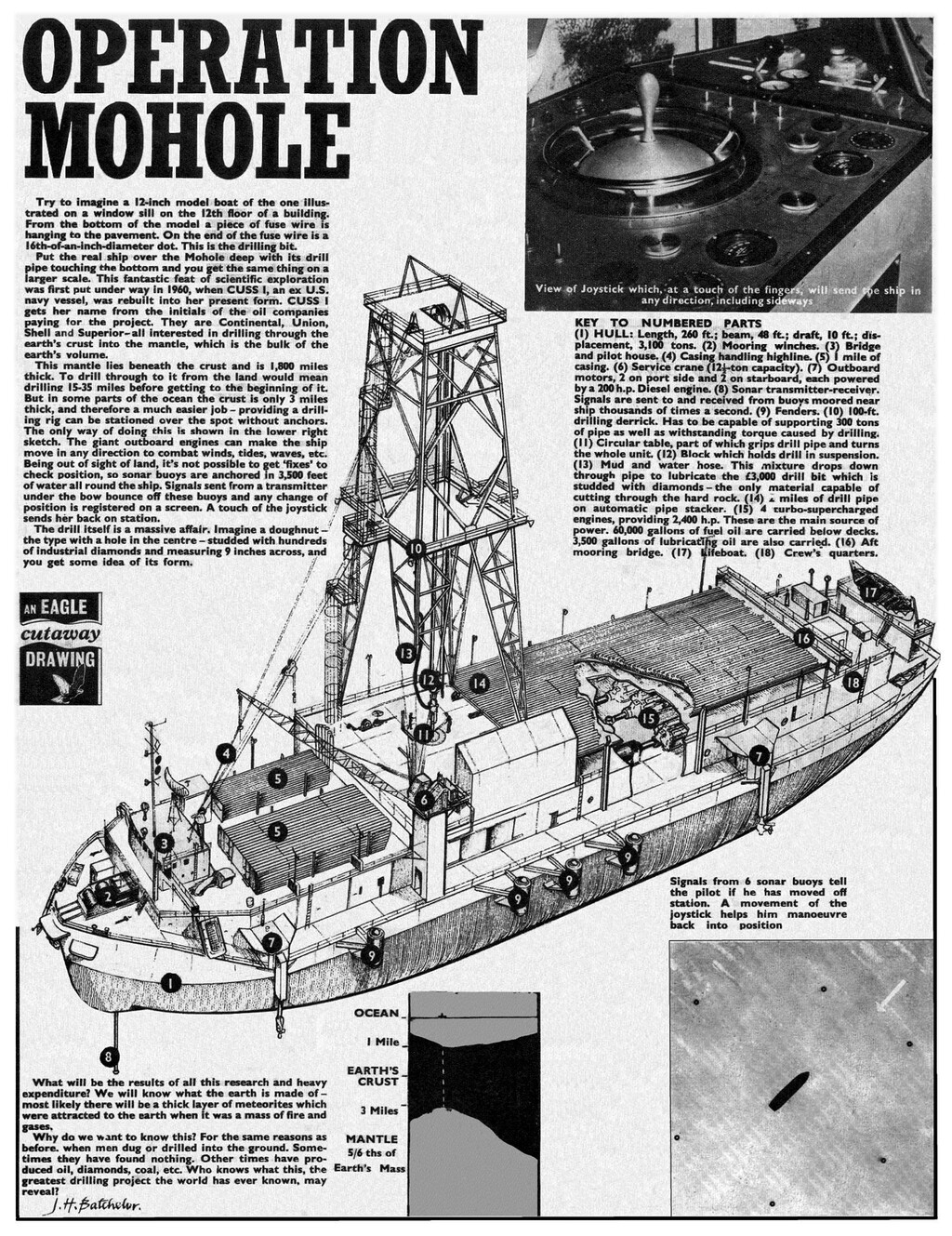
The project was led by AMSOC, a group of scientists that included geologist Harry Hess and oceanographer Walter Munk. They proposed drilling a hole that would reach the Mohorovičić discontinuity, which lies at a depth of 5 to 10 kilometers below the ocean floor.
The Science Behind the Drilling
The Mohorovičić discontinuity, or Moho, is the boundary between the crust and the mantle. It was discovered in 1909 by Andrija Mohorovičić, who noticed a sudden increase in seismic wave velocity at that depth.
By drilling to the Moho, scientists hoped to obtain samples of the mantle and learn more about Earth's composition and structure.
The Cold War Context
The project was also a response to the Soviet Union's scientific achievements. The Soviets had already launched Sputnik in 1957, and the U.S. was looking for ways to show its scientific superiority.
Drilling to the mantle was seen as a way to demonstrate American technological prowess and gain a strategic advantage in the Cold War. The longer history behind the story is traced in Project Mohole: The 1957 Plan to Drill 40 Kilometers Into the Ocean.
Funding and Challenges
Project Mohole received funding from the National Science Foundation and the U.S. Navy. However, the project faced numerous technical challenges, including the difficulty of drilling in deep water and the high pressures and temperatures encountered at such depths. The background to this story is set out in Deep Sea Drilling at 2,500 Meters Reveals Hidden Life Below Ocean Floor. A related thread runs through New Horizons Wakes Up 9.5 Billion Kilometers from Earth. Earlier coverage in Saltwater Crocodiles Surf Ocean Currents to Travel 590 Kilometers shows how the argument developed.
The Legacy of Project Mohole
Despite its ultimate failure, Project Mohole had a lasting impact on deep-sea drilling. It spurred the development of new drilling technologies and techniques that are still used today. A closer look at the same subject appears in How to Drill a Hole in a Glass Bottle!. Anyone following the wider picture can start with Creative Drill Uses: From Drilling to Polishing with the Right Accessories. The same theme surfaces in Know the types of drill bits you should use for drilling, which takes a different angle.
It also led to the creation of the Deep Sea Drilling Project (DSDP) and its successor, the Integrated Ocean Drilling Program (IODP), which have made significant contributions to our understanding of Earth's history and processes. Context on how this played out before sits in Differences between the drill driver and the impact driver. A companion piece, Science: latest articles, approaches the same subject from another angle.
Key Takeaways
- Project Mohole was an ambitious plan to drill into the Earth's mantle.
- It was driven by Cold War competition and scientific curiosity.
- The project faced technical challenges and was eventually canceled.
- Its legacy lives on in modern deep-sea drilling programs.
Technical Specifications
| Aspect | Details |
|---|---|
| Target Depth | 40 km (continental) / 5-10 km (oceanic) |
| Location | Off the coast of California |
| Funding | National Science Foundation, U.S. Navy |
| Outcome | Canceled in 1966 |
FAQ
What was the goal of Project Mohole?
The goal was to drill through the Earth's crust to reach the Mohorovičić discontinuity and obtain samples of the mantle.
Why did Project Mohole fail?
The project faced technical difficulties and cost overruns, and was eventually canceled by Congress in 1966.
What was the legacy of Project Mohole?
It advanced deep-sea drilling technology and led to the creation of the Deep Sea Drilling Project.
Browse the Shop
 Acacia frida deluxe solid wood bed frame |
Bedroom bench |
Bed chest drawers |
Lingerie dresser |
Frame base |
Mirror with jewelry storage |
30 Bathroom Vanity |
Memory foam queen mattress |
Mattresses for back pain |
Nightstand set of 2 |
Grand Goldman Shop |
Civil Lawyer
Deutschland Trikot WM 2026







