

Saturn's south pole has revealed a surprising decagonal cloud pattern, confirmed by the Hubble Space Telescope. This discovery, published this week, shows that the planet's famous hexagonal storm at the north pole is not a unique geometric exception. Amateur astronomers played a key role in spotting the anomaly, which opens new questions about Saturn's atmospheric dynamics.
What Happened: From Hexagon to Decagon
In 1988, the Voyager mission captured images of a six-sided jet stream—the hexagon—at Saturn's north pole. For decades, scientists wondered if a similar structure existed in the south. However, Saturn's axial tilt made the southern hemisphere invisible from Earth between 2012 and 2023.
Find Original Home Decor sparking conversation at Grand Goldman Shop.

After that wait, the Hubble Space Telescope turned its gaze south and collected data that led to the new study. The result: a ten-sided polygon, or decagon, instead of a hexagon. This finding was made possible partly through the efforts of amateur astronomers who monitored the planet over years.
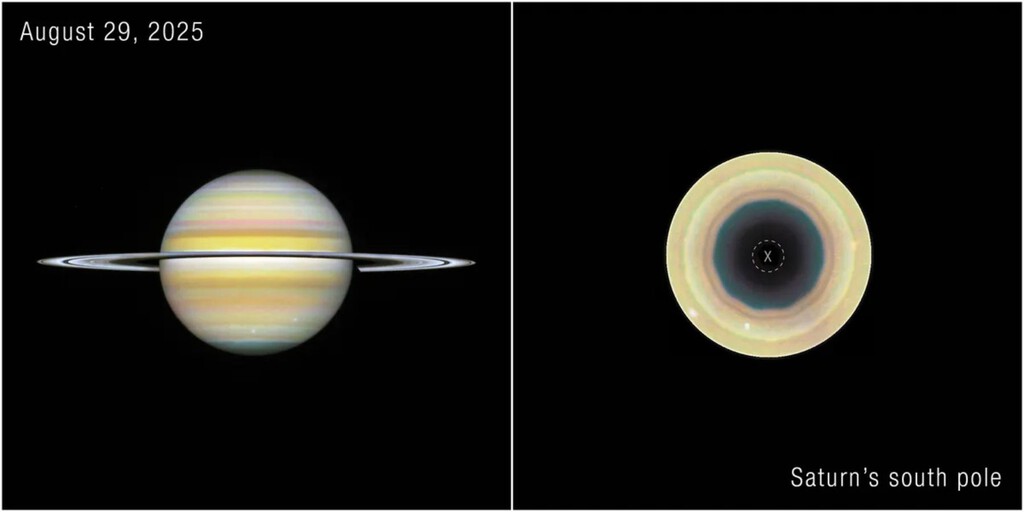
Why It Matters: A Window into Planetary Weather
Saturn's atmosphere is a complex system of gas and clouds. The presence of geometric shapes at both poles suggests that planetary meteorology can produce stable, long-lived patterns. Understanding these patterns helps scientists model atmospheric flows on gas giants, including exoplanets.
The decagon is not just a curiosity; it indicates that different latitudes can host distinct wave structures. This challenges assumptions that polar vortices are always hexagonal or circular.
Who Is Affected: Scientists and Amateur Observers
Professional astronomers gain a new dataset for comparative planetology. Amateur astronomers, who often contribute to long-term monitoring, see their role validated. The collaboration between professionals and hobbyists is increasingly important for time-domain astronomy. The longer history behind the story is traced in Why Blackbird Song Calms You: The Science of Its Acoustic Recipe.
Space agencies like NASA and ESA may adjust future mission priorities to study Saturn's poles in more detail. The Hubble Space Telescope, despite its age, continues to deliver groundbreaking results. The background to this story is set out in Spot Saturn at Its Closest Approach to Earth This Year. A related thread runs through Indigenous Astronomy Exhibition Connects Australia and South. Earlier coverage in Indigenous Astronomy Exhibition Links Australia and South Africa shows how the argument developed.
What to Watch Next: Future Observations
Upcoming missions to Saturn, such as proposed orbiters, could provide higher-resolution images of the decagon. In the meantime, ground-based telescopes and the James Webb Space Telescope may also contribute. A closer look at the same subject appears in England's North-South Divide: Burnham's Devolution Challenge. Anyone following the wider picture can start with Science: latest articles. The same theme surfaces in Moon Formation Could Have Taken Just Hours, New Study Finds, which takes a different angle.
Researchers will compare the north and south polar structures to understand why they differ in shape. This could reveal how seasonal changes affect atmospheric patterns. Context on how this played out before sits in Tacoma Narrows Bridge Collapse: How It Changed Engineering Forever. A companion piece, Saturn's South Pole Reveals a Rare Decagonal Cloud Pattern, approaches the same subject from another angle.
- Saturn's south pole hosts a decagonal cloud pattern, confirmed by Hubble.
- The north pole's hexagon is not unique; both poles have geometric structures.
- Amateur astronomers contributed to the discovery by monitoring Saturn.
- The finding challenges models of planetary atmospheric dynamics.
- Future missions may study these polar vortices in greater detail.
Comparing Saturn's Polar Structures
| Feature | North Pole | South Pole |
|---|---|---|
| Shape | Hexagon | Decagon |
| Discovery | 1988 (Voyager) | 2025 (Hubble) |
| Visibility | Visible since 1980s | Hidden 2012-2023 |
| Key Contributor | Voyager mission | Hubble & amateur astronomers |
FAQ
What is the decagon at Saturn's south pole?
It is a ten-sided cloud pattern, similar to the hexagonal storm at the north pole, but with ten sides. It was confirmed by Hubble observations after Saturn's southern hemisphere became visible again in 2023.
Why did it take so long to discover?
Saturn's axial tilt made the south pole invisible from Earth between 2012 and 2023. Before that, no spacecraft had captured high-resolution images of the region.
How did amateur astronomers help?
They monitored Saturn over years, providing data that helped identify the anomaly and supported the Hubble observations.
What does this mean for planetary science?
It shows that gas giants can form stable geometric cloud patterns at both poles, informing models of atmospheric dynamics and weather on other planets.
Browse the Shop
 Acacia frida deluxe solid wood bed frame |
Bedroom bench |
Bed chest drawers |
Lingerie dresser |
Frame base |
Mirror with jewelry storage |
30 Bathroom Vanity |
Memory foam queen mattress |
Mattresses for back pain |
Nightstand set of 2 |
Grand Goldman Shop |
Civil Lawyer
Deutschland Trikot WM 2026







