

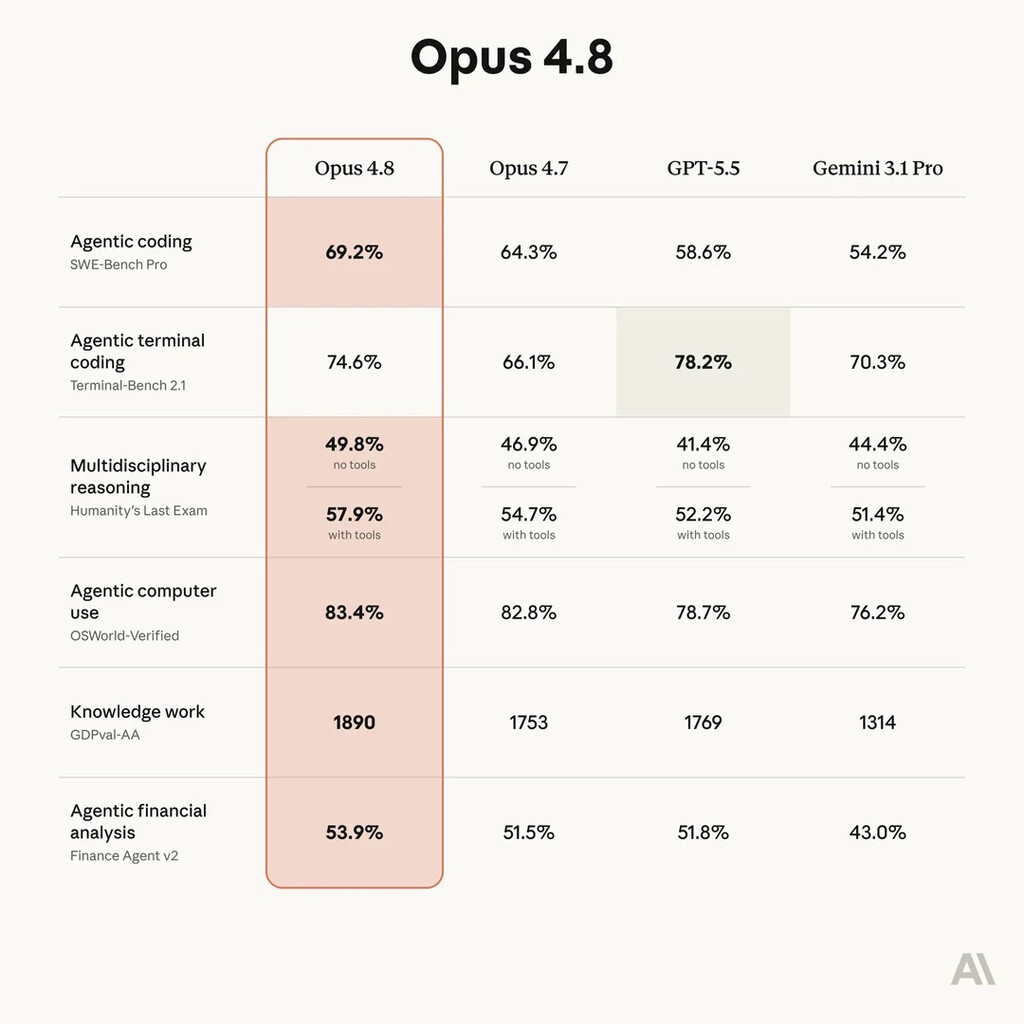
Claude 4.8 Opus is the newest version of Anthropic's most advanced AI model, and it arrives just 41 days after Claude Opus 4.7. While the improvements are minimal, there is one significant change: the model is now more honest about what it doesn't know.
In this article, we'll break down the key updates in Claude 4.8 Opus, explain why they matter, and what you should watch for next. Whether you're a developer, researcher, or AI enthusiast, understanding these changes will help you make the most of the model.
Find Original Home Decor sparking conversation at Grand Goldman Shop.

What Is Claude 4.8 Opus?
Claude 4.8 Opus is part of Anthropic's Opus line, which represents the most powerful and advanced models in the Claude family. Opus models are designed for complex tasks, especially in programming, and they consume usage limits faster than other models.
Anthropic also offers Sonnet, a more efficient model for everyday tasks (currently at version 4.6 since February 2026), and Haiku, a lightweight model for quick and simple questions (still at version 4.5 from October 2025). The Opus line is the go-to choice when you need top-tier performance.
Key Updates in Claude 4.8 Opus
The update to Claude 4.8 Opus is incremental, but it includes several noteworthy improvements. Here's a quick overview:
- Enhanced honesty: The model is more upfront about its limitations and admits when it doesn't know something.
- Minimal performance gains: Overall capabilities see slight improvements, but no dramatic leaps.
- Faster release cycle: Arriving just 41 days after 4.7, this shows Anthropic's rapid iteration pace.
- Continued focus on reasoning and coding: Opus remains the best choice for complex programming tasks.
Let's dive into each of these updates in more detail.
Improved Honesty
The most significant change in Claude 4.8 Opus is its improved honesty. According to early users, the model is now better at acknowledging when it lacks information or is uncertain about an answer. This is a crucial step forward for AI reliability, as it reduces the risk of hallucinations—confident but incorrect responses.
For example, if you ask Claude 4.8 Opus a question it can't answer, it's more likely to say "I don't know" rather than inventing a plausible-sounding response. This builds trust and makes the model safer for critical applications.
Minimal Performance Improvements
Aside from honesty, the performance improvements in Claude 4.8 Opus are modest. The model's reasoning and coding abilities are slightly better, but users shouldn't expect a dramatic upgrade from 4.7. This aligns with the short development cycle between versions.
That said, even small gains can add up over time. Anthropic's iterative approach ensures that each release refines the model's capabilities, leading to steady progress.
Rapid Release Cycle
The fact that Claude 4.8 Opus launched only 41 days after 4.7 is notable. It suggests that Anthropic is adopting a fast-paced release strategy, possibly to address user feedback quickly or to keep up with competitors. This could mean more frequent updates in the future, so users should stay tuned.
How Claude 4.8 Opus Compares to Other Models
To understand where Claude 4.8 Opus fits in, it helps to compare it with other models in the Claude family and beyond. The table below summarizes key differences.
| Model | Version | Best For | Release Date |
|---|---|---|---|
| Claude Opus | 4.8 | Complex tasks, programming | Recent (41 days after 4.7) |
| Claude Sonnet | 4.6 | Everyday tasks | February 2026 |
| Claude Haiku | 4.5 | Quick, simple questions | October 2025 |
As you can see, Opus is the most advanced but also the most resource-intensive. Sonnet offers a balance, while Haiku is the lightest option.
Why the Honesty Update Matters
The improved honesty in Claude 4.8 Opus is more than a minor tweak—it addresses a fundamental challenge in AI: hallucination. When AI models confidently state false information, it can lead to serious consequences, especially in fields like healthcare, law, and finance.
By making the model more willing to admit uncertainty, Anthropic is taking a step toward more reliable AI. This aligns with broader industry efforts to improve AI safety and transparency. Users can now have more confidence that when Claude 4.8 Opus gives an answer, it's likely to be accurate—or at least, the model will flag when it's unsure. The background to this story is set out in Claude Opus 4.8: AI That Admits When It's Unsure. A related thread runs through The new Glashütte Senator Cosmopolite 2018 version arrives. Earlier coverage in GLM-5.2 Matches Claude Opus 4.8 in Cybersecurity, Experts Warn shows how the argument developed.
What to Watch Next
Given the rapid release cycle, we can expect further updates to Claude models in the near future. Keep an eye on how Anthropic balances performance improvements with safety features like honesty. Also, watch for changes to Sonnet and Haiku, which may receive similar updates. A closer look at the same subject appears in AI MRI Analysis Fail: Why Claude Opus 4.8 Missed a Torn Tendon. Anyone following the wider picture can start with Anthropic's Model 2: A New AI That Outperforms Mythos. The same theme surfaces in Anthropic Launches Claude Science for Laboratory Research, which takes a different angle.
For developers, the improved honesty could reduce the need for extensive fact-checking, but it's still essential to verify critical information. As always, use AI as a tool, not a replacement for human judgment. Context on how this played out before sits in Anthropic: Claude May Aid Biological Weapons Development. A companion piece, Anthropic Faces Multibillion-Dollar Song Copyright Lawsuit, approaches the same subject from another angle.
FAQ
What is the main new feature in Claude 4.8 Opus?
The main new feature is improved honesty: the model is more likely to admit when it doesn't know something, reducing hallucinations.
How does Claude 4.8 Opus differ from 4.7?
The differences are minimal, with only slight performance gains and the notable honesty improvement. It was released just 41 days after 4.7.
Should I upgrade to Claude 4.8 Opus?
If you rely on AI for complex tasks and value accuracy, the honesty improvement may be worth it. However, if you're satisfied with 4.7, the upgrade is not urgent.
What are the other Claude models available?
Anthropic offers Sonnet 4.6 for everyday tasks and Haiku 4.5 for quick questions. Opus is the most advanced but also the most resource-intensive.
Browse the Shop
 Acacia frida deluxe solid wood bed frame |
Bedroom bench |
Bed chest drawers |
Lingerie dresser |
Frame base |
Mirror with jewelry storage |
30 Bathroom Vanity |
Memory foam queen mattress |
Mattresses for back pain |
Nightstand set of 2 |
Grand Goldman Shop |
Civil Lawyer
Deutschland Trikot WM 2026







