

Global wine consumption has fallen to its lowest level since 1957, according to the latest annual report from the International Organisation of Vine and Wine (OIV). The decline marks nearly seven decades since the world drank so little wine, and it signals a deepening crisis for the industry.
The OIV, which represents 51 countries accounting for 88% of global wine production, painted a sobering picture for 2025. Consumption hit historic lows, trade weakened in both volume and value, and production remained below the century's average.
Find Original Home Decor sparking conversation at Grand Goldman Shop.

Even China, once seen as a potential savior for the industry, has not reversed the trend. The world appears increasingly less interested in wine, and the sector is struggling to adapt.
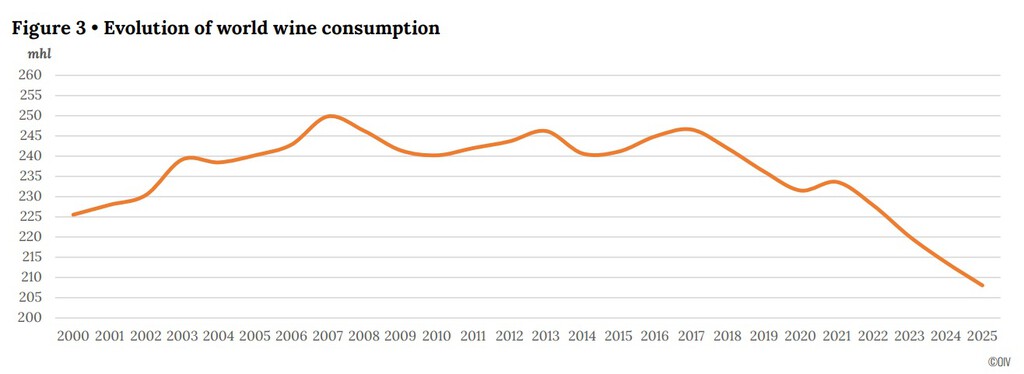
What the OIV Report Reveals About Global Wine Consumption
The OIV's 2025 balance sheet shows a broad retreat from wine across major markets. Consumption dropped to levels not seen since 1957, and exports also suffered, with declines in both volume and value.
Production improved only slightly, remaining well below the average for the 21st century. The total area under vine has also shrunk, reflecting a sector in retrenchment.
OIV Director General John Barker said the industry has been "adapting to constant climatic, economic, and social challenges." But the data suggests adaptation has not been enough to halt the slide.
Why China Has Not Rescued the Wine Industry
For years, wine producers looked to China as a growth market that could offset declining consumption in Europe. That hope has not materialized.
China's wine market has faced its own headwinds, including changing consumer preferences and economic pressures. The country's consumption has not grown enough to compensate for falling demand elsewhere.
As a result, the global wine industry can no longer rely on China as a lifeline. The search for new growth drivers continues, but no single market has emerged to fill the gap.
Key Takeaways from the OIV 2025 Report
- Global wine consumption fell to its lowest level since 1957.
- Wine exports declined in both volume and value.
- Production improved slightly but remained below the 21st-century average.
- The area under vine has decreased worldwide.
- China has not provided the expected boost to global demand.
Wine Production and Vineyard Area: A Shrinking Footprint
The OIV report notes that global vineyard area has been declining. This contraction reflects farmers' responses to low prices and uncertain demand.
Production in 2025 was slightly up from the previous year but still insufficient to reach the average of the past two decades. The combination of reduced acreage and below-average output underscores the structural challenges facing the sector.
Climate change also continues to affect harvests, with extreme weather events impacting yields in key producing regions.
How the Wine Industry Is Responding to the Crisis
Wine producers are adapting in various ways. Some are focusing on premium segments, while others are diversifying into other beverages or reducing their vineyard holdings.
Marketing efforts increasingly target younger consumers and emphasize sustainability and innovation. However, these measures have yet to reverse the overall decline in consumption.
The OIV's Barker highlighted the industry's resilience, but the report's findings suggest that structural shifts in consumer behavior may be permanent.
Comparison of Key Wine Metrics: 2025 vs. Historical Averages
| Metric | 2025 | Historical Comparison |
|---|---|---|
| Global wine consumption | Lowest since 1957 | Significantly below recent decades |
| Wine exports (volume) | Declined | Down from previous year |
| Wine exports (value) | Declined | Down from previous year |
| Wine production | Slight increase | Below 21st-century average |
| Vineyard area | Decreased | Shrinking globally |
What to Watch Next for the Global Wine Market
The wine industry faces a pivotal moment. If consumption continues to fall, producers may need to further reduce output or seek new markets.
Emerging economies in Asia and Latin America could offer growth, but their potential remains uncertain. Meanwhile, changing attitudes toward alcohol in developed countries pose a long-term challenge.
The OIV's next report will be closely watched for signs of stabilization or further decline.
FAQ
What is the OIV and what does it do?
The International Organisation of Vine and Wine (OIV) is an intergovernmental organization that collects and publishes data on global wine production, consumption, and trade. It has 51 member countries representing 88% of world wine production.
Why is global wine consumption declining?
The decline is attributed to changing consumer preferences, economic pressures, and shifting attitudes toward alcohol, particularly among younger generations. Climate change and reduced vineyard area also play a role.
Has China become a major wine consumer?
Despite expectations, China has not become a major wine-consuming nation. Its market has faced its own challenges, and consumption has not grown enough to offset declines elsewhere.
What was the last year global wine consumption was this low?
According to the OIV, global wine consumption in 2025 was the lowest since 1957. This highlights a long-term downward trend.
As the wine industry grapples with these challenges, it may look to other sectors for lessons in adaptation. The energy sector, for example, has faced similar pressures to evolve. China's 582-ton magnet for artificial sun fusion energy demonstrates how innovation can drive progress even in difficult times. Such breakthroughs in fusion energy show that industries can transform when faced with existential threats.
Similarly, the wine industry's response to climate change and shifting consumer habits will determine its future. Just as the artificial sun project pushes the boundaries of technology, winemakers must innovate to stay relevant.
Ultimately, the decline in wine consumption is a wake-up call. The industry must adapt or risk further erosion. As the Chinese fusion magnet illustrates, bold investments in new technologies can yield transformative results.
For the wine sector, the path forward may lie in similar boldness—whether through new products, sustainable practices, or tapping into emerging markets. The 582-ton magnet is a reminder that even traditional industries can reinvent themselves.
As we watch the wine industry's next moves, one thing is clear: the fusion energy breakthrough shows that innovation is key to overcoming crises. The wine world would do well to take note.
Browse the Shop
 Acacia frida deluxe solid wood bed frame |
Bedroom bench |
Bed chest drawers |
Lingerie dresser |
Frame base |
Mirror with jewelry storage |
30 Bathroom Vanity |
Memory foam queen mattress |
Mattresses for back pain |
Nightstand set of 2 |
Grand Goldman Shop |
Civil Lawyer
Deutschland Trikot WM 2026







