

The AI race is not just about which model is best; it's about which provider is winning the enterprise market. According to a new chart from Visual Capitalist, OpenAI is the clear leader in paid AI subscriptions among US companies, capturing 35.2% market share as of March 2026. This data, based on anonymized spending from over 50,000 businesses on the Ramp platform, reveals a market that is consolidating rapidly around a few key players.
While Google's Nano Banana 2 might be praised for image generation and Claude for rigorous report writing, the real battle is for market dominance. The chart, which tracks monthly spending from January 2023 to March 2026, shows that OpenAI has maintained a strong lead since the beginning, but the landscape is shifting. The AI market is not just about technological superiority; it's about adoption, revenue, and enterprise trust.
Find Original Home Decor sparking conversation at Grand Goldman Shop.

OpenAI's Dominance in the Enterprise AI Market
OpenAI's early entry with ChatGPT gave it a first-mover advantage that has translated into significant enterprise adoption. The data shows that OpenAI's paid subscriptions have consistently outpaced competitors, reaching 35.2% by March 2026. This suggests that businesses value the reliability and integration capabilities of OpenAI's offerings, such as ChatGPT Enterprise and API access.
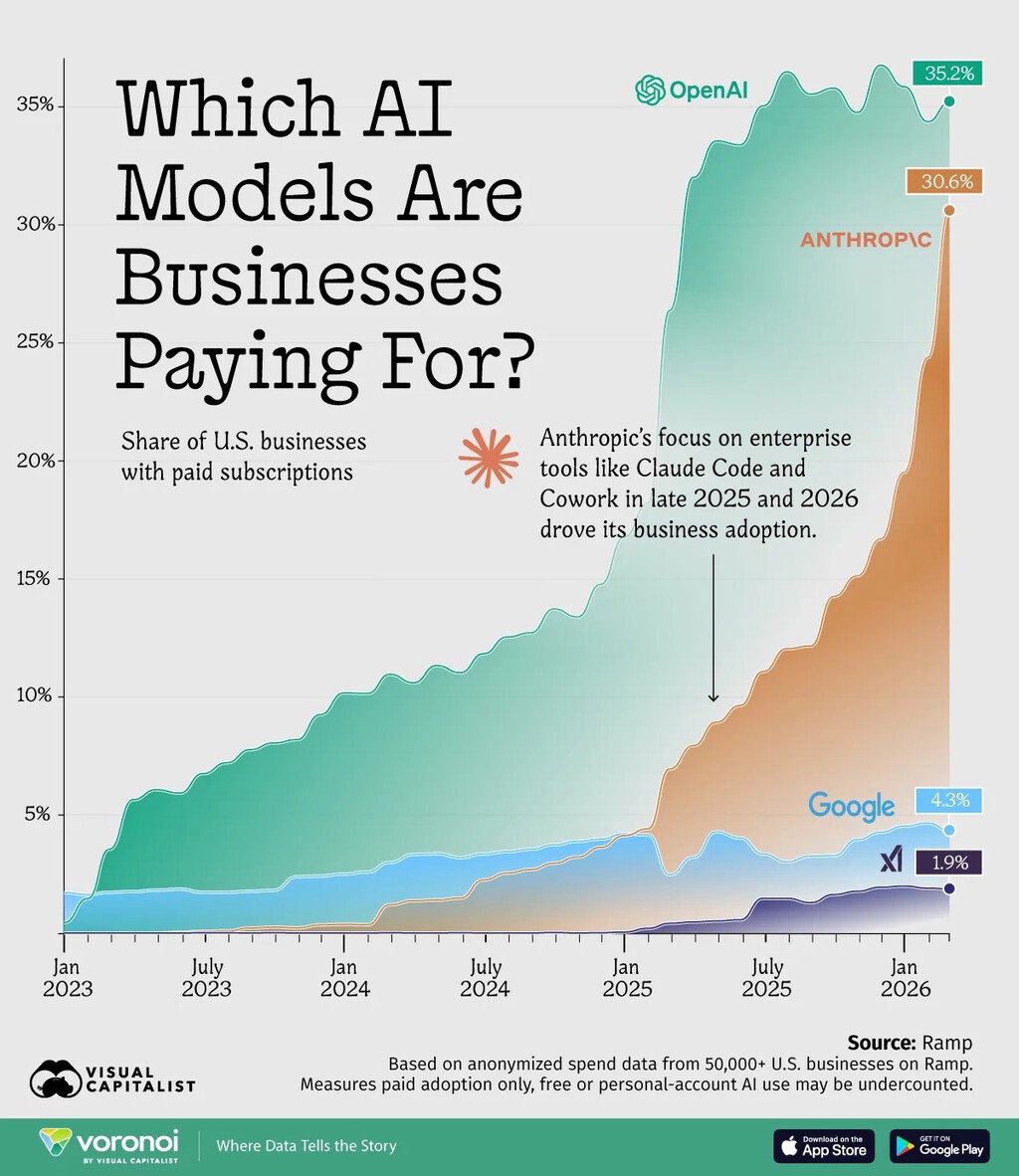
However, OpenAI's lead is not unchallenged. The chart indicates that other providers are gaining ground, albeit slowly. The consolidation trend means that while many AI startups exist, enterprises are choosing established players with proven track records. This is crucial for businesses that need scalable, secure, and compliant AI solutions.
Google and Anthropic: Strong Contenders but Lagging
Google, despite its advanced AI research and products like Gemini, has not captured the same enterprise market share as OpenAI. The chart shows Google's share hovering around 10-15% in recent months. This might be surprising given Google's cloud infrastructure and AI capabilities, but it highlights the challenge of converting technological prowess into enterprise sales.
Anthropic's Claude, known for its rigorous and safe outputs, has also made inroads but remains a smaller player. The data suggests that Claude's market share is growing but from a lower base, indicating that enterprises are still cautious about adopting newer models. The key takeaway is that being the "best" in specific tasks does not automatically translate to market dominance.
Market Consolidation: A Few Players Dominate
The Visual Capitalist chart paints a picture of a market that is contracting towards a few major providers. This consolidation is driven by several factors, including the high cost of developing and maintaining large language models, the need for enterprise-grade security and compliance, and the network effects of widely adopted platforms.
For businesses, this means fewer choices but potentially more robust and integrated solutions. However, it also raises concerns about vendor lock-in and the pace of innovation. As the market matures, we can expect further consolidation and possibly acquisitions as larger players absorb smaller ones.
- OpenAI leads with 35.2% of paid enterprise AI subscriptions as of March 2026.
- Google and Anthropic are strong contenders but have lower market shares.
- The market is consolidating rapidly, with a few providers dominating.
- Enterprise adoption is driven by reliability, security, and integration, not just model performance.
- Businesses should watch for vendor lock-in and evaluate multi-provider strategies.
What This Means for Businesses
For companies looking to adopt AI, the data suggests that choosing a provider is not just about the model's capabilities but also about market momentum. OpenAI's dominance means a larger ecosystem of tools, integrations, and talent. However, relying on a single provider can be risky. Businesses should consider a multi-provider approach to hedge against disruptions and leverage the strengths of different models.
Moreover, the consolidation trend indicates that enterprises are prioritizing stability and proven track records over cutting-edge features. This is particularly important for regulated industries where compliance and data security are paramount. As the AI race continues, the winners will be those that can balance innovation with enterprise needs. The background to this story is set out in UK Telecoms Upgrades: The Key to Winning the AI Race. A related thread runs through Mercadona Market Share Stalls: What the Data Reveals. Earlier coverage in Nvidia's China GPU Hopes Fade as Market Share Hits Zero shows how the argument developed.
| Provider | Market Share (March 2026) | Key Strengths | Enterprise Adoption Challenges |
|---|---|---|---|
| OpenAI | 35.2% | Early mover, broad integration, ChatGPT Enterprise | High cost, potential vendor lock-in |
| 10-15% | Advanced AI research, Gemini, cloud infrastructure | Complex pricing, less enterprise focus | |
| Anthropic | 5-10% | Safety, rigorous outputs, Claude | Newer entrant, limited enterprise features |
| Others | ~40% | Specialized models, niche applications | Fragmented market, lack of scale |
What to Watch Next in the AI Race
The AI race is far from over. While OpenAI leads, the rapid pace of innovation means that challengers could disrupt the market. Google's deep pockets and AI expertise could translate into enterprise gains if it focuses on sales and support. Anthropic's emphasis on safety and reliability might appeal to risk-averse industries. A closer look at the same subject appears in Samsung's 93% Foldable Market Share in Spain: What It Means. Anyone following the wider picture can start with No Mobile Brand Is Eternal: 18 Years of Market Share Shifts. The same theme surfaces in OpenAI Employees Cash Out: The Real Winners of the AI Race, which takes a different angle.
Additionally, the rise of open-source models and smaller, specialized providers could fragment the market further. However, the current trend suggests that enterprises prefer integrated, end-to-end solutions from established players. The next few years will be critical in determining whether OpenAI can maintain its lead or if others can catch up. Context on how this played out before sits in Nvidia's Hugging Face Buy: OpenAI's Jalapeño Chip Changes AI Race. A companion piece, China's Free AI Model Threatens US Lead in AI Race, approaches the same subject from another angle.
FAQ
Which AI provider has the largest market share among US enterprises?
OpenAI leads with a 35.2% market share of paid AI subscriptions as of March 2026, according to data from Visual Capitalist and Ramp.
Why is OpenAI leading the enterprise AI market?
OpenAI's early mover advantage with ChatGPT, broad integration capabilities, and enterprise-grade offerings like ChatGPT Enterprise have driven its adoption among businesses.
How are Google and Anthropic performing in the AI race?
Google and Anthropic are strong contenders but have lower market shares. Google's share is around 10-15%, while Anthropic's is estimated at 5-10%, as they continue to build enterprise trust.
What does market consolidation mean for businesses adopting AI?
Consolidation means fewer choices but potentially more robust and integrated solutions. However, businesses should be aware of vendor lock-in and consider multi-provider strategies to maintain flexibility.
Browse the Shop
 Acacia frida deluxe solid wood bed frame |
Bedroom bench |
Bed chest drawers |
Lingerie dresser |
Frame base |
Mirror with jewelry storage |
30 Bathroom Vanity |
Memory foam queen mattress |
Mattresses for back pain |
Nightstand set of 2 |
Grand Goldman Shop |
Civil Lawyer
Deutschland Trikot WM 2026







