

LG's ThinQ Claw, an AI agent unveiled at IFA 2026, promises to make smart homes truly intelligent by using generative AI to understand context and coordinate devices automatically. The company believes this solves the long-standing contradiction of smart homes: technology meant to save work often requires more effort to configure.
Why Smart Homes Haven't Been Truly Smart
For years, consumer electronics companies have sold the idea of the smart home, but the reality is that getting everything to work together is often a chore. Users must create "scenes," set schedules, or chain actions and conditions (if this happens, do that). This complexity has kept many smart homes from reaching their potential.
Find Original Home Decor sparking conversation at Grand Goldman Shop.

LG argues that generative AI can overcome this obstacle with a simple yet powerful idea: tell your home what you want to achieve and let it figure out how to do it. Instead of manually programming every device, you can simply state your goal and let the system handle the details.
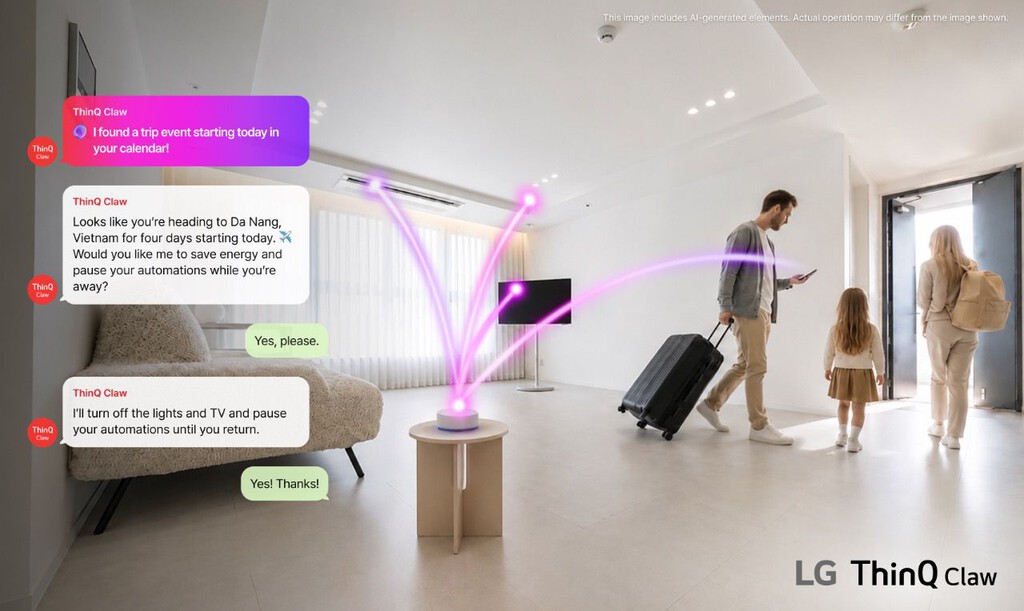
Meet ThinQ Claw: LG's AI Agent
ThinQ Claw is an AI agent built on OpenClaw and presented at IFA 2026. It can be used as a chat tool within LG's AI Home platform. The company claims it doesn't interpret each message in isolation but uses information about schedules, routines, preferences, and devices in the home to understand context and act accordingly.
Rather than receiving a command directed at a specific appliance, ThinQ Claw receives a request and determines which services and devices it needs to coordinate—and how—to fulfill it. This shift from device-centric to intent-centric control is a significant departure from traditional smart home interfaces.
How ThinQ Claw Understands Context
The agent leverages data from your home environment to build a contextual understanding. For example, if you say, "Some friends are coming over this afternoon," ThinQ Claw could use that information to start preparing the appliances you'll use for cooking and know when you'll need them. It might preheat the oven, adjust the lighting, or set the thermostat based on your routines and preferences.
This level of contextual awareness is what sets ThinQ Claw apart from simple voice assistants. It's not just about responding to commands; it's about anticipating needs and orchestrating multiple devices seamlessly.
Key Features and Capabilities
- Contextual understanding: Uses schedules, routines, and preferences to interpret requests accurately.
- Multi-device coordination: Determines which appliances and services to involve and how to sequence them.
- Intent-based interaction: Focuses on what you want to achieve rather than which device to control.
- Chat interface: Accessible via LG's AI Home platform for natural language conversations.
- Built on OpenClaw: Leverages an open foundation for AI agent development.
ThinQ Claw vs. Traditional Smart Home Systems
To appreciate the difference, consider how traditional systems handle a request like "I'm watching a movie." You might need to create a scene that dims lights, turns on the TV, and adjusts the sound system. With ThinQ Claw, you simply state your intent, and the agent figures out the rest. Context on how this played out before sits in LG ThinQ Claw: AI Agent Makes Smart Homes Truly Intelligent. A companion piece, Microsoft AI Token Spending: Employee Burns $28,000 in a Month, approaches the same subject from another angle.
| Aspect | Traditional Smart Home | ThinQ Claw |
|---|---|---|
| Interaction | Device-specific commands | Intent-based requests |
| Setup | Manual scene creation | Learns from context and routines |
| Coordination | Pre-programmed sequences | Dynamic, on-the-fly orchestration |
| Adaptability | Limited to predefined rules | Adjusts based on preferences and schedules |
| User effort | High (requires configuration) | Low (just state what you want) |
What This Means for the Future of Smart Homes
If ThinQ Claw delivers on its promise, it could mark a turning point in home automation. Instead of spending time programming scenes and schedules, users can simply express their desires and let the AI handle the complexity. This could make smart homes accessible to a wider audience, including those who found current systems too cumbersome. The background to this story is set out in Google Home MCP: Control Your Smart Home With Any AI Agent. A related thread runs through Ai Video: latest articles.
Moreover, the agent's ability to learn from routines and preferences means it could become more personalized over time. As it gathers more data, it can anticipate needs and make proactive suggestions, further reducing the friction of managing a smart home. Earlier coverage in Best Handheld Vacuums: Top Picks from $39 and Buying Guide shows how the argument developed. A closer look at the same subject appears in Africa's Great Green Wall: 100 Million Trees and Counting.
However, challenges remain. Privacy and data security are paramount when an AI agent has access to detailed information about your daily life. LG will need to assure users that their data is handled responsibly. Additionally, the system's reliance on OpenClaw raises questions about interoperability and long-term support. Anyone following the wider picture can start with Why the Future of Mobile Cameras Is Realism, Not Perfect Photos. The same theme surfaces in Huawei Watch D3 Review: Blood Pressure on Your Wrist, which takes a different angle.
FAQ
What is LG ThinQ Claw?
ThinQ Claw is an AI agent developed by LG, built on OpenClaw, and integrated into the AI Home platform. It uses generative AI to understand context and coordinate smart home devices based on user intent.
How does ThinQ Claw differ from other smart home assistants?
Unlike traditional assistants that respond to specific device commands, ThinQ Claw interprets requests holistically, using information about schedules, routines, and preferences to determine which devices to coordinate and how.
When will ThinQ Claw be available?
LG presented ThinQ Claw at IFA 2026, but the company has not yet announced a release date or pricing. It is expected to be integrated into LG's AI Home platform in the future.
Can ThinQ Claw work with non-LG devices?
LG has not specified whether ThinQ Claw will support third-party devices. The agent is built on OpenClaw, which suggests potential for interoperability, but details are currently limited.
As smart homes evolve, the focus is shifting from individual gadgets to holistic experiences. LG's ThinQ Claw represents a step toward that future, where AI acts as the invisible conductor orchestrating your home's devices. While challenges remain, the potential to finally make smart homes truly smart is compelling.
Browse the Shop
 Acacia frida deluxe solid wood bed frame |
Bedroom bench |
Bed chest drawers |
Lingerie dresser |
Frame base |
Mirror with jewelry storage |
30 Bathroom Vanity |
Memory foam queen mattress |
Mattresses for back pain |
Nightstand set of 2 |
Grand Goldman Shop |
Civil Lawyer
Deutschland Trikot WM 2026







