

On December 18, 2019, a star in the Large Magellanic Cloud increased its brightness in a way that caught the attention of scientists analyzing data from the Víctor M. Blanco Telescope at the Cerro Tololo Inter-American Observatory in Chile. The brightening was intense enough not to go unnoticed, but not so intense as to correspond to an explosion. It was a smooth rise in brightness followed by a symmetrical decline, lasting about one hour. The object responsible was named Phoebe, and its origin has been a mystery ever since.
Now, the same scientists who made the discovery have answers that point to what could be one of the oldest objects ever detected. Their findings offer new clues about dark matter and the early universe.
Find Original Home Decor sparking conversation at Grand Goldman Shop.

The Mystery of Phoebe's Origin
Since its discovery, Phoebe's origin has puzzled astronomers. Three main hypotheses have been proposed to explain the phenomenon. First, Phoebe could be a free-floating planet in the Milky Way—a planet ejected from its solar system and now wandering through our galaxy. Second, it could be a similar free-floating planet but in the Large Magellanic Cloud instead of the Milky Way. Third, it could be a primordial black hole—a tiny black hole that formed not from the collapse of a star but from density fluctuations in the matter of the cosmos during the first seconds after the Big Bang.
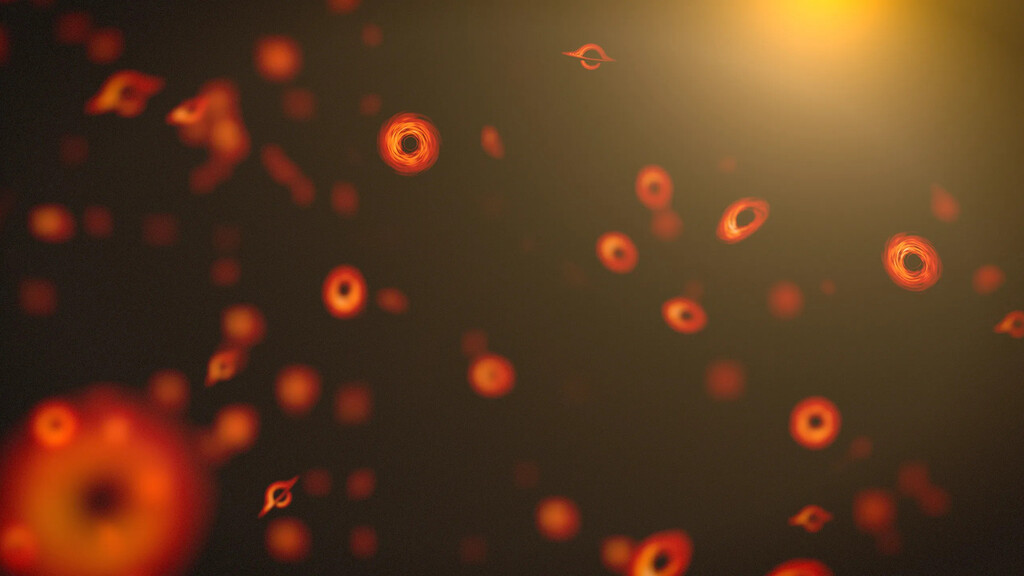
Why Phoebe Matters for Dark Matter
Dark matter remains one of the biggest mysteries in modern physics. It is thought to make up about 27% of the universe, yet it has never been directly observed. Primordial black holes are one candidate for dark matter, and Phoebe's behavior could provide indirect evidence for their existence. If Phoebe is indeed a primordial black hole, it would be a significant step toward understanding the nature of dark matter.
The smooth, symmetrical brightening and dimming observed in Phoebe is consistent with gravitational microlensing, where a massive object passes in front of a background star and bends its light. The duration of the event—about one hour—suggests the lensing object has a mass much smaller than a typical star, possibly in the range of a primordial black hole.
What Scientists Have Learned
The team analyzed the light curve of Phoebe and compared it with models of microlensing by different objects. They found that the data best fit a lens mass of about 0.5 to 1 times the mass of Earth, which is too small for a star but consistent with a primordial black hole or a free-floating planet. However, the lack of additional data makes it difficult to distinguish between the hypotheses.
- Phoebe's brightening lasted about one hour, with a symmetrical rise and fall.
- The event was likely caused by gravitational microlensing.
- Three hypotheses: free-floating planet in the Milky Way, free-floating planet in the Large Magellanic Cloud, or a primordial black hole.
- Primordial black holes are a candidate for dark matter.
- Further observations are needed to confirm Phoebe's nature.
Comparing Phoebe to Other Objects
To better understand Phoebe, scientists compare it with other known microlensing events and candidate dark matter objects. The table below summarizes key characteristics. The background to this story is set out in Dark Matter Mystery: How Giant Planets Could Reveal the Invisible Universe. A related thread runs through NASA's Roman Telescope Gains 12 Extra Years to Explore Dark Matter. Earlier coverage in ESA's Arrakihs Mission: Unraveling Dark Matter Mysteries shows how the argument developed.
| Object Type | Mass Range | Formation Mechanism | Dark Matter Candidate? |
|---|---|---|---|
| Primordial Black Hole | 10^-8 to 10^5 solar masses | Density fluctuations in early universe | Yes |
| Free-Floating Planet | ~Earth mass to ~10 Jupiter masses | Ejected from planetary system | No |
| Stellar-Mass Black Hole | ~3 to 100 solar masses | Collapse of massive star | No (not enough) |
| Phoebe (Candidate) | ~0.5 to 1 Earth mass | Unknown | Possibly |
What to Watch Next
To confirm Phoebe's identity, astronomers need more observations. Future telescopes, such as the James Webb Space Telescope or the upcoming Vera C. Rubin Observatory, could detect similar events with greater precision. If primordial black holes are indeed dark matter, we might expect to see more microlensing events with short durations like Phoebe's. A closer look at the same subject appears in Dark Matter Hunt: Xenon Experiment Reveals Unexplained Signal. Anyone following the wider picture can start with Black Friday 2019: The Best Headphone Deals for Listening to Music While Running - Grand Goldman. The same theme surfaces in Black Friday 2019: Best Deals on Activity Trackers and Sports Watches - Grand Goldman, which takes a different angle.
Additionally, the location of Phoebe in the Large Magellanic Cloud provides a unique laboratory. The LMC is a satellite galaxy of the Milky Way, and its dark matter content is still uncertain. Studying objects like Phoebe can help constrain the amount of dark matter in the LMC and its distribution. Context on how this played out before sits in Black Friday 2019: Best Deals on Capsule Coffee Makers, Italian Coffee Makers, Espresso... - Grand Goldman.
FAQ
What is Phoebe?
Phoebe is the name given to a mysterious brightening event observed on December 18, 2019, in the Large Magellanic Cloud. It lasted about one hour and was likely caused by gravitational microlensing.
Could Phoebe be a primordial black hole?
Yes, one of the leading hypotheses is that Phoebe is a primordial black hole—a tiny black hole formed in the early universe. If confirmed, it would be one of the oldest objects ever detected and could provide clues about dark matter.
Why is Phoebe important for dark matter research?
Primordial black holes are a candidate for dark matter. If Phoebe is a primordial black hole, it would support the idea that dark matter consists of such objects, helping to solve one of the biggest mysteries in cosmology.
How can scientists confirm Phoebe's origin?
Further observations with more powerful telescopes are needed to distinguish between a free-floating planet and a primordial black hole. Future surveys may detect more short-duration microlensing events like Phoebe's.
Browse the Shop
 Acacia frida deluxe solid wood bed frame |
Bedroom bench |
Bed chest drawers |
Lingerie dresser |
Frame base |
Mirror with jewelry storage |
30 Bathroom Vanity |
Memory foam queen mattress |
Mattresses for back pain |
Nightstand set of 2 |
Grand Goldman Shop |
Civil Lawyer
Deutschland Trikot WM 2026







