

Europe's tourism map reveals a startling reality: in 2024, the number of nights spent in tourist accommodations surpassed 3 billion for the first time, a 2.2% increase from 2023, according to Eurostat. This milestone underscores the growing pressure of overtourism, particularly in regions where visitors outnumber residents.
The map, created by the European Commission's statistical office, highlights the contrast between popular destinations and those with fewer visitors. While tourism is an economic driver, its intensity can strain housing, services, infrastructure, and daily life for locals.
Find Original, High-end Home Decor that spark conversation at Grand Goldman Shop.
Record Tourism Numbers Across Europe
Spain leads with 500 million overnight stays, followed by Italy (458 million), France (451 million), and Germany (441 million). Together, these four countries account for 61.6% of all nights spent in the EU. At the other end, Luxembourg (3.4 million), Latvia (4.7 million), and Estonia (6.6 million) see far fewer visitors.
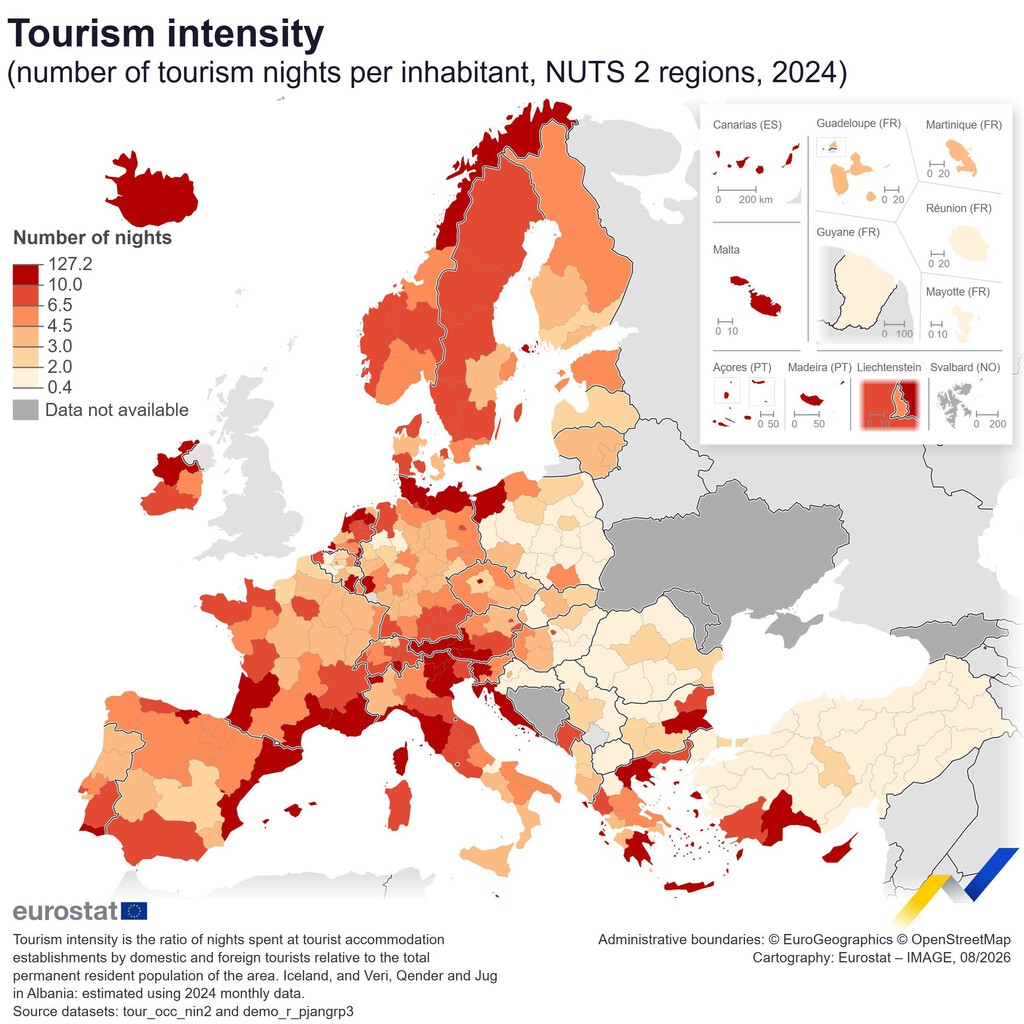
But these macro figures only tell part of the story. The map zooms in on specific regions, revealing hotspots where tourism density is exceptionally high. For instance, the Balearic and Canary Islands in Spain experience visitor numbers that dwarf their resident populations, creating unique challenges.
Measuring Tourism Pressure: Beyond Overnight Stays
Overnight stays alone don't capture the full impact. Eurostat's map considers the ratio of tourists to residents, highlighting areas where tourism intensity is highest. In 2024, 10% of Europe's territory had more visitors than residents, a clear sign of overtourism.
This pressure affects housing markets, as short-term rentals reduce available homes for locals, driving up prices. Public services and infrastructure also bear the brunt, from crowded transport to overwhelmed healthcare. Moreover, the daily life of residents can be disrupted by noise, congestion, and cultural dilution.
Key Takeaways from the Tourism Map
- Spain, Italy, France, and Germany dominate overnight stays, accounting for over 60% of the EU total.
- 10% of Europe's territory has more visitors than residents, indicating severe overtourism.
- Popular regions like the Balearic and Canary Islands face extreme tourism density.
- Overtourism strains housing, services, and infrastructure, impacting local communities.
- Eurostat's map provides a tool to identify hotspots and guide sustainable tourism policies.
Comparing Tourism Intensity Across Countries
The table below shows the number of overnight stays in tourist accommodations for selected European countries in 2024, along with their share of the EU total. This data illustrates the concentration of tourism in a few major destinations.
| Country | Overnight Stays (millions) | Share of EU Total (%) |
|---|---|---|
| Spain | 500 | 16.7 |
| Italy | 458 | 15.3 |
| France | 451 | 15.0 |
| Germany | 441 | 14.7 |
| Luxembourg | 3.4 | 0.1 |
| Latvia | 4.7 | 0.2 |
| Estonia | 6.6 | 0.2 |
While these figures show the biggest players, the map's real value lies in its regional breakdown, revealing pockets of intense tourism even in countries with lower national totals.
Implications for Local Communities and Travelers
For residents in overtouristed areas, the consequences are tangible: rising rents, strained public services, and a sense of displacement. Local governments are responding with measures such as tourist taxes, limits on short-term rentals, and campaigns to disperse visitors to less crowded regions. The longer history behind the story is traced in Europe Tourism Map Reveals Overtourism Pressure on 10% of Territory.
Travelers, too, are affected. Popular spots may become less enjoyable due to crowds, and prices can soar. However, increased awareness is leading to more sustainable travel choices, such as visiting during off-peak seasons or choosing lesser-known destinations. The background to this story is set out in Big Sur Overtourism Crisis: Wildfires and Tourist Deaths. A related thread runs through Scotland Tourism Booms as Europe Heatwave Drives Visitors North. Earlier coverage in Scotland Tourism Surges as Europe Heatwave Drives Visitors North shows how the argument developed.
What to Watch Next
As tourism continues to grow, expect more regions to implement policies to manage visitor numbers. The Eurostat map will be a crucial tool for monitoring trends and assessing the effectiveness of these measures. Additionally, the balance between economic benefits and quality of life for residents will remain a central debate. A closer look at the same subject appears in Marseille Overtourism: France's New Capital of Travel. Anyone following the wider picture can start with Rome Golf Cart Tours Spark Local Outrage Amid Overtourism. The same theme surfaces in For every call we make a map is created!, which takes a different angle.
For now, the map serves as a wake-up call: tourism is a powerful force, but without careful management, it can overwhelm the very places it celebrates. Context on how this played out before sits in Mike Hodgson: Soil Scientist Who Created National Soil Map. A companion piece, Jim Chalmers' Bad Week: Economic Pressure and Labor Tensions, approaches the same subject from another angle.
FAQ
What does the Eurostat tourism map show?
The map visualizes tourism intensity across Europe, highlighting regions where the number of visitors exceeds residents. It uses data on overnight stays and the ratio of tourists to locals.
Which European countries have the highest tourism numbers?
Spain leads with 500 million overnight stays, followed by Italy, France, and Germany. Together, they account for over 60% of the EU total.
Why is overtourism a concern?
Overtourism can lead to housing shortages, strained infrastructure, and a diminished quality of life for residents. It also affects the travel experience for visitors.
What can be done to manage overtourism?
Strategies include implementing tourist taxes, regulating short-term rentals, promoting off-season travel, and encouraging visitors to explore less crowded areas.
Browse the Shop
 Acacia frida deluxe solid wood bed frame |
Bedroom bench |
Bed chest drawers |
Lingerie dresser |
Frame base |
Mirror with jewelry storage |
30 Bathroom Vanity |
Memory foam queen mattress |
Mattresses for back pain |
Nightstand set of 2 |
Grand Goldman Shop |
Civil Lawyer
Deutschland Trikot WM 2026







