

Patio heaters have a reputation for burning money as fast as they burn fuel. It is not entirely unfair: a full-size gas mushroom heater running at maximum can chew through a propane cylinder in a handful of evenings, and a 2kW electric model left on all afternoon will show up clearly on your bill. But the gap between the cheapest and most expensive ways to heat a patio is wide, and the single biggest factor is not the heater itself — it is how long you leave it on and whether you are heating people or the sky.
The honest answer is that patio heaters cost somewhere between a few cents and a couple of euros an hour to run, depending on fuel type, output setting and local energy prices. Below we break down how we assessed the options, compare the main product families, and explain the numbers you need to do your own sums before you buy.
Find Original Home Decor sparking conversation at Grand Goldman Shop.

 View on Amazon
How we chose
We did not run lab tests. Instead we assessed patio heater families on the factors that actually determine running cost and satisfaction: rated heat output and how it is delivered (radiant versus convective), fuel type and the realistic burn rate at full and half setting, whether the heater can be turned down or zoned, build quality and weather resistance for year-round outdoor storage, and how easy it is to refuel or plug in. We favoured families that are widely sold, well documented by the manufacturer, and supported with spare parts. Where a manufacturer publishes a heat output in kW, we used that figure rather than marketing language like "covers 20 square metres".
Comparison table
| Product | Best for | Key feature | Verdict |
|---|---|---|---|
| Garden Sun patio heater | Large open patios | Full-size mushroom reflector spreads heat widely | Strong radiant reach but thirsty at full output |
| Outsunny patio heater | Budget-conscious buyers | Wide range of gas and electric formats | Good value entry point; check the wattage carefully |
| Amazon Basics patio heater | Straightforward gas heating | Simple wheeled base and standard regulator | No-frills option that is easy to live with |
| Herschel infrared heater | Walls and covered terraces | Directional radiant panels heat objects, not air | Most efficient way to heat a small seated area |
| De'Longhi patio heater | Design-led terraces | Freestanding electric formats with adjustable power | Neat and controllable; best under a roof |
| Sunred patio heater | Wall-mounted setups | Compact radiant units with multiple power levels | Good for balconies where floor space is tight |
| Parasol heater | Umbrella tables | Clamps to the pole and heats downwards | Clever for dining sets; limited coverage area |
 View on Amazon
Garden Sun patio heater
- Full-height mushroom reflector throws heat outward over a wide radius
- Standard propane cylinder fits inside the base on most models
- Wheels and a tilt switch make it practical to move
- Spare parts and regulators are widely available
This is the classic patio heater shape, and it is the one most people picture when they worry about running costs. The reflector does a reasonable job of pushing radiant heat out and down rather than straight up, which is the main reason these units are not as wasteful as they look. The catch is that a full-output gas burner is the thirstiest option in this roundup, so the cost per evening depends heavily on whether you run it on high all night or knock it back once people are seated.
Buy it if you have a large, open patio and want heat that reaches several people at once. Skip it if your space is small or sheltered — you will pay for heat that lands on the fence.
Outsunny patio heater
- Very broad range, from tall gas models to compact electric ones
- Electric versions let you compare wattage directly before buying
- Generally keen pricing across the range
- Build quality varies by model, so check the spec sheet
Outsunny is useful precisely because the range is so wide. If you are trying to work out running costs, an electric model with a published wattage is far easier to budget for than a gas unit, because you can multiply kilowatts by your electricity rate and know the answer to the cent. The trade-off is that cheaper electric units often have only one heat setting, which removes your ability to run them at half power on milder evenings.
Buy it if you want a low-cost starting point and are comfortable reading the specification carefully. Skip it if you need a single, well-documented premium unit with long-term parts support.
 View on Amazon
Amazon Basics patio heater
- Simple, standard gas design with few surprises
- Wheeled base and familiar regulator fitting
- Easy to source replacement parts for
- Limited refinement on the controls
There is not much to say about a basic gas patio heater, and that is the point. It uses a standard cylinder, a standard regulator and a standard burner, so your running cost is essentially the same as any comparable gas unit: the price of propane divided by how many hours the cylinder lasts. That predictability is genuinely useful if you are budgeting.
Buy it if you want gas heat without paying for styling. Skip it if you need variable output or a heater you can leave out uncovered through winter.
Herschel infrared heater
- Radiant panels warm people and surfaces rather than the air
- Directional mounting means less heat lost to wind
- Multiple power levels allow genuine half-output running
- No fuel to store or refill
Infrared is the technology that most changes the running-cost conversation. Because the heat is radiant and directional, a modest-wattage panel mounted above a seating area can feel warmer than a much more powerful gas mushroom heater that is losing heat sideways. That does not make electricity cheap, but it means you can often use a lower output for the same perceived comfort — and lower output is the only lever that reliably cuts the bill.
Buy it if you have a wall, ceiling or pergola to mount it on and a defined seating zone. Skip it if your patio is completely open to the wind, where radiant panels lose much of their advantage.
 View on Amazon
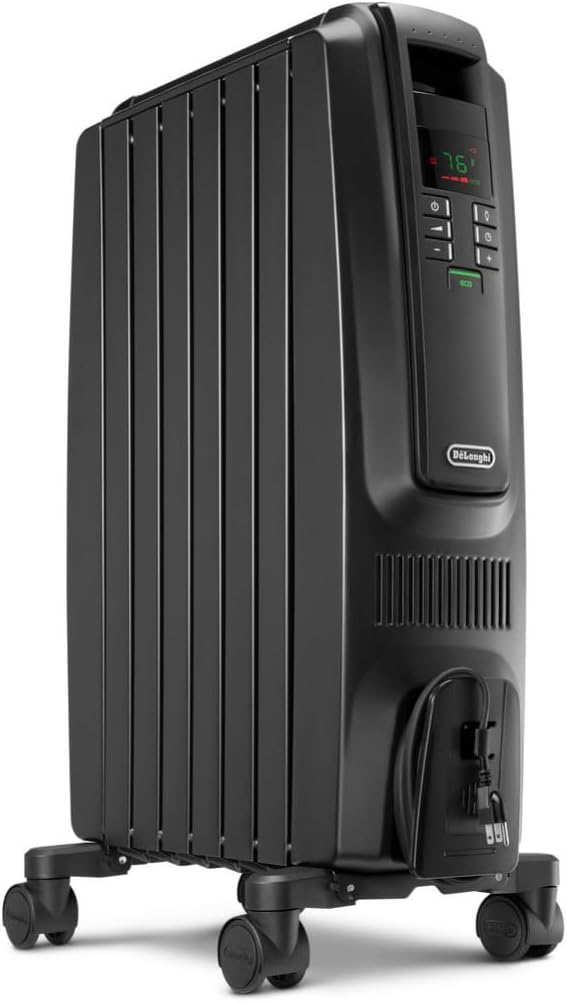
De'Longhi patio heater
- Clean, furniture-like styling for visible terraces
- Adjustable power on most freestanding electric models
- Quartz and halogen elements heat up almost instantly
- No cylinders, no refills, no fumes
Electric freestanding heaters like these are the easiest to cost out: the rated wattage is the running cost, full stop. The practical question is whether you actually need the top setting. Running a heater at half power for twice as long usually feels better than blasting it on high, and it costs the same. Instant heat also means you are less tempted to switch on early "just in case".
Buy it if you want predictable bills and a heater that looks good on a covered terrace. Skip it if you need to heat a large open garden where there is no convenient outdoor socket.
Sunred patio heater
- Wall-mounted format frees up floor space
- Several power levels on many models
- Good for balconies and narrow terraces
- Requires safe, weatherproof mounting and wiring
Wall-mounted radiant heaters are the sleeper pick for anyone worried about running costs, because they put the heat exactly where the people are. A unit mounted at head height above a small table directs almost all of its output into the seating zone rather than into the night sky. The installation is the catch — you need a solid fixing point and an outdoor-rated supply.
Buy it if you have a balcony or a wall beside your seating area. Skip it if you rent and cannot drill, or if you want something you can move around the garden.
Parasol heater
- Clamps to an existing umbrella pole, no extra floor space
- Heats downwards onto the table and diners
- Electric models are cheap to buy and simple to run
- Coverage is limited to the area under the canopy
These are the most targeted option in this list. Because the heat goes down onto the table, very little is wasted, which makes them one of the more efficient ways to keep a dining set usable in spring and autumn. The limitation is obvious: step away from the table and you are cold again.
Buy it if your patio life revolves around a dining table under a parasol. Skip it if you want general warmth across a seating area rather than a hot spot at the table.
Buying guide
Do the arithmetic before you choose a fuel
Running cost is output multiplied by fuel price. For electric heaters, take the rated wattage, divide by 1,000 to get kilowatts, and multiply by your electricity price per kWh. A 2kW heater on full is simply two kilowatt-hours for every hour of use. For gas, the calculation is less direct but still simple: a standard patio gas cylinder holds a known quantity of fuel, and the burner's rated output tells you roughly how many hours it will last at full setting. Halve the output and you roughly double the hours. Once you have those two numbers, the comparison is straightforward, and it usually shows that the setting you choose matters more than the fuel you pick.
Radiant heat beats hot air outdoors
Outdoor air is constantly moving, so any heater that tries to warm the air is fighting a losing battle. Radiant heaters — gas mushrooms, infrared panels, halogen elements — warm surfaces and people directly, which is why a modest radiant unit can feel better than a powerful convective one. When comparing products, ignore vague coverage claims and look for directional design: a reflector, a tilting head, a wall bracket. Direction is efficiency.
Match the heater to the space, not the catalogue
A large open patio needs a heater with real reach, which usually means gas. A covered terrace, balcony or pergola suits electric radiant panels that can be mounted overhead and switched between power levels. A dining table under a parasol suits a pole-mounted unit. Buying a big gas heater for a small sheltered space wastes fuel; buying a small electric panel for an exposed lawn wastes electricity. Also factor in storage and shelter — a heater that lives outdoors year-round needs to be built for it, and one that lives in a shed needs to be light enough to move.
A full-size gas mushroom heater can chew through a propane cylinder in a handful of evenings, and the same sizing logic applies when a pressure washer punishes you for buying the wrong size.
Keeping a patio heater running costs more than many expect, and the same practical care applies to lawn mowers when the cutting season ends. Choosing a mower for sloping ground is also worth thought, since an uneven lawn is harder on the machine. For cleaning paving and vehicles, pressure washers handle two very different jobs.
Running a full-size gas mushroom heater at maximum can drain a propane cylinder over a handful of evenings, so it is worth weighing that outlay against the cost of charcoal grills. A dripping drum that leaves puddles and a damp hose is a familiar frustration, and leak-free garden hose reels spare a garden that quiet annoyance.
FAQ
Is it cheaper to run a gas or electric patio heater?
It depends on local fuel prices and, more importantly, on the setting you use. Electric heaters are easier to cost precisely because the wattage is fixed, while gas running costs depend on cylinder price and burn rate. In many markets gas works out cheaper per hour of full-output heat, but a lower-powered electric radiant panel used directionally can undercut a gas heater running flat out.
How long does a gas patio heater cylinder last?
A full-size mushroom heater on high will typically empty a standard cylinder over a handful of evenings, while running it on a lower setting stretches that considerably. Smaller tabletop and pole-mounted units use far less. Check the burner's rated output and the cylinder's capacity, then divide to estimate hours at full power.
Do patio heaters work in wind?
Radiant heaters lose much of their benefit in strong wind because the heat is blown away from the people it was aimed at. A reflector or a directional wall-mounted panel helps, and a windbreak such as a screen or parasol side panel makes a bigger difference than upgrading the heater.
Can I leave a patio heater outside all winter?
Only if it is designed for it. Gas units with steel bodies and exposed burners should be covered or stored under shelter, and cylinders should be kept according to the supplier's instructions. Many electric radiant panels are rated for outdoor mounting but still need a weatherproof connection.
Does turning a heater down actually save money?
Yes, and it is the most reliable saving available. Halving the output roughly halves the fuel or electricity used per hour, and a directional heater at half power often feels as warm as an undirected one at full power. Instant-on electric elements also discourage leaving a heater running before anyone is sitting outside.
Are infrared patio heaters worth the higher purchase price?
If you have somewhere to mount them and a defined seating area, they often are, because they deliver heat where it is needed and let you run at lower output. If your patio is large and open, a gas heater with real radiant reach may still be the more practical choice despite higher running costs.
Patio heaters are not automatically a luxury expense. The cost gap between a sensible setup and a wasteful one comes down to direction, output setting and how long you leave it running — not the fuel badge on the box. Choose a heater that aims heat at people, run it lower for longer, and the hourly figure stays modest.
As an Amazon Associate we earn from qualifying purchases.







