

The Ornn Price Index is surging, and it's bad news for AI startups and the entire tech ecosystem. According to a recent analysis by Tomasz Tunguz, the cost of renting NVIDIA B200 GPUs has more than doubled in just six weeks, driven by the relentless release of new frontier models from OpenAI and Anthropic.
Tunguz shared two revealing charts on X this week. They show that the rental price for B200 GPUs, based on the Blackwell architecture, jumped from $2.31 per hour in early March to $4.95 per hour by mid-April—a 114% increase. The correlation with model launches is almost perfect: each new release from OpenAI or Anthropic triggers a spike in demand and, consequently, in price.
Find Original Home Decor sparking conversation at Grand Goldman Shop.

What the Ornn Price Index Reveals
The Ornn Price Index tracks the cost of renting cloud compute on a marketplace where supply and demand set the price. Tunguz's first chart covers B200 rental prices from late 2025 to today, with vertical lines marking each major model launch. The pattern is unmistakable: GPT-5 Codex, Claude 4.5, GPT-5.3 Codex, Claude Opus 4.7, and GPT-5.5 all coincide with sharp increases in the index.
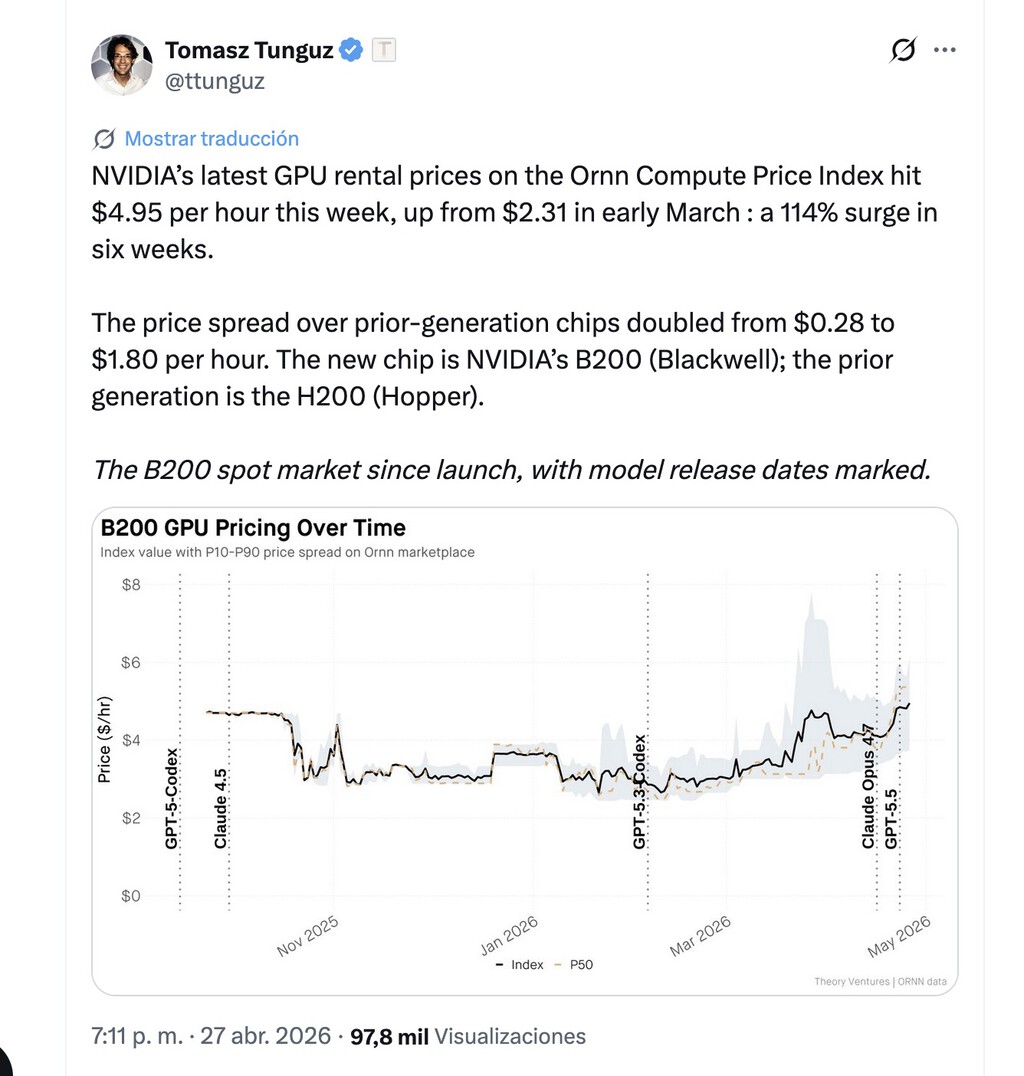
This suggests that every time a new state-of-the-art model is announced, companies rush to fine-tune, deploy, or experiment with it, driving up demand for the most powerful GPUs. The result is a volatile market where prices can spike dramatically in a matter of days.
The Widening Gap Between GPU Generations
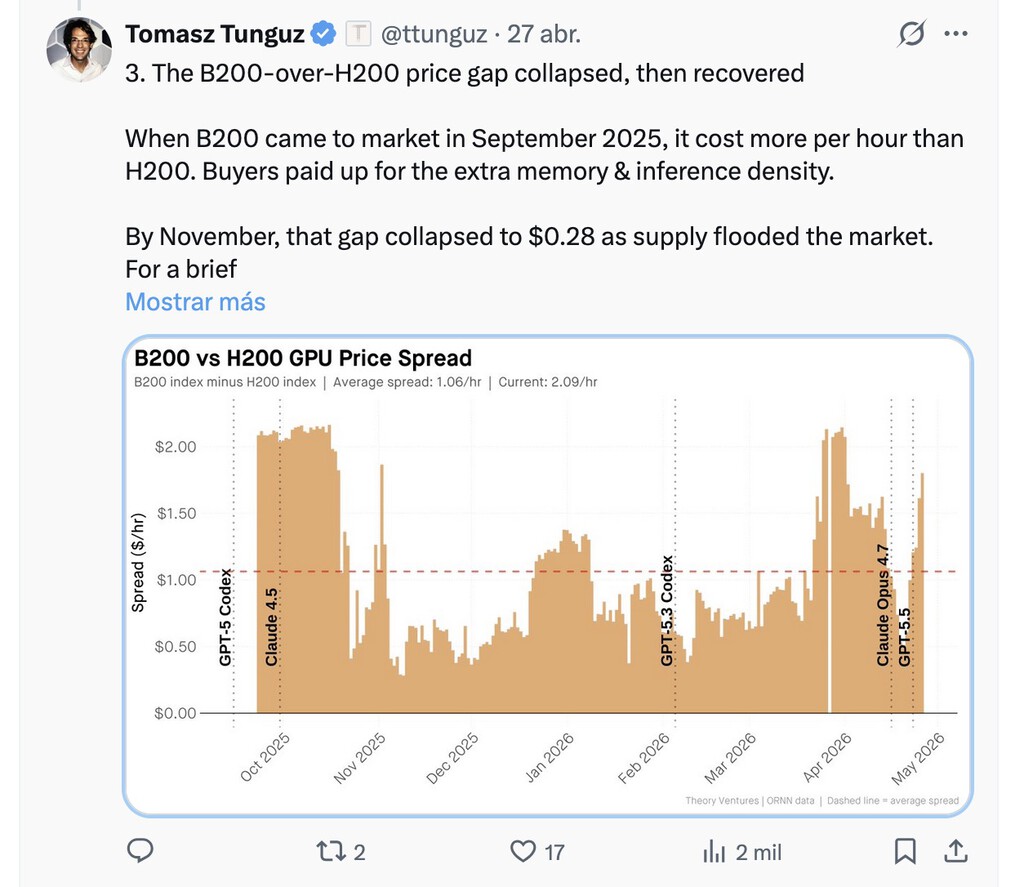
The second chart highlights the price difference—or spread—between renting the previous generation of chips (H200 with Hopper architecture) and the new B200. Historically, that spread has averaged $1.06 per hour. But according to Tunguz, it now sits at a much higher level, reflecting the premium that startups are willing to pay for the latest hardware.
This widening spread indicates that access to cutting-edge compute is becoming a luxury. Startups that can't afford the B200 premium may be forced to use older GPUs, potentially limiting their ability to train and run the most advanced models.
Why This Matters for Startups and the AI Ecosystem
The surge in GPU rental prices has several implications. First, it raises the barrier to entry for AI startups. Companies with limited budgets may struggle to secure the compute they need to compete, leading to a consolidation of power among well-funded players.
Second, it could slow innovation. If startups can't afford to experiment with the latest models, they may fall behind in developing new applications and services. This could ultimately reduce the diversity of the AI ecosystem.
Third, it creates uncertainty for investors. Rising compute costs make it harder to predict burn rates and profitability, which could make venture capitalists more cautious about funding AI startups. The longer history behind the story is traced in Ornn Price Index Surges: AI Compute Costs Skyrocket.
- B200 rental prices have more than doubled in six weeks, from $2.31 to $4.95 per hour.
- New model launches from OpenAI and Anthropic correlate with price spikes, as demand surges.
- The price gap between H200 and B200 GPUs has widened, making cutting-edge compute a premium commodity.
- Startups face higher barriers to entry and may struggle to compete with well-funded rivals.
- Investors are wary of unpredictable compute costs affecting startup burn rates.
Comparing GPU Rental Costs
The table below summarizes the key price points and spreads mentioned in the analysis. The background to this story is set out in Global Bond Sell-Off Resumes as Surging Oil Prices Stoke Inflation. A related thread runs through Ai Video: latest articles. Earlier coverage in Nvidia's China GPU Hopes Fade as Market Share Hits Zero shows how the argument developed.
| GPU Model | Architecture | Price (per hour) | Notes |
|---|---|---|---|
| NVIDIA B200 | Blackwell | $4.95 (current) | Up from $2.31 in early March |
| NVIDIA H200 | Hopper | Not specified | Previous generation, typically cheaper |
| Spread (B200 vs H200) | — | Above historical average | Historical average: $1.06 |
What to Watch Next
All eyes are on the next model releases from OpenAI and Anthropic. If the pattern holds, each announcement will likely trigger another price surge. Startups should plan accordingly, perhaps by securing compute contracts in advance or exploring alternative cloud providers. A closer look at the same subject appears in Nvidia Nemotron 3 Nano Omni: AI That Reads, Sees, and Hears. Anyone following the wider picture can start with Jensen Huang: AI Agents Will Micromanage You and Create More Jobs. The same theme surfaces in Oil Price Surge: Why Polyester Clothing Prices Are Set to Climb, which takes a different angle.
Additionally, keep an eye on NVIDIA's production capacity for B200 chips. If supply can't keep up with demand, prices could remain elevated for the foreseeable future. The Ornn Price Index will be a key indicator to monitor. Context on how this played out before sits in GPU Prices Skyrocket: RTX 50 and RX 9000 in 2026. A companion piece, Secondhand Fashion Prices Skyrocket: Why Thrifting Got So, approaches the same subject from another angle.
FAQ
What is the Ornn Price Index?
The Ornn Price Index tracks the cost of renting cloud compute, particularly GPUs, on a marketplace where prices are set by supply and demand. It is used as a benchmark for AI compute costs.
Why have GPU rental prices increased so much?
Prices have surged due to the release of new frontier models from OpenAI and Anthropic, which drive demand for the most powerful GPUs like the NVIDIA B200. The limited supply of these chips further exacerbates the increase.
How does this affect AI startups?
Higher compute costs raise the barrier to entry for startups, potentially slowing innovation and making it harder for smaller players to compete with well-funded companies. It also complicates financial planning and investor relations.
What can startups do to mitigate rising costs?
Startups can secure long-term contracts for compute, explore alternative cloud providers, or optimize their models to run efficiently on older hardware. Staying informed about market trends is crucial.
Browse the Shop
 Acacia frida deluxe solid wood bed frame |
Bedroom bench |
Bed chest drawers |
Lingerie dresser |
Frame base |
Mirror with jewelry storage |
30 Bathroom Vanity |
Memory foam queen mattress |
Mattresses for back pain |
Nightstand set of 2 |
Grand Goldman Shop |
Civil Lawyer
Deutschland Trikot WM 2026







