

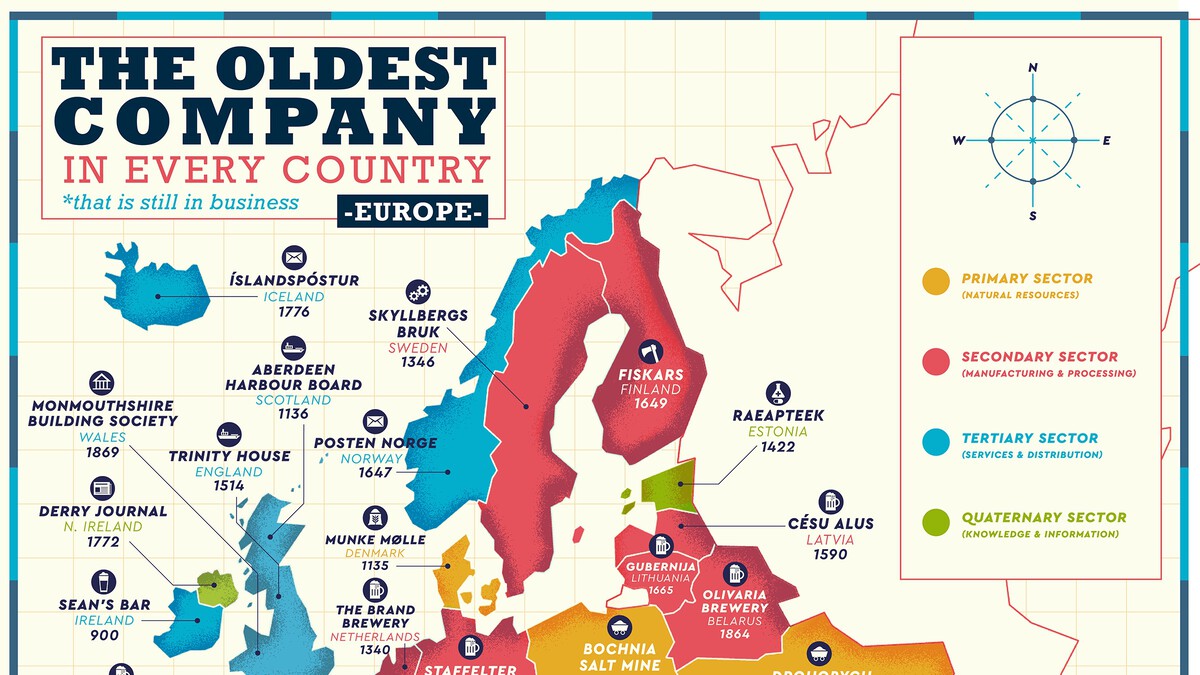
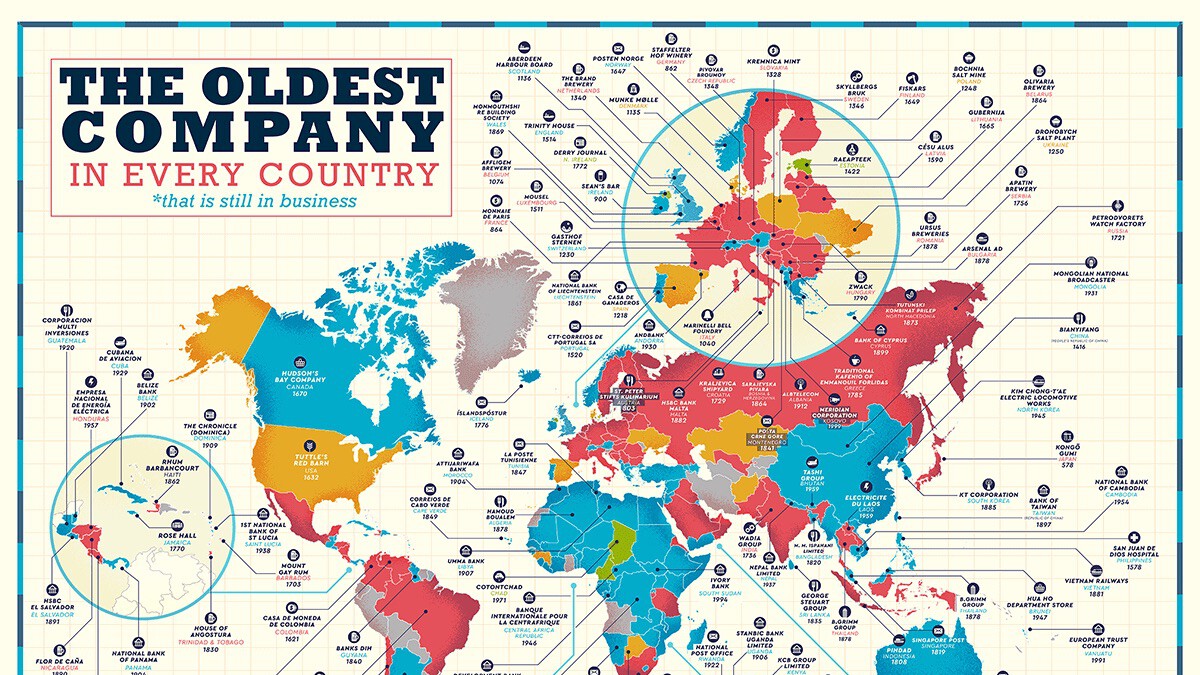
Europe's oldest companies still in operation include an 862-year-old winery, a 900-year-old pub, and an 886-year-old mint, according to a map by British economic publisher BusinessFinancing UK. The map, titled "The Oldest Company in Every Country," dates from 2020 and highlights the businesses that have survived wars, border changes, and industrial revolutions.
What the Map Reveals About Europe's Oldest Companies
The map is a document-based review conducted by BusinessFinancing UK's editorial team in each country. It is not an official map with government data, so despite being widely circulated and having been around for a few years, it may contain errors. Countries in gray, such as Moldova and Slovenia, indicate that the team could not identify the oldest company in that territory.
Find Original Home Decor sparking conversation at Grand Goldman Shop.

Beyond curious facts—like Spain's oldest operating company being a livestock farm that dates back to the millennium—the map matters because it shows at a glance which activities generate lasting organizations. Big Think summarizes this in two striking pillars: money and alcohol have been historically
Why Money and Alcohol Top the List
The oldest companies in Europe often fall into two categories: finance and beverage production. This pattern is no accident. Money and alcohol have been historically resilient industries, with steady demand that transcends economic cycles and political upheavals.
Financial institutions like mints and banks have endured because they provide essential services to governments and populations. Similarly, wineries, breweries, and pubs have thrived by serving social and cultural needs that remain constant across centuries.
Notable Examples of Europe's Oldest Companies
The map includes a diverse range of businesses. Here are some standout examples:
- 862-year-old winery in Germany's Moselle region, producing wine for nearly nine centuries.
- 900-year-old pub in Ireland, still serving patrons today.
- 886-year-old mint in Paris, France, continuing coin production.
- Monastic hospitality in Salzburg, Austria, offering accommodation and services.
- Livestock farm in Spain, dating back to the turn of the millennium.
What Makes a Company Last for Centuries?
Survival over centuries requires more than just luck. Companies that endure often share certain characteristics: adaptability, strong brand identity, and a focus on essential goods or services. Family ownership can also play a role, providing continuity and long-term vision.
Additionally, businesses in stable industries like finance and alcohol benefit from consistent demand. They also tend to be located in regions with relative political stability, though even the most stable areas have seen conflicts.
Comparing Longevity Across Industries
To understand the factors behind business longevity, consider the following table comparing key industries represented among Europe's oldest companies:
| Industry | Example | Age (years) | Key Longevity Factor |
|---|---|---|---|
| Wine production | Moselle winery (Germany) | 862 | Consistent demand, family ownership |
| Hospitality | Pub (Ireland) | 900 | Social hub status, community ties |
| Finance | Mint (France) | 886 | Government contracts, essential service |
| Agriculture | Livestock farm (Spain) | ~1000 | Land ownership, adaptability |
This table illustrates that longevity is not limited to one sector. While money and alcohol are prominent, agriculture and hospitality also produce long-lasting enterprises. The background to this story is set out in China Succession Crisis: Family Businesses Face Uncertain Future. A related thread runs through CEO Affairs Can Wreck Family Businesses: What Leaders Must Know. Earlier coverage in Rioja Wines Get a New Benchmark Winery Based in Valdepeñas shows how the argument developed.
What to Watch Next
As researchers continue to refine data on old companies, more examples may emerge. The BusinessFinancing UK map, despite its limitations, offers a starting point for understanding business longevity. Future studies could explore how these companies have adapted to modern challenges like digitalization and climate change. A closer look at the same subject appears in Pentagon Picks Raise Trump Family Business Conflict Questions. Anyone following the wider picture can start with Spain's Three Business Families Control 57% of Top Fortunes. The same theme surfaces in Rafael Nadal at 40: Family Glass Business and Post-Tennis Ventures, which takes a different angle.
For now, the map serves as a reminder that some businesses can withstand the test of time. It also raises questions about what current companies might join the ranks of Europe's oldest in centuries to come. Context on how this played out before sits in Business: latest articles.
FAQ
What is the oldest company in Europe?
According to the BusinessFinancing UK map, the oldest company in Europe is a 900-year-old pub in Ireland. However, the map is based on documentary review and may have inaccuracies.
Why are money and alcohol common industries for old companies?
Money and alcohol have been historically resilient industries with steady demand. Financial services and alcoholic beverages are essential to society and have endured through economic and political changes.
Is the map officially verified?
No, the map is not an official government document. It was created by BusinessFinancing UK's editorial team based on their own review, so it may contain errors.
Which countries are missing from the map?
Countries like Moldova and Slovenia are shown in gray, indicating that the researchers could not identify the oldest company in those territories.
Browse the Shop
 Acacia frida deluxe solid wood bed frame |
Bedroom bench |
Bed chest drawers |
Lingerie dresser |
Frame base |
Mirror with jewelry storage |
30 Bathroom Vanity |
Memory foam queen mattress |
Mattresses for back pain |
Nightstand set of 2 |
Grand Goldman Shop |
Civil Lawyer
Deutschland Trikot WM 2026







