

China's Linghang tunnel boring machine has completed its record-breaking drive under the Yangtze River, marking a major milestone for the Chongming-Taicang tunnel and the country's high-speed rail ambitions.
According to CCTV, the machine finished an 11-kilometer underwater section after 23 months of continuous excavation. The breakthrough brings the Shanghai-Nanjing high-speed rail corridor one step closer to reality.
Find Original Home Decor sparking conversation at Grand Goldman Shop.

What Happened: Linghang's Record Drive
The Linghang TBM began its journey on April 29, 2024, from Chongming Island in Shanghai. After nearly two years of tunneling, it emerged at Taicang in Jiangsu Province, having crossed beneath the Yangtze River and passed the southern dike.
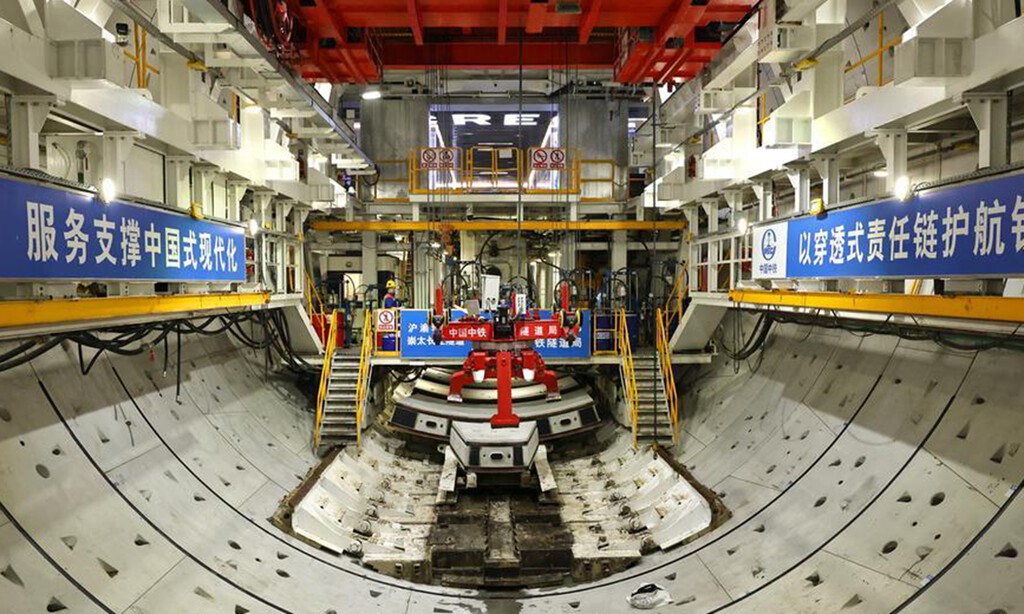
The 11-kilometer underwater bore is a key component of the 14.25-kilometer Chongming-Taicang tunnel. This tunnel forms part of the Shanghai-Nanjing section of the larger Shanghai-Chongqing-Chengdu high-speed rail corridor.
The completion of the subaqueous section is significant because it demonstrates China's growing expertise in large-scale underground engineering. The machine had to navigate soft riverbed soils and high water pressure, challenges that require advanced technology and careful planning.
Why It Matters: Engineering and Connectivity
China has spent years pushing the boundaries of infrastructure engineering, and the Linghang TBM is the latest example. The country is not just building more—it is building in increasingly difficult conditions, from deep underwater tunnels to high-altitude railways.
This project matters for two main reasons. First, it showcases the technical capability of Chinese engineers and machinery. The Linghang TBM is a domestically developed machine, reflecting China's push for self-sufficiency in high-tech equipment.
Second, the tunnel will enhance connectivity in the Yangtze River Delta, one of China's most economically dynamic regions. Once completed, the high-speed rail line will reduce travel times between Shanghai and Nanjing, boosting business and tourism.
- Record-breaking bore: Linghang excavated over 11 kilometers continuously under the Yangtze River.
- Timeframe: The drive took 23 months, starting April 29, 2024.
- Project scale: The Chongming-Taicang tunnel is 14.25 kilometers long.
- Strategic corridor: Part of the Shanghai-Chongqing-Chengdu high-speed rail line.
- Technical feat: Overcame soft riverbed and high water pressure challenges.
Inside the Chongming-Taicang Tunnel Project
The Chongming-Taicang tunnel is a critical link in the Shanghai-Nanjing high-speed rail segment. It connects Chongming Island, a growing ecological and residential area, to Taicang in Jiangsu Province.
The tunnel's total length of 14.25 kilometers includes the 11-kilometer underwater section just completed. The remaining portion includes approach sections and the southern dike crossing, which the TBM has already passed.
This infrastructure is designed to support high-speed trains operating at speeds of up to 350 kilometers per hour. The tunnel's completion will allow trains to cross the Yangtze without disrupting river traffic or the surrounding environment.
Technical Specifications at a Glance
| Specification | Detail |
|---|---|
| Machine name | Linghang |
| Excavation length | Over 11 kilometers (underwater section) |
| Start date | April 29, 2024 |
| Duration | 23 months |
| Total tunnel length | 14.25 kilometers |
| Location | Under the Yangtze River, from Chongming Island to Taicang |
| Part of | Shanghai-Nanjing high-speed rail corridor |
Who Is Affected: Passengers, Businesses, and the Environment
The completion of this tunnel will directly benefit millions of residents in the Yangtze River Delta. Faster rail connections between Shanghai, Chongming, and Taicang will make commuting and travel more efficient.
Businesses along the corridor can expect improved logistics and access to larger markets. The high-speed rail line is also expected to spur economic development in less-connected areas like Chongming Island.
From an environmental perspective, tunneling under the Yangtze minimizes disruption to the river ecosystem compared to building a bridge. It also reduces noise and visual impact on surrounding communities.
What to Watch Next: Remaining Works and Future Milestones
With the underwater section complete, the Linghang TBM has emerged at Taicang. The next steps likely involve finishing the remaining tunnel sections, installing track and systems, and conducting rigorous testing. The background to this story is set out in China's Jiaoping No.1: The World's Largest Tunnel Boring Machine. A related thread runs through Mayrit Tunnel Boring Machine: 5,200 Meters Under Madrid in Two Years. Earlier coverage in Mayrit Tunnel Boring Machine Crosses Under Manzanares and M-30 shows how the argument developed.
The Chongming-Taicang tunnel is just one part of the broader Shanghai-Chongqing-Chengdu high-speed rail corridor, which aims to connect major cities across central and western China. Once fully operational, it will significantly cut travel times and boost regional integration. A closer look at the same subject appears in China Builds Record-Breaking Undersea High-Speed Rail Tunnel. Anyone following the wider picture can start with Madrid Metro Line 11 Tunnel Boring Machine Advances Rapidly. The same theme surfaces in Genoa's 16-Meter Tunnel Boring Machine: A Subsea Solution to Traffic, which takes a different angle.
China's continued investment in mega-infrastructure projects like this one signals its long-term commitment to domestic connectivity and technological leadership. The Linghang TBM's successful drive is a testament to the scale and ambition of these efforts. Context on how this played out before sits in China's Three Gorges Dam Ship Elevator: How the Yangtze Became Navigable. A companion piece, Australia's 137-Ton Tunnel Boring Machine Needs 152-Wheel Truck, approaches the same subject from another angle.
FAQ
What is the Linghang tunnel boring machine?
Linghang is a Chinese tunnel boring machine (TBM) that recently completed an 11-kilometer underwater excavation under the Yangtze River. It was used to build the Chongming-Taicang tunnel, part of a high-speed rail corridor.
How long did it take Linghang to bore under the Yangtze?
The machine started on April 29, 2024, and finished the underwater section after 23 months of continuous work, according to CCTV.
Why is the Chongming-Taicang tunnel important?
It is a key link in the Shanghai-Nanjing high-speed rail line, which will improve connectivity in the Yangtze River Delta and support trains at speeds up to 350 km/h. The tunnel also avoids disrupting river traffic and the environment.
What happens next for the project?
With the underwater bore complete, remaining works include finishing the tunnel, laying tracks, and testing. The full corridor is expected to enhance regional integration and reduce travel times across eastern and central China.
Browse the Shop
 Acacia frida deluxe solid wood bed frame |
Bedroom bench |
Bed chest drawers |
Lingerie dresser |
Frame base |
Mirror with jewelry storage |
30 Bathroom Vanity |
Memory foam queen mattress |
Mattresses for back pain |
Nightstand set of 2 |
Grand Goldman Shop |
Civil Lawyer
Deutschland Trikot WM 2026







