

The idea that a day has exactly 24 hours is a convenient fiction that most of us accept without question. In reality, the 24-hour day is an average, and Earth's rotation is far more complex than a simple spin on its axis.
According to the Spanish Royal Academy's dictionary, a day is the "period of 24 hours, which corresponds approximately to the time it takes Earth to complete one rotation on its axis." The key word here is "approximately." That approximation hides a fascinating astronomical reality.
Find Original, High-end Home Decor that spark conversation at Grand Goldman Shop.
What Is a Day, Really?
We've grown accustomed to treating the 24-hour day as an absolute truth. But those 24 hours are a mean value: if you measure the time between two solar noons, most days last slightly more or slightly less than 24 hours.
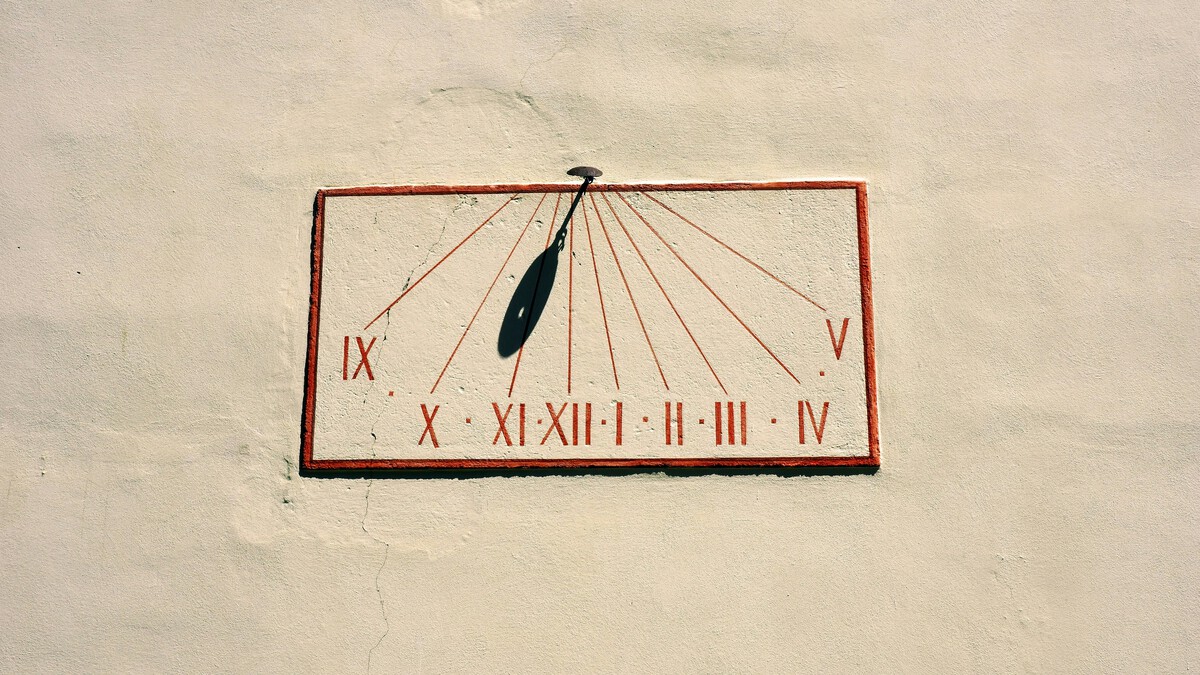
If a day were simply the time it takes Earth to rotate 360° on its axis, it would last 23 hours, 56 minutes, and 4.09 seconds. This is called the sidereal day, measured against the stars rather than the Sun.
But Earth doesn't just spin in place; it also orbits the Sun, moving nearly one degree per day. For the Sun to return to the same point in the sky, our planet must rotate that extra degree—a little over 361° in total. That takes about four additional minutes.
The Solar Day vs. the Sidereal Day
This is where the conventional definition of a day comes from: the mean solar day, which equals 86,400 seconds (24 hours) and forms the basis of civil time. It is the average of the true solar day—the actual time between consecutive passages of the Sun across the meridian.
Throughout the year, the true solar day can be about 20 seconds shorter or 30 seconds longer than the average. In astronomy, this variation is well known and accounted for in precise timekeeping.
So why do we stick with 24 hours? Because it's practical. Our clocks and calendars need a stable unit, and the mean solar day provides that consistency. But it's important to recognize that this is a human construct, not a fixed law of nature.
Why Earth's Rotation Isn't Constant
Earth's rotation is influenced by a variety of factors, from the gravitational pull of the Moon and Sun to the redistribution of mass within the planet. Even the movement of air and water can subtly affect the length of a day.
Scientists use techniques like Very Long Baseline Interferometry to measure these tiny variations. Over time, the length of a day can change by milliseconds, and these changes accumulate.
For example, the Moon's tidal forces are gradually slowing Earth's rotation, lengthening the day by about 1.7 milliseconds per century. It's a tiny effect, but over millions of years, it adds up.
How We Keep Time in a Non-24-Hour World
To keep our clocks in sync with Earth's irregular rotation, we use Coordinated Universal Time (UTC), which is based on atomic clocks but adjusted with leap seconds to stay close to solar time.
Leap seconds are added occasionally to account for the discrepancy between atomic time and Earth's rotation. Without them, our clocks would gradually drift away from the natural day-night cycle. The background to this story is set out in Science: latest articles.
This system works well, but it's a reminder that our timekeeping is a careful negotiation between human precision and planetary reality. A related thread runs through Amazon's Foldable Prefab House: Bedroom, Kitchen, Bath for €6,299.
Key Takeaways
- The 24-hour day is an average, not an exact measure of Earth's rotation.
- A sidereal day (rotation relative to stars) is about 23 hours, 56 minutes.
- The mean solar day is 24 hours, but true solar days vary by up to 30 seconds.
- Earth's rotation is gradually slowing due to tidal forces.
- Leap seconds help keep atomic time aligned with solar time.
Comparing Day Lengths
| Type of Day | Duration | Reference Point |
|---|---|---|
| Sidereal day | 23h 56m 4.09s | Distant stars |
| Mean solar day | 24h (86,400s) | Average Sun position |
| True solar day | ~24h ± 20-30s | Actual Sun position |
FAQ
Why is a day not exactly 24 hours?
A day is not exactly 24 hours because Earth's rotation relative to the Sun varies throughout the year. The 24-hour day is an average of the true solar day, which can be slightly longer or shorter depending on Earth's orbital position and speed.
What is the difference between a sidereal day and a solar day?
A sidereal day is the time it takes Earth to rotate 360° relative to the stars, about 23 hours and 56 minutes. A solar day is the time between successive solar noons, which averages 24 hours because Earth must rotate a little extra to bring the Sun back to the same position.
Does Earth's rotation speed change over time?
Yes, Earth's rotation speed is gradually slowing due to tidal friction from the Moon and Sun. This lengthens the day by about 1.7 milliseconds per century. Other factors, like the redistribution of mass, can cause short-term variations as well.
How do leap seconds relate to the length of a day?
Leap seconds are added to Coordinated Universal Time (UTC) to keep atomic clocks synchronized with Earth's rotation. Because Earth's rotation is not perfectly constant, leap seconds ensure that our clocks stay aligned with the solar day.
Browse the Shop
 Acacia frida deluxe solid wood bed frame |
Bedroom bench |
Bed chest drawers |
Lingerie dresser |
Frame base |
Mirror with jewelry storage |
30 Bathroom Vanity |
Memory foam queen mattress |
Mattresses for back pain |
Nightstand set of 2 |
Grand Goldman Shop |
Civil Lawyer
Deutschland Trikot WM 2026










