

Overtourism in Europe is starkly illustrated by a new map that reveals how tourist nights are concentrated in specific regions, with Mediterranean Spain among the hardest-hit areas. The map, created by data analyst Josep Ferrer, highlights the uneven distribution of tourism across the continent.
Using 2025 Eurostat data on nights spent in registered accommodations, the map shows that nearly 25% of the 3.28 billion tourist nights occur in just 28 regions. Another 25% is spread across 74 regions, leaving the remaining 50% distributed among 1,145 regions.
Find Original Home Decor sparking conversation at Grand Goldman Shop.

What the Map Shows: Extreme Concentration of Tourist Nights
The visualization orders regions from most to least nights and colors them based on their share of total nights. This reveals a striking pattern: half of all tourist nights in Europe are concentrated in only 102 out of 1,247 regions.
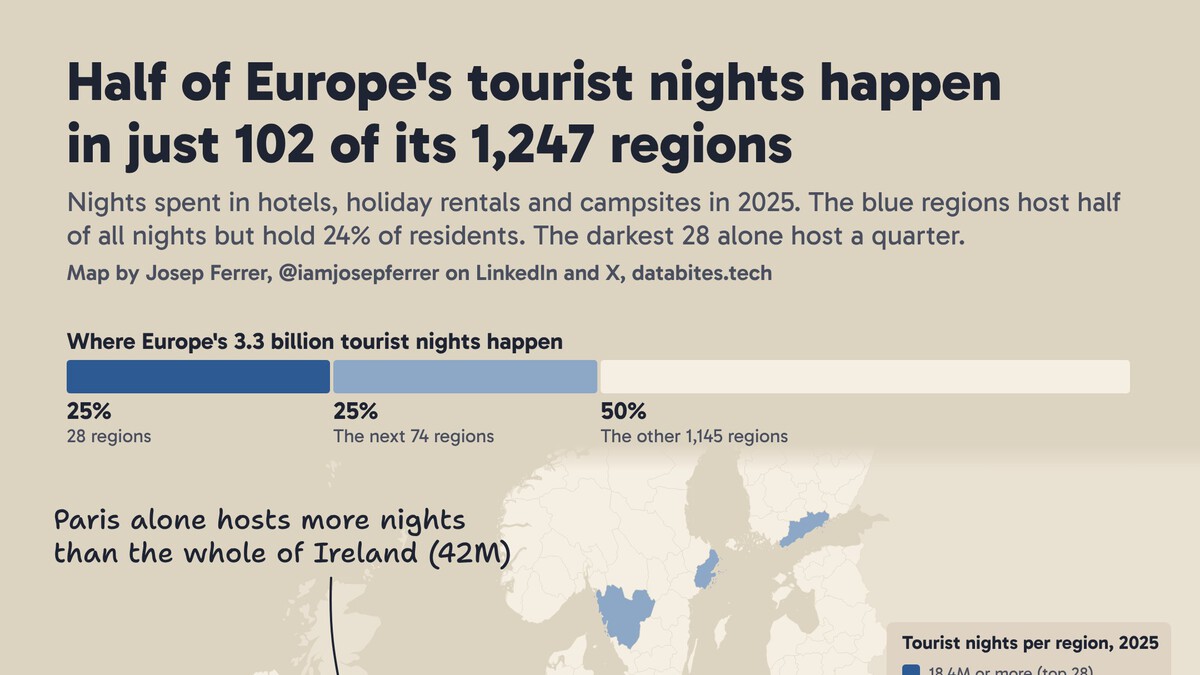
This means that a small number of destinations bear the brunt of tourism, while many others see relatively few visitors. The map underscores the challenge of overtourism, defined by the World Tourism Organization as when tourism's impact on a municipality significantly affects residents' quality of life, often negatively.
Why Mediterranean Spain Is a Hotspot
Mediterranean Spain stands out as a prime example of this concentration. Municipalities like Benidorm, with its high-rise hotels and packed beaches, are classic cases of overtourism. In contrast, places like Almazán in Soria see far fewer tourists, highlighting the disparity within Spain itself.
The map shows that coastal areas, islands, historic capitals, and Alpine valleys are the primary magnets for tourists. These regions often struggle with overcrowding, strained infrastructure, and housing pressures, while other areas remain under-visited.
The Data Behind the Map
The analysis is based on Eurostat data for 2025, which records nights spent in registered accommodations. However, it's important to note that this data may understate the true scale of tourism, as it excludes unregistered accommodations like short-term rentals.
Ferrer's method involves sorting regions by nights and summing them until reaching 25% and 50% thresholds. This approach allows for a clear visual representation of tourism concentration across Europe.
Key Takeaways from the Overtourism Map
- Half of Europe's tourist nights are concentrated in just 102 of 1,247 regions.
- Mediterranean Spain, including Benidorm, is a major overtourism hotspot.
- Eurostat data on registered accommodations may underestimate actual tourism levels.
- Overtourism can negatively impact residents' quality of life in affected areas.
- The map highlights the need for sustainable tourism management across Europe.
Comparing Regional Tourism Concentration
The table below summarizes the distribution of tourist nights across European regions, based on the map's findings. It shows how a small number of regions account for a large share of total nights.
| Share of Total Nights | Number of Regions | Percentage of Regions |
|---|---|---|
| First 25% | 28 | 2.2% |
| Second 25% | 74 | 5.9% |
| Remaining 50% | 1,145 | 91.8% |
This table illustrates the extreme inequality in tourism distribution, with a tiny fraction of regions handling half of all tourist nights.
Implications for Overtourism and Sustainable Travel
The map's findings have significant implications for policymakers and destination managers. Overtourism can lead to environmental degradation, housing shortages, and resident dissatisfaction. In hotspots like Benidorm, measures such as visitor caps or tourism taxes are being debated.
Meanwhile, under-visited regions could benefit from promotional efforts to spread tourism more evenly. However, this requires careful planning to avoid creating new overtourism hotspots. The background to this story is set out in Europe Tourism Map Reveals Overtourism Pressure on 10% of Territory. A related thread runs through European Tourist Tax Guide: Italy Hotspots Lead the Way. Earlier coverage in Spain's Heatwave Season Begins: Mediterranean Regions Face Growing Risk shows how the argument developed.
What to Watch Next
As tourism continues to recover post-pandemic, the concentration of visitors in certain areas is likely to persist. Monitoring Eurostat data and local initiatives will be key to understanding how destinations manage overtourism. A closer look at the same subject appears in Big Sur Overtourism Crisis: Wildfires and Tourist Deaths. Anyone following the wider picture can start with Spain Rotates Clockwise as Mediterranean Nears Closure, Study Finds. The same theme surfaces in Guadix Cave Houses: Europe's Climate Refuge for Tourists, which takes a different angle.
For now, the map serves as a powerful tool to visualize the challenge and spark conversation about sustainable tourism in Europe. Context on how this played out before sits in Japan's Hotel Staffing Crisis: A Natural Brake on Overtourism. A companion piece, Galapagos Islands Face Overtourism as Airbnb Rentals Surge, approaches the same subject from another angle.
FAQ
What is overtourism?
Overtourism occurs when the impact of tourism on a destination significantly affects residents' quality of life, often negatively. It is characterized by overcrowding, strained infrastructure, and environmental pressures.
Which regions in Europe are most affected by overtourism?
Mediterranean coastal areas, islands, historic capitals, and Alpine valleys are among the most affected. In Spain, Benidorm is a notable example of high tourism concentration.
How was the map created?
The map was created by Josep Ferrer using 2025 Eurostat data on nights spent in registered accommodations. Regions were ordered by nights and colored based on their share of total nights.
Why does the map show only registered accommodations?
The map uses data on registered accommodations, which may exclude unregistered short-term rentals. This means the actual concentration of tourists could be even higher than depicted.
Browse the Shop
 Acacia frida deluxe solid wood bed frame |
Bedroom bench |
Bed chest drawers |
Lingerie dresser |
Frame base |
Mirror with jewelry storage |
30 Bathroom Vanity |
Memory foam queen mattress |
Mattresses for back pain |
Nightstand set of 2 |
Grand Goldman Shop |
Civil Lawyer
Deutschland Trikot WM 2026







