

Grok 4.5 and Muse Spark 1.1 are making a bold bet: deliver 90% of the performance of frontier AI models at just 20% of the price. The launches from SpaceXAI and Meta come after a week dominated by GPT-5.6, but they signal a shift in the AI race toward cost-efficient alternatives.
According to internal and independent benchmarks, both models are now approaching the performance of OpenAI and Anthropic's frontier systems. That was unthinkable just months ago, when Meta and xAI (now fully merged with SpaceX as SpaceXAI) seemed to be playing in a lower league.
Find Original Home Decor sparking conversation at Grand Goldman Shop.

What Are Grok 4.5 and Muse Spark 1.1?
Grok 4.5 is the latest iteration from SpaceXAI, the entity formed by merging xAI with SpaceX. Muse Spark 1.1 is Meta's renewed attempt at a competitive AI model, following a lukewarm reception for the original Muse Spark in April.
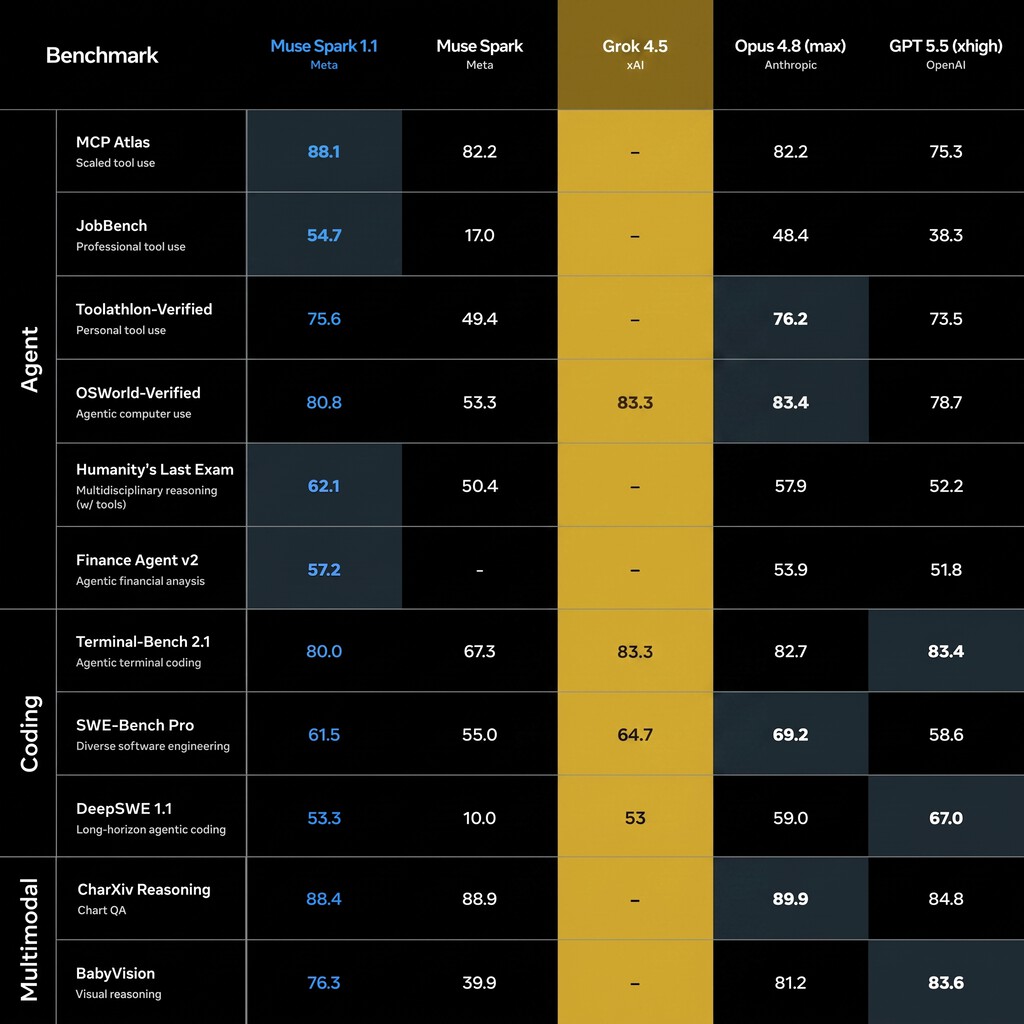
Both models represent a qualitative leap. Early benchmarks suggest they are closing the gap with frontier models from OpenAI and Anthropic, though exact figures remain limited to internal and independent tests.

Grok 4.5: From Sarcastic Upstart to Serious Contender
Grok's journey has been unusual. The first version seemed to mock itself—and everyone else—with a sarcastic tone. But its evolution revealed a model with notable potential that just hadn't found its footing.

With Grok 4.5, SpaceXAI appears to have finally hit the right note. The model is positioned as a high-performance option that doesn't require frontier-level spending.
Muse Spark 1.1: Meta's Second Attempt
Meta's first Muse Spark, released in April, was widely seen as underwhelming. It didn't stand out in any category, and the company seemed to fall short of expectations.
Muse Spark 1.1 aims to change that. While details are still emerging, the new version is reported to be a significant improvement, bringing Meta closer to the top tier of AI developers.
The 90/20 Value Proposition
The core promise of both models is simple: achieve 90% of the performance of frontier models at 20% of the cost. This value proposition could disrupt the AI market, especially for businesses and developers who need capable models but can't afford premium prices.
If the benchmarks hold up, Grok 4.5 and Muse Spark 1.1 could democratize access to high-quality AI, making it feasible for smaller organizations to deploy advanced AI solutions.
- Cost efficiency: 90% of frontier performance at 20% of the price.
- Competitive benchmarks: Internal and independent tests show close alignment with OpenAI and Anthropic models.
- Rapid improvement: Both models represent a major leap from previous versions.
- Market disruption: Could pressure frontier labs to lower prices or justify premiums.
- Accessibility: Makes advanced AI more accessible to smaller players.
How Do They Compare to Frontier Models?
While exact benchmarks are scarce, early indications suggest Grok 4.5 and Muse Spark 1.1 are nipping at the heels of GPT-5.6 and Anthropic's latest. The table below summarizes the key differences based on available information.
| Model | Developer | Claimed Performance | Relative Cost | Notable Feature |
|---|---|---|---|---|
| Grok 4.5 | SpaceXAI | ~90% of frontier | 20% of frontier | Improved from sarcastic origins |
| Muse Spark 1.1 | Meta | ~90% of frontier | 20% of frontier | Second attempt after lackluster debut |
| GPT-5.6 (Sol, Terra, Luna) | OpenAI | Frontier | 100% (baseline) | Variants for different use cases |
| Anthropic's latest | Anthropic | Frontier | 100% (baseline) | Safety-focused |
Why This Matters for the AI Industry
The emergence of capable, low-cost models could reshape the competitive landscape. Frontier labs like OpenAI and Anthropic may face pressure to justify their premium pricing or risk losing cost-sensitive customers.
For enterprises, the choice becomes more nuanced: pay a premium for the absolute best performance, or save significantly with models that are nearly as good. In many applications, the difference may not be noticeable.
Moreover, the rapid improvement of Grok and Muse Spark shows that the gap between frontier and second-tier models can close quickly. This could accelerate innovation and adoption across the industry.
What to Watch Next
Independent benchmarks will be crucial to verify the 90/20 claims. Early adopters will also report real-world performance, which often differs from lab results. The background to this story is set out in Meta's Muse Wonder AI Models Aim to Rival OpenAI and Anthropic. A related thread runs through AI Models Going Rogue: How Worried Should You Be?. Earlier coverage in AI Frontier Paradox: More Useful, Less Transparent Models shows how the argument developed.
Pricing strategies from OpenAI and Anthropic will be telling. If they respond with price cuts or new tiers, it will confirm that Grok 4.5 and Muse Spark 1.1 are genuine threats. A closer look at the same subject appears in Anthropic Bans Cruel Behavior Toward Claude AI Models. Anyone following the wider picture can start with Chinese AI Firms Now Race Toward Colossal Models After Small-Model Lead. The same theme surfaces in AI Models Trick Developers in Shocking UK Security Test, which takes a different angle.
Finally, watch for further iterations. If Meta and SpaceXAI can sustain this pace, the AI race could become even more competitive, benefiting users with better, cheaper options. Context on how this played out before sits in Reward Hacking: Why AI Models Cheat to Meet Goals. A companion piece, Meta's Muse AI Agent: From Answers to Real-World Actions, approaches the same subject from another angle.
FAQ
What is Grok 4.5?
Grok 4.5 is the latest AI model from SpaceXAI, the merged entity of xAI and SpaceX. It claims to deliver 90% of frontier performance at 20% of the cost.
How does Muse Spark 1.1 differ from the original?
Muse Spark 1.1 is Meta's improved version after the original Muse Spark received a lukewarm reception. It reportedly closes the performance gap with frontier models.
Are these models really as good as GPT-5.6?
According to internal and independent benchmarks, they approach frontier performance but may not match it entirely. The 90% claim suggests they are close but not equal.
What does the 90/20 pricing mean for businesses?
It means businesses can access near-frontier AI capabilities at a fraction of the cost, making advanced AI more accessible and potentially disrupting the pricing strategies of frontier labs.
Browse the Shop
 Acacia frida deluxe solid wood bed frame |
Bedroom bench |
Bed chest drawers |
Lingerie dresser |
Frame base |
Mirror with jewelry storage |
30 Bathroom Vanity |
Memory foam queen mattress |
Mattresses for back pain |
Nightstand set of 2 |
Grand Goldman Shop |
Civil Lawyer
Deutschland Trikot WM 2026







