

When it comes to the best European cities for quality of life and cost, Malaga and Valencia have emerged as standout destinations, according to a new ranking. The analysis, based on Numbeo data, highlights how mid-sized cities in Southern and Central-Eastern Europe offer living standards comparable to pricier counterparts but at a fraction of the cost.
The ranking was created by financial analyst Valerii Emelianov, who currently lives in Porto. His scatterplot of 125 European cities evaluates the balance between quality of life and affordability, revealing that cities like Malaga and Valencia are particularly attractive for remote workers and digital nomads seeking a high standard of living without breaking the bank.
Find Original, High-end Home Decor that spark conversation at Grand Goldman Shop.
Why Malaga and Valencia Stand Out
Malaga and Valencia both boast a high quality of life relative to their cost of living. With excellent healthcare, climate, and infrastructure, these Spanish cities offer a compelling alternative to more expensive European capitals. The ranking underscores that a euro stretches further in these locales, making them ideal for those with limited budgets.
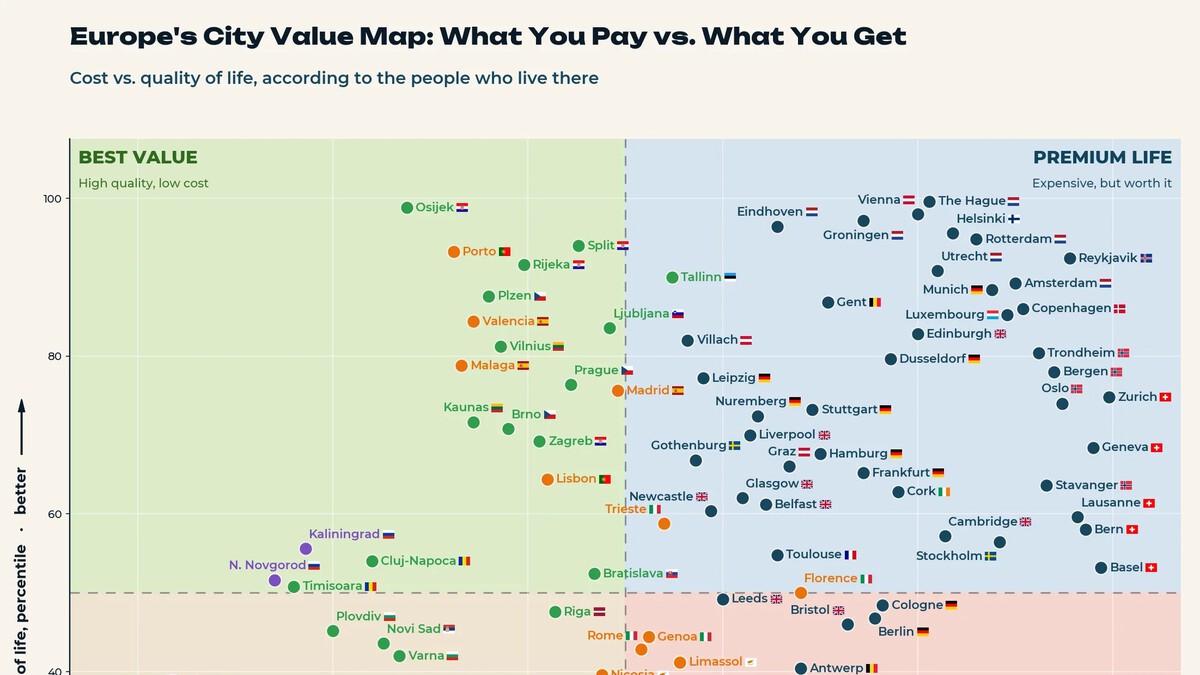
For digital nomads, the combination of affordable housing, good internet connectivity, and vibrant expat communities is a major draw. The analysis also notes that intangible factors—such as access to public healthcare and safety—play a crucial role in the overall value proposition.
How the Ranking Was Compiled
Emelianov's ranking uses data from Numbeo, a collaborative platform where users contribute cost-of-living and quality-of-life statistics. The scatterplot positions cities based on two axes: quality of life and cost of living. Cities in the top-left quadrant—high quality, low cost—are considered the sweet spot.
While income levels are not directly factored in, the ranking implicitly considers purchasing power by juxtaposing living costs with quality-of-life indicators. This approach reveals that many mid-sized cities in Southern and Central-Eastern Europe outperform their pricier Western European counterparts.
Key Takeaways for Remote Workers
- Affordability meets quality: Malaga and Valencia offer a high quality of life at a lower cost than cities like Paris or London.
- Healthcare matters: Access to public healthcare can significantly impact overall value, as out-of-pocket expenses can erode savings.
- Remote work enables migration: The ability to work remotely allows individuals to choose cities based on lifestyle and cost, not just job location.
- Mid-sized cities shine: Smaller cities in Southern and Central-Eastern Europe often provide better value than larger metropolises.
- Data-driven insights: Tools like Numbeo help quantify intangible factors, making comparisons more objective.
Comparison of Top Cities
The table below compares Malaga and Valencia with two other popular European cities for remote workers, based on approximate Numbeo data. It illustrates the trade-offs between cost and quality of life.
| City | Quality of Life Index | Cost of Living Index | Purchasing Power |
|---|---|---|---|
| Malaga | High | Moderate | Good |
| Valencia | High | Moderate | Good |
| Lisbon | High | Moderate to High | Fair |
| Berlin | High | High | Fair |
Note: Indices are relative and based on Numbeo user-contributed data. Higher quality of life and lower cost of living are preferable. The longer history behind the story is traced in Airbus U740 Valkyrie: Germany's Plan B for Fighter Jet Gap.
Implications for the Future of Work
The ranking reflects a broader trend: the rise of remote work is enabling a new type of migration. Workers are no longer tethered to expensive urban centers and can choose cities that offer a better quality of life for less. This shift could reshape urban economies, as cities like Malaga and Valencia attract talent and investment. The background to this story is set out in Ebike Parking Solutions in London: Lessons from European Cities. A related thread runs through Cost of Living Australia: Rate Rise Sparks Household Crisis. Earlier coverage in Nomatic Travel Bag Review: For Digital Nomads' Arsenal shows how the argument developed.
However, as demand increases, housing costs may rise, potentially eroding the very affordability that made these cities attractive. Policymakers and city planners will need to balance growth with maintaining affordability to sustain their appeal. A closer look at the same subject appears in European City Break Tips: Share Your Hidden Gem Destinations. Anyone following the wider picture can start with Hidden European City Break Gems: Insider Travel Tips. The same theme surfaces in Inflation Surge Heightens Burnham's Cost of Living Challenge, which takes a different angle.
For now, Malaga and Valencia remain prime examples of how mid-sized European cities can offer a compelling mix of quality and cost. As remote work continues to evolve, such rankings will become increasingly important for individuals seeking to optimize their lifestyle and finances. Context on how this played out before sits in Woolworths Profit Surge Amid Cost-of-Living Crisis. A companion piece, Cormann Warns Against Populist Policies for Cost of Living, approaches the same subject from another angle.
FAQ
What makes Malaga and Valencia top choices for quality of life and cost?
Malaga and Valencia offer a high quality of life at a moderate cost, with excellent healthcare, climate, and infrastructure. They provide a better balance than many larger, more expensive European cities.
How was the ranking of European cities compiled?
The ranking was created by financial analyst Valerii Emelianov using data from Numbeo, a collaborative platform. It plots 125 cities based on quality of life and cost of living indices.
Why is this ranking relevant for digital nomads?
Digital nomads can work remotely and choose where to live based on lifestyle and cost. The ranking highlights cities where they can enjoy a high quality of life without spending as much, making remote work more sustainable.
What are the potential downsides of moving to these affordable cities?
As popularity grows, housing costs may increase, reducing affordability. Additionally, while salaries may be lower locally, remote workers earning foreign incomes are less affected.
Browse the Shop
 Acacia frida deluxe solid wood bed frame |
Bedroom bench |
Bed chest drawers |
Lingerie dresser |
Frame base |
Mirror with jewelry storage |
30 Bathroom Vanity |
Memory foam queen mattress |
Mattresses for back pain |
Nightstand set of 2 |
Grand Goldman Shop |
Civil Lawyer
Deutschland Trikot WM 2026










