

Anthropic's recent study on AI's economic impact suggests that white-collar workers—programmers, designers, financiers, and journalists—may face significant disruption, while trade workers like plumbers and electricians could benefit. The study introduces the Econ Scenario Explorer, a tool that models various AI advancement scenarios.
What the Anthropic Study Found
The study explores three scenarios based on variables like AI capabilities, adoption rates, autonomy, productivity gains, and job transition time. In the most substantial scenario, by 2030, AI could perform half of white-collar work tasks autonomously, doubling economic growth but potentially suppressing wages for knowledge workers.
Find Original, High-end Home Decor that spark conversation at Grand Goldman Shop.
Meanwhile, trades such as electrical work, nursing, and construction may see increased demand and wages as AI complements rather than replaces their roles—at least until robots master these physical jobs.
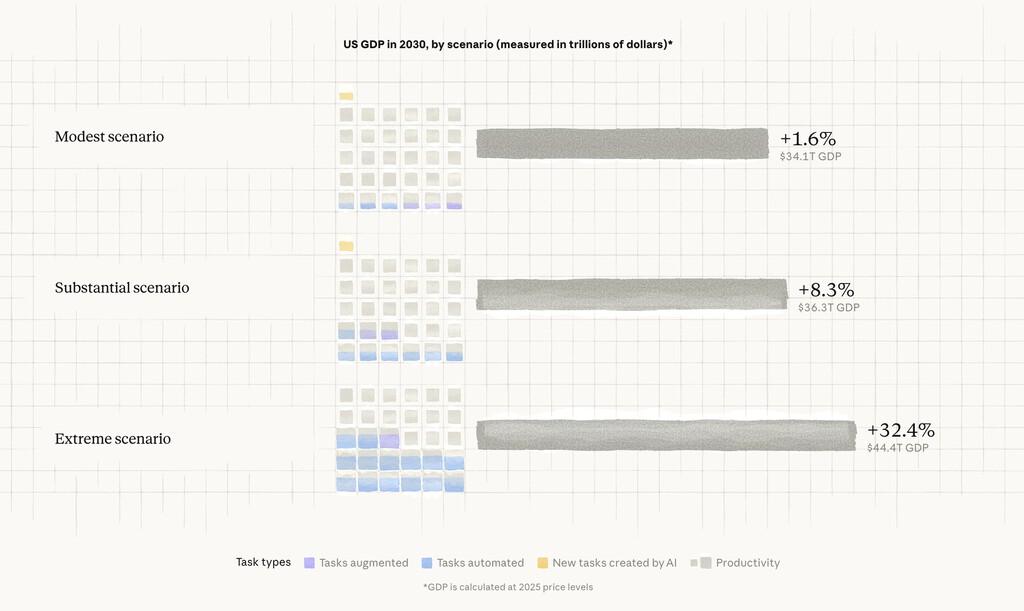
- AI could automate 50% of white-collar tasks by 2030 in a high-adoption scenario.
- Economic growth may double, but wage growth for knowledge workers could lag.
- Trade jobs like plumbing and electrical work are likely to benefit from AI advancements.
- The Econ Scenario Explorer allows users to test different AI impact variables.
- Job transition time is a critical factor in how smoothly economies adapt.
Why White-Collar Workers Should Pay Attention
White-collar roles are particularly vulnerable because AI excels at cognitive tasks. The study suggests that in a substantial scenario, AI could autonomously handle most tasks currently done by office workers, even if not fully adopted across all industries.
This doesn't mean mass unemployment overnight, but it does signal a shift in skill demand. Workers may need to adapt by focusing on tasks AI can't easily replicate, such as complex decision-making or interpersonal skills.
Impact on Wages and Job Security
While overall economic growth could accelerate, the distribution of gains may be uneven. The study indicates that wages for engineers, accountants, and other knowledge workers might stagnate or decline as AI reduces the value of routine cognitive labor.
Job security could also erode, with more tasks automated and fewer roles requiring human intervention. This puts pressure on workers to continuously upskill or transition to roles less susceptible to automation.
Trade Jobs: The Unexpected Winners
In contrast, trades like plumbing, electrical work, and nursing are poised to benefit. These jobs require physical dexterity and situational judgment that AI and robotics currently struggle to replicate.
As AI boosts productivity in other sectors, demand for trade services may rise due to increased economic activity. Moreover, an aging workforce in trades creates opportunities for new entrants. The background to this story is set out in Anthropic to Donate 5% of Shares to AI Job Impact Fund. A related thread runs through Amazon AI Impact: Jobs Displaced, Not Destroyed. Earlier coverage in AI's Impact on Jobs: Why We Accept the Oligarchs' Agenda shows how the argument developed.
| Job Category | AI Impact by 2030 (Substantial Scenario) | Wage Outlook |
|---|---|---|
| White-Collar (e.g., programming, design) | 50% of tasks automatable; high autonomy | Stagnant or declining |
| Trade Jobs (e.g., plumbing, electrical) | Low automation risk; complementary AI use | Increasing demand, potential wage growth |
| Healthcare (e.g., nursing) | Moderate automation of administrative tasks | Stable to growing |
How to Prepare for an AI-Driven Economy
For white-collar workers, the message is clear: adapt or risk obsolescence. Upskilling in AI management, creative problem-solving, and emotional intelligence can help future-proof careers. A closer look at the same subject appears in Slave Trade History: Evolving Understanding of Britain's Role. Anyone following the wider picture can start with AI Boom Economic Impact: Are Datacentres Worth. The same theme surfaces in AI Extinction Risk by 2030: Anthropic Researchers Warn, which takes a different angle.
For those considering career changes, trades offer a promising path with lower automation risk. But remember, as AI and robotics advance, even trades may eventually face disruption—so lifelong learning is key. Context on how this played out before sits in AI Climate Impact: Fossil Fuel Boost Outweighs Green Gains. A companion piece, AI Takeover in China: How Robotaxis Are Reshaping Jobs, approaches the same subject from another angle.
FAQ
What is the Econ Scenario Explorer?
It's a tool by Anthropic that lets users adjust variables like AI capabilities and adoption rates to model potential economic outcomes. It helps visualize how different AI trajectories could affect jobs and wages.
Will AI really take half of white-collar jobs by 2030?
The study presents this as a possible scenario under high AI capability and adoption, not a prediction. It's a warning to prepare for significant disruption in knowledge work.
Why are trade jobs less vulnerable to AI?
Trade jobs involve physical tasks and real-world problem-solving that current AI and robotics struggle with. They also require adaptability and human judgment, making them harder to automate.
What can workers do to protect themselves?
Focus on skills AI can't easily replicate, like creativity, emotional intelligence, and complex decision-making. Consider upskilling or transitioning to roles with lower automation risk, such as trades.
Browse the Shop
 Acacia frida deluxe solid wood bed frame |
Bedroom bench |
Bed chest drawers |
Lingerie dresser |
Frame base |
Mirror with jewelry storage |
30 Bathroom Vanity |
Memory foam queen mattress |
Mattresses for back pain |
Nightstand set of 2 |
Grand Goldman Shop |
Civil Lawyer
Deutschland Trikot WM 2026







