

Desertification in Europe is no longer a distant threat, and a new map from the European Commission's Joint Research Centre shows that half of Spain is on a path toward becoming desert. The map, which uses a harmonized methodology combining land cover, land productivity, aridity, and soil degradation data, classifies territory as either degraded arid land (red) or healthy arid land (green). The results are alarming: Mediterranean Europe fares poorly, with Spain among the hardest-hit countries.
The sense that it no longer rains as much as it did when you were a child, and that summers are hotter, is not just a suspicion. It is a measurable reality, and the map makes it visual. As climate change drives more frequent and intense weather events like DANAs (isolated high-altitude depressions), the land loses its ability to retain water, triggering a cascade of consequences from megafires to landscapes that increasingly resemble dry scrubland.
Find Original Home Decor sparking conversation at Grand Goldman Shop.

What the Desertification Map Shows
The Joint Research Centre's map is intuitive yet rigorous. It combines satellite data on land cover and productivity with aridity indices and soil degradation metrics to produce a clear picture of where land is healthy and where it is degrading. Red areas indicate degraded arid land, while green areas show healthy arid land. The Mediterranean basin, including Spain, Italy, Greece, and Portugal, stands out as a hotspot of degradation.
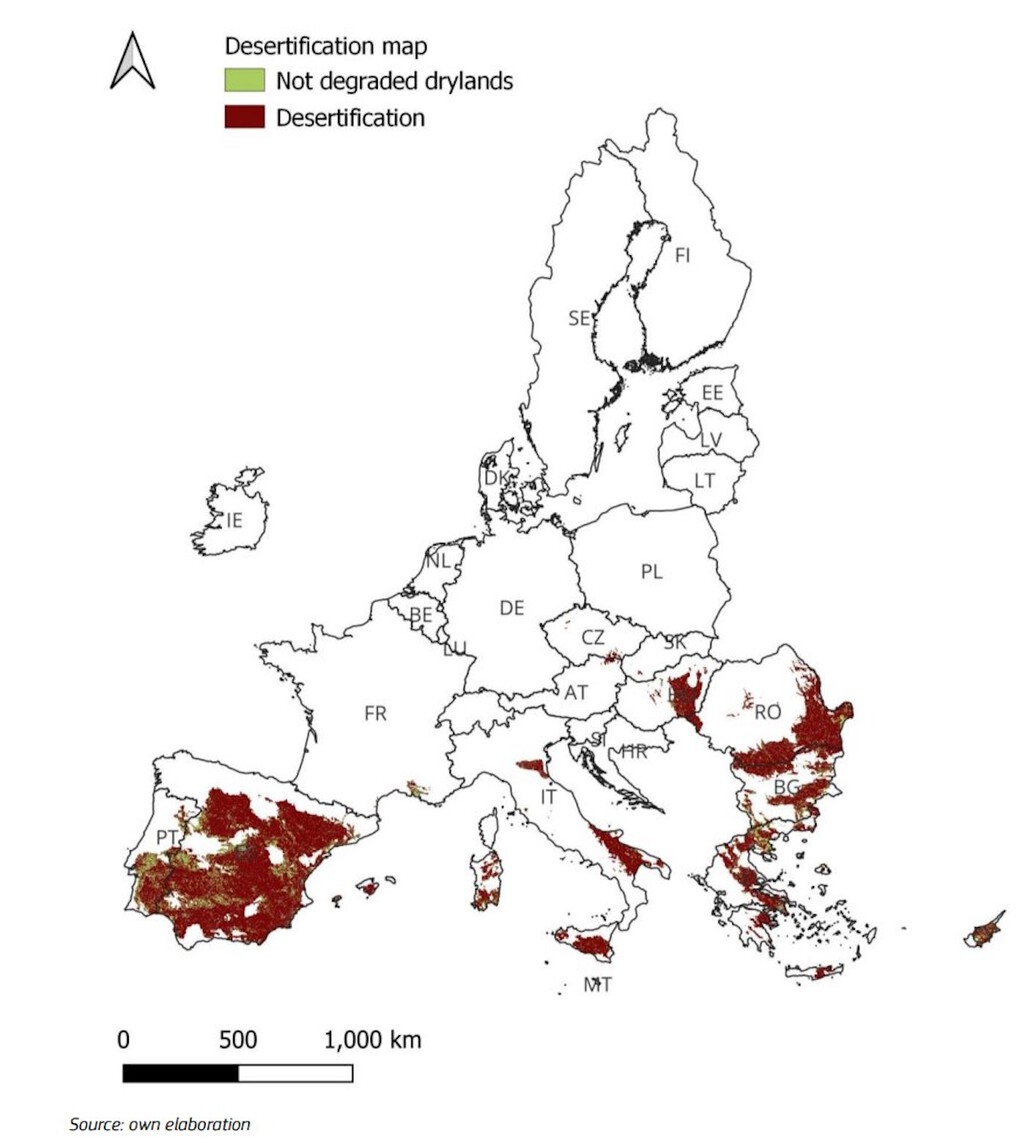
According to the United Nations Convention to Combat Desertification (UNCCD), desertification is defined as "land degradation in arid, semi-arid, and dry sub-humid areas resulting from various factors, including climatic variations and human activities." This definition is crucial: desertification refers specifically to degradation in areas that are already arid. It is not simply the expansion of deserts into humid zones, but the deterioration of drylands that millions of people depend on.
Why Half of Spain Is at Risk
Spain's vulnerability stems from a combination of climatic and human factors. The country already has a semi-arid climate in many regions, with long dry summers and irregular rainfall. Climate change is exacerbating these conditions, bringing higher temperatures, more frequent droughts, and extreme weather events that strip away topsoil and prevent water infiltration.
Human activities compound the problem. Intensive agriculture, overgrazing, deforestation, and poorly planned urbanization all contribute to soil degradation. When land is stripped of vegetation, it loses its capacity to retain water, making it more susceptible to erosion and further degradation. This creates a vicious cycle: degraded land supports less vegetation, which leads to even more degradation.
- Climate change drives higher temperatures and more erratic rainfall, intensifying aridity.
- Unsustainable land management such as intensive farming and overgrazing depletes soil health.
- Extreme weather events like DANAs cause flash flooding that erodes topsoil and prevents water retention.
- Wildfires become more frequent and severe, destroying vegetation cover and leaving land bare.
- Urbanization and infrastructure seal soil and disrupt natural water cycles.
The Consequences for Spain and Europe
The degradation of land has far-reaching consequences. It threatens food security, as degraded soil cannot support productive agriculture. It increases the risk of megafires, as dry, degraded landscapes provide ample fuel. It also affects water availability, as land that cannot retain water exacerbates drought conditions. For communities in affected areas, the economic and social impacts can be devastating.
Moreover, desertification is not confined to Spain. The map shows that Mediterranean Europe as a whole is at risk. Italy, Greece, Portugal, and parts of France are also experiencing significant land degradation. This regional dimension means that coordinated action is needed across borders.
What Can Be Done to Halt Desertification
Combating desertification requires a multifaceted approach. Sustainable land management practices, such as crop rotation, conservation agriculture, and reforestation, can help restore soil health and improve water retention. Water management strategies, including efficient irrigation and rainwater harvesting, are also crucial. Policy measures at the EU and national levels can provide incentives for sustainable practices and penalties for harmful ones.
Experts emphasize that early action is essential. Once land is severely degraded, restoration is costly and slow. The Joint Research Centre's map serves as a wake-up call, highlighting areas that need urgent attention. Public awareness and education also play a role, as informed communities are more likely to support and adopt sustainable practices.
Comparing Desertification Risk Across Mediterranean Countries
The table below summarizes the relative risk of desertification in selected Mediterranean EU countries, based on the Joint Research Centre's assessment. It shows the proportion of land classified as degraded arid land (red areas) versus healthy arid land (green areas), along with key contributing factors. The background to this story is set out in UN Desertification Summit Allocates $12bn to Fight Drought. A related thread runs through Global Glacial Lake Flood Map Reveals 15 Million People at Risk. Earlier coverage in Europeans Want United Europe but Doubt Path to Achieve shows how the argument developed.
| Country | Share of Land at Risk | Main Drivers |
|---|---|---|
| Spain | ~50% | Climate change, intensive agriculture, wildfires |
| Italy | High | Erosion, urbanization, drought |
| Greece | High | Overgrazing, wildfires, aridity |
| Portugal | Moderate to High | Deforestation, wildfires, soil erosion |
| France (Mediterranean) | Moderate | Drought, land abandonment |
What to Watch Next
The Joint Research Centre's map is a snapshot of current conditions, but the situation is dynamic. Continued monitoring and updated assessments will be crucial to track progress or further degradation. The EU has committed to land degradation neutrality by 2030 under the UNCCD, but achieving this goal will require sustained effort and investment. A closer look at the same subject appears in Europe Wildfires 2026: Visual Guide to the Crisis. Anyone following the wider picture can start with UN Desertification Summit: $12bn Fund for Drought and Land Restoration. The same theme surfaces in Europe Wildfires: Thousands Evacuated in France and Spain, which takes a different angle.
For Spain, the stakes are particularly high. With half the country at risk, desertification could reshape the economy, environment, and society. The map is not just a scientific tool; it is a call to action for policymakers, farmers, and citizens alike. The future of Spain's landscapes depends on the choices made today. Context on how this played out before sits in Europe's Bike Lane Map: Cycling in Spain Is a Miracle. A companion piece, Adif's Official Map: All Railway Infrastructure Works in Spain, approaches the same subject from another angle.
FAQ
What is desertification?
Desertification is the degradation of land in arid, semi-arid, and dry sub-humid areas due to climatic variations and human activities. It is not the expansion of existing deserts but the deterioration of drylands that are already vulnerable.
Why is half of Spain at risk of desertification?
Spain's semi-arid climate, combined with climate change, intensive agriculture, overgrazing, and wildfires, has made large areas vulnerable to land degradation. The Joint Research Centre's map shows that about half of the country's land is classified as degraded arid land.
Which other European countries are affected?
Mediterranean countries such as Italy, Greece, Portugal, and parts of France are also experiencing significant desertification risk. The entire Mediterranean basin is a hotspot due to its dry climate and human pressures.
What can be done to stop desertification?
Sustainable land management, reforestation, efficient water use, and supportive policies are key. Early action is essential because restoring degraded land is much harder and more expensive than preventing degradation.
Browse the Shop
 Acacia frida deluxe solid wood bed frame |
Bedroom bench |
Bed chest drawers |
Lingerie dresser |
Frame base |
Mirror with jewelry storage |
30 Bathroom Vanity |
Memory foam queen mattress |
Mattresses for back pain |
Nightstand set of 2 |
Grand Goldman Shop |
Civil Lawyer
Deutschland Trikot WM 2026







