

The James Webb Space Telescope has discovered a black hole that appears to have formed before its host galaxy, upending long-held assumptions about cosmic evolution. This finding, published in a recent study, challenges the conventional wisdom that galaxies form first and black holes grow within them.
Astronomers have long believed that galaxies precede their central black holes. However, new observations of a distant galaxy called Abell 2744-QSO1 suggest the opposite may be true in some cases.
Find Original Home Decor sparking conversation at Grand Goldman Shop.

Discovery of a Mysterious Red Dot
In recent years, the James Webb Space Telescope has identified numerous small red dots scattered across the universe. Many of these objects remain enigmatic, defying easy explanation with current technology.
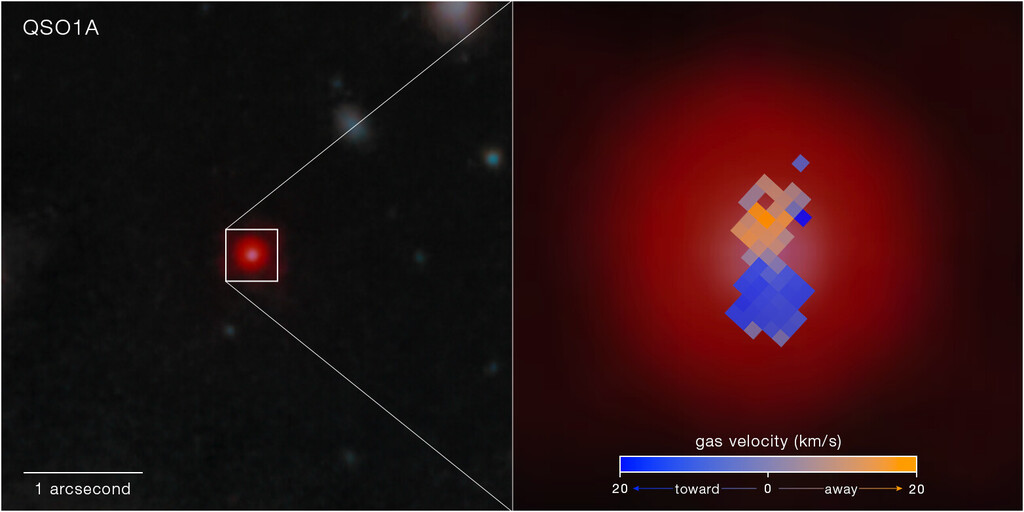
Thanks to a fortunate gravitational lensing effect, Webb was able to peer inside one of these red dots. What it found was a supermassive black hole with a mass 50 million times that of the Sun, residing in a surprisingly tiny galaxy.
Details of the Host Galaxy and Black Hole
The galaxy, Abell 2744-QSO1, measures only 1,300 light-years across. By comparison, our Milky Way spans over 100,000 light-years. This compact galaxy is estimated to have formed just 700 million years after the Big Bang, making it incredibly ancient.
Yet, according to calculations by a team from the University of Cambridge and the University of Florence, the black hole may have formed a mere second after the Big Bang. This timeline implies the black hole predates its galaxy by hundreds of millions of years.
Challenging the Chicken-and-Egg Dilemma
For decades, astronomers have debated whether galaxies or black holes come first. The prevailing view held that galaxies form first, and black holes grow within them. This new discovery flips that assumption on its head.
If confirmed, this finding would require a major revision of our understanding of cosmic evolution. It suggests that in some cases, black holes may seed galaxy formation rather than the other way around.
Implications for Galaxy Formation Theories
This discovery poses significant challenges to current models of galaxy formation. It raises questions about how a black hole could grow so massive so quickly, and how it could exist before its host galaxy.
One possibility is that the black hole formed directly from the collapse of massive gas clouds in the early universe, without needing a preceding galaxy. Another is that the black hole and galaxy formed simultaneously but evolved differently. The background to this story is set out in James Webb Reveals Supermassive Black Holes Don't Sterilize. A related thread runs through Black Hole Star Discovery: New Cosmic Object Found. Earlier coverage in James Webb Finds First Black Hole Star, a Theoretical Object shows how the argument developed.
What to Watch Next
Future observations with the James Webb Space Telescope will focus on finding more such objects and studying their properties. Researchers will also refine theoretical models to accommodate this new evidence. A closer look at the same subject appears in James Webb Red Dots Explained by Early Universe Simulation. Anyone following the wider picture can start with James Webb Finds Impossible Galaxy GN20 With a Stellar Bar. The same theme surfaces in James Webb Telescope Detects Mysterious Signal in Fornax, which takes a different angle.
As Webb continues to peer deeper into the cosmos, it may uncover more instances of black holes preceding their galaxies. Each discovery will help piece together the complex puzzle of how the universe evolved. Context on how this played out before sits in James Webb Corrects Hubble's Exoplanet WASP-94A b Atmosphere Data. A companion piece, Massive Black Hole Weighs 6 Billion Suns, Study Finds, approaches the same subject from another angle.
Key Takeaways
- James Webb discovered a black hole that formed before its host galaxy.
- The black hole is 50 million times the mass of the Sun, in a galaxy only 1,300 light-years across.
- The galaxy formed 700 million years after the Big Bang, but the black hole may have formed just one second after.
- This challenges the conventional view that galaxies form first.
- Future observations will search for more such objects to refine theories.
Comparison of Galaxy and Black Hole Properties
| Property | Abell 2744-QSO1 Galaxy | Milky Way Galaxy |
|---|---|---|
| Diameter | 1,300 light-years | 100,000+ light-years |
| Formation time | 700 million years after Big Bang | ~13.6 billion years ago |
| Black hole mass | 50 million solar masses | 4 million solar masses (Sagittarius A*) |
| Black hole formation | Possibly 1 second after Big Bang | ~13 billion years ago |
FAQ
What did the James Webb Space Telescope discover?
James Webb discovered a supermassive black hole that appears to have formed before its host galaxy, Abell 2744-QSO1. This challenges the conventional view that galaxies form first.
How massive is the black hole?
The black hole has a mass 50 million times that of the Sun. It resides in a galaxy only 1,300 light-years across, much smaller than the Milky Way.
When did the black hole and galaxy form?
The galaxy is estimated to have formed 700 million years after the Big Bang. The black hole may have formed just one second after the Big Bang, according to calculations by researchers.
Why is this discovery important?
It challenges existing theories of galaxy formation and suggests that black holes may sometimes precede and even seed galaxy formation. Future observations will help confirm and refine these ideas.
Browse the Shop
 Acacia frida deluxe solid wood bed frame |
Bedroom bench |
Bed chest drawers |
Lingerie dresser |
Frame base |
Mirror with jewelry storage |
30 Bathroom Vanity |
Memory foam queen mattress |
Mattresses for back pain |
Nightstand set of 2 |
Grand Goldman Shop |
Civil Lawyer
Deutschland Trikot WM 2026







