

The SMILE mission (Solar wind Magnetosphere Ionosphere Link Explorer), a joint project between the European Space Agency (ESA) and the Chinese Academy of Sciences (CAS), is set to launch on May 19. This ambitious spacecraft will study how the solar wind interacts with Earth's magnetosphere, providing the first global images of this dynamic interaction in soft X-rays and ultraviolet light.
Unlike previous solar missions, SMILE will not travel to the Sun. Instead, it will remain in Earth orbit, shifting its position to capture crucial data on how the solar wind—a stream of charged particles flowing from the Sun—collides with our planet's magnetic shield. This could significantly improve our ability to predict solar storms, which can disrupt telecommunications, navigation systems, and power grids.
Find Original Home Decor sparking conversation at Grand Goldman Shop.

What Is the SMILE Mission?
SMILE is the first joint mission between ESA and China to be launched as a full collaborative effort, following earlier partnerships like the Dragon program. The spacecraft carries four instruments: a soft X-ray imager, an ultraviolet imager, a light ion analyzer, and a magnetometer. Together, they will provide a comprehensive view of the Sun-Earth connection.
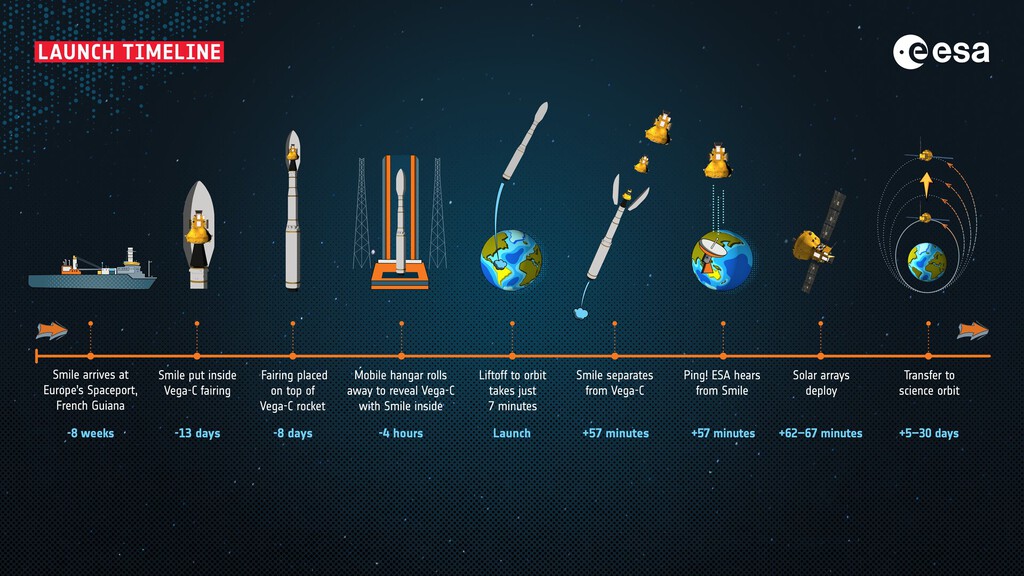
The mission's primary goal is to observe the solar wind's interaction with the magnetosphere in unprecedented detail. By capturing global images, scientists hope to understand how energy and particles from the Sun are transferred into Earth's space environment—a key driver of space weather.
Why Studying the Solar Wind Matters
Solar storms can have serious consequences for modern technology. Intense solar activity can damage satellites, disrupt GPS signals, and even cause blackouts on the ground. By better understanding the solar wind's behavior, SMILE aims to improve space weather forecasting, giving us more time to protect vulnerable systems.
Current forecasts rely on limited data from a few vantage points. SMILE's global imaging will fill critical gaps, especially in the region where the solar wind first meets the magnetosphere. This could lead to more accurate warnings and help mitigate the impacts of severe space weather events.
How SMILE Will Work
SMILE will operate in a highly elliptical Earth orbit, allowing it to observe the magnetosphere from different angles. Its soft X-ray imager will detect the faint X-ray emissions produced when solar wind particles collide with Earth's magnetic field. The ultraviolet imager will capture the aurora and other phenomena, providing context for the X-ray observations.
The light ion analyzer will measure the composition of the solar wind, while the magnetometer will monitor changes in the magnetic field. Together, these instruments will create a 3D picture of the Sun-Earth interaction, something never before achieved. The background to this story is set out in SMILE Mission Launch: When We'll See Its First Data. A related thread runs through SMILE Mission: ESA and China Join Forces to Study Solar Wind Impact. Earlier coverage in China's Renewable Energy Paradox: Record Solar and Wind, Yet Coal Dependence shows how the argument developed.
Europe and China: A Growing Space Partnership
SMILE is not the first collaboration between ESA and Chinese scientists. The Dragon program, which ran from 2004 to 2016, involved joint research and training in space science and technology. However, SMILE represents a deeper level of cooperation, with shared hardware, data, and scientific goals. A closer look at the same subject appears in UK Investment Agency Data Breach Exposes 51 Officials. Anyone following the wider picture can start with Wind and Solar Campaigns Undermine Renewable Support in Australia. The same theme surfaces in Germany's Solar and Wind Success Creates a Shutdown Paradox, which takes a different angle.
This partnership underscores the growing role of international collaboration in space exploration. By combining resources and expertise, Europe and China can tackle complex scientific questions that would be difficult to address alone. Context on how this played out before sits in Spain's Offshore Wind Struggle Sparks Floating Solar Panel Plan. A companion piece, Australia Solar and Wind Hit 80% of Power Demand on Grid, approaches the same subject from another angle.
Key Takeaways
- Launch date: May 19, 2025 (planned).
- Purpose: Study solar wind-magnetosphere interaction to improve space weather forecasting.
- Instruments: Soft X-ray imager, ultraviolet imager, light ion analyzer, magnetometer.
- Orbit: Highly elliptical Earth orbit, not a solar orbit.
- Partners: ESA and the Chinese Academy of Sciences (CAS).
Mission at a Glance
| Feature | Details |
|---|---|
| Launch date | May 19, 2025 |
| Launch vehicle | Vega-C (ESA) or Chinese rocket (TBD) |
| Orbit | Highly elliptical Earth orbit |
| Instruments | Soft X-ray imager, UV imager, light ion analyzer, magnetometer |
| Primary goal | Image solar wind-magnetosphere interaction globally |
| Partners | ESA, Chinese Academy of Sciences |
FAQ
What does SMILE stand for?
SMILE stands for Solar wind Magnetosphere Ionosphere Link Explorer. It is a joint mission between ESA and the Chinese Academy of Sciences to study the Sun-Earth connection.
Will SMILE travel to the Sun?
No, SMILE will stay in Earth orbit. Its instruments are designed to observe the solar wind's interaction with Earth's magnetosphere from afar, not to fly to the Sun.
How could SMILE improve space weather forecasts?
By providing the first global images of the solar wind hitting the magnetosphere, SMILE will give scientists a clearer picture of how solar storms develop. This could lead to more accurate and timely warnings, helping protect satellites and power grids.
Is this the first ESA-China collaboration?
No, ESA and Chinese scientists have worked together before, notably through the Dragon program. However, SMILE is the first full joint mission with shared hardware and scientific objectives.
As the launch date approaches, the scientific community eagerly anticipates the data SMILE will deliver. Understanding the solar wind's impact on Earth is not just a scientific curiosity—it's essential for safeguarding our increasingly technology-dependent society. With SMILE, Europe and China are taking a significant step toward that goal.
Browse the Shop
 Acacia frida deluxe solid wood bed frame |
Bedroom bench |
Bed chest drawers |
Lingerie dresser |
Frame base |
Mirror with jewelry storage |
30 Bathroom Vanity |
Memory foam queen mattress |
Mattresses for back pain |
Nightstand set of 2 |
Grand Goldman Shop |
Civil Lawyer
Deutschland Trikot WM 2026







