

The minimum wage gap between Eastern and Western Europe is a striking indicator of the continent's economic divide. According to Eurostat data for 2026, the difference in statutory minimum wages across European countries is not just a crack—it's a chasm. Two workers on the same continent, putting in the same hours, can end the month with paychecks that bear no resemblance to each other.
Visual Capitalist has mapped these figures, offering a one-glance comparison of minimum wages across Europe. The map underscores the wide variation in pay—and economic conditions—across the continent.
Find Original Home Decor sparking conversation at Grand Goldman Shop.

What Is a Minimum Wage and Why Does It Matter?
A minimum wage is the lowest legal remuneration an employer can pay a worker. It exists to ensure a decent standard of living and prevent labor exploitation. According to the European Labour Authority (EURES), minimum wages also help reduce economic inequality and support domestic consumption, as low-wage workers tend to spend a larger share of their income.
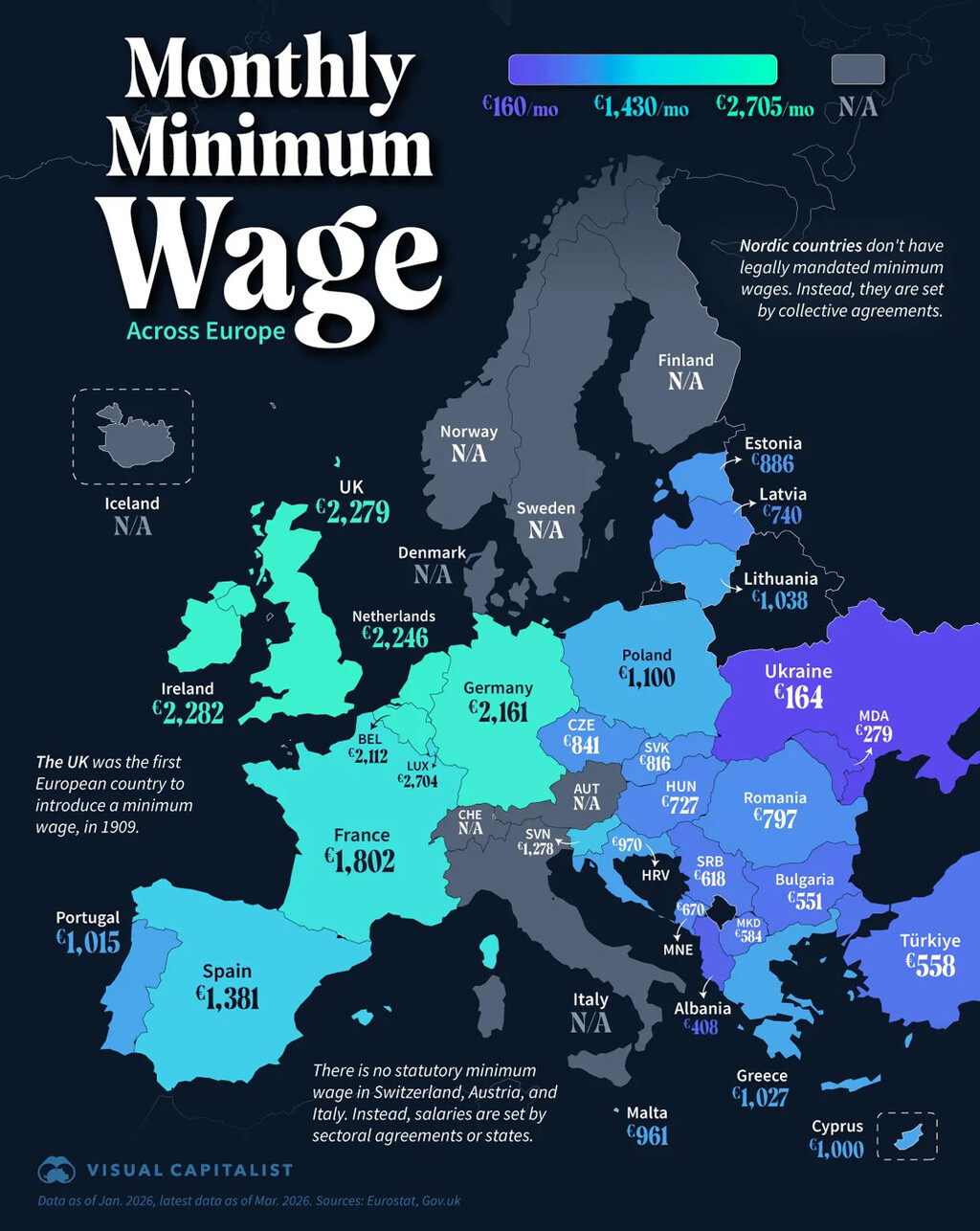
Not all European countries set minimum wages the same way. Austria, Denmark, Finland, Italy, and Sweden have no statutory minimum wage, leaving negotiations to unions and employers through collective agreements. Switzerland, while not an EU member, has a different approach altogether.
The East-West Minimum Wage Gap in Numbers
The map reveals a clear pattern: Western European countries generally have much higher minimum wages than their Eastern counterparts. For instance, Luxembourg leads with a minimum wage well above €2,000 per month, while countries like Bulgaria and Hungary lag far behind, with figures below €500.
This gap reflects broader economic disparities—differences in productivity, cost of living, and social policies. It also influences migration patterns, as workers from lower-wage countries often move westward in search of better pay.
| Country | Monthly Minimum Wage (EUR, 2026) | Region |
|---|---|---|
| Luxembourg | ~2,500 | Western Europe |
| Germany | ~2,100 | Western Europe |
| France | ~1,800 | Western Europe |
| Spain | ~1,300 | Southern Europe |
| Poland | ~1,000 | Eastern Europe |
| Hungary | ~600 | Eastern Europe |
| Bulgaria | ~450 | Eastern Europe |
These figures are approximate and based on Eurostat data for 2026. They highlight the stark contrast between the highest and lowest minimum wages in Europe.
Why Such a Wide Gap?
The gap stems from historical and structural factors. Western European economies are generally more productive and have stronger social safety nets, allowing for higher minimum wages. Eastern European countries, many of which transitioned from planned to market economies in the 1990s, still catch up in terms of productivity and wages.
Additionally, the cost of living varies significantly. A minimum wage that seems low in Western Europe might provide a decent living in parts of Eastern Europe, where prices for goods and services are lower. However, this doesn't fully offset the disparity, especially for workers in expensive urban areas.
Who Is Affected by the Minimum Wage Gap?
The gap affects millions of workers across Europe. Those in low-wage countries may struggle to make ends meet, especially if they have families. It also impacts businesses, as companies in high-wage countries face higher labor costs, potentially affecting competitiveness.
Moreover, the gap can drive migration from East to West, leading to labor shortages in some sectors in Eastern Europe and wage pressures in Western Europe. Policymakers must balance the need for fair wages with economic competitiveness. The background to this story is set out in Chancellor Fails to Guarantee Minimum Wage Pledge for Younger Workers. A related thread runs through Tesla CEO Pay Gap: Musk Earns 2.5M Times Worker Salary. Earlier coverage in UK CEO Pay Gap Widens to Record 130x Average Worker Salary shows how the argument developed.
What to Watch Next
The minimum wage gap is likely to remain a contentious issue. The European Union has been discussing a framework for adequate minimum wages, but progress is slow. Meanwhile, some countries are taking unilateral steps to raise their minimum wages, which could narrow the gap over time. A closer look at the same subject appears in UK Boss Pay Gap Widens to 130 Times Average Worker Salary. Anyone following the wider picture can start with UK Bosses Earn 130 Times Average Worker Salary: Pay Gap Widens. The same theme surfaces in California Minimum Wage Increase to $17.40: What It Means for Workers, which takes a different angle.
As economies evolve and inflation impacts purchasing power, the debate over minimum wages will continue. Keeping an eye on Eurostat updates and national policy changes will be crucial for understanding the future of work in Europe. Context on how this played out before sits in Australia Delivery Driver Pay: $31.30 Minimum Wage Set. A companion piece, Spain's Minimum Wage Rise in 2026: Inflation Eats the Gains, approaches the same subject from another angle.
FAQ
Which European country has the highest minimum wage?
Luxembourg has the highest minimum wage in Europe, at approximately €2,500 per month in 2026. Germany and France follow with lower but still substantial minimum wages.
Do all European countries have a minimum wage?
No, several countries—including Austria, Denmark, Finland, Italy, and Sweden—do not have a statutory minimum wage. Instead, wages are set through collective bargaining between unions and employers.
Why is there such a big gap between East and West?
The gap reflects differences in economic development, productivity, and cost of living. Western European countries generally have stronger economies and higher productivity, allowing for higher minimum wages.
How does the minimum wage gap affect workers?
Workers in low-wage countries may face financial hardship and may be incentivized to migrate to higher-wage countries. This can lead to labor shortages in some regions and wage pressures in others.
Browse the Shop
 Acacia frida deluxe solid wood bed frame |
Bedroom bench |
Bed chest drawers |
Lingerie dresser |
Frame base |
Mirror with jewelry storage |
30 Bathroom Vanity |
Memory foam queen mattress |
Mattresses for back pain |
Nightstand set of 2 |
Grand Goldman Shop |
Civil Lawyer
Deutschland Trikot WM 2026







