

Google's submarine cable plan is set to transform the Dominican Republic into a digital heart of Latin America. The project, called Americas Connect, involves three new cables—Alisios, Canoa, and Olaluz—that will create new corridors across the Pacific, Caribbean, and Atlantic. This move aims to address the stark inequality in global internet infrastructure, where some regions are dense with cables while others are left behind.
Why Submarine Cables Matter for Global Internet
Submarine cables carry more than 99% of intercontinental internet traffic, according to TeleGeography. They are the backbone of global connectivity, enabling everything from cloud services to artificial intelligence. For Google, investing in cable infrastructure is not just about expanding its network but also about supporting essential services like banking, security, and communications.
Find Original Home Decor sparking conversation at Grand Goldman Shop.

The current map of submarine cables is highly uneven. While North America and Central America have many nodes and cables, density drops drastically as you move south. Singapore, for example, is a major hub in Asia, but Latin America and the Caribbean have fewer connections. Google's plan seeks to change this by adding new routes and increasing capacity in underserved regions.
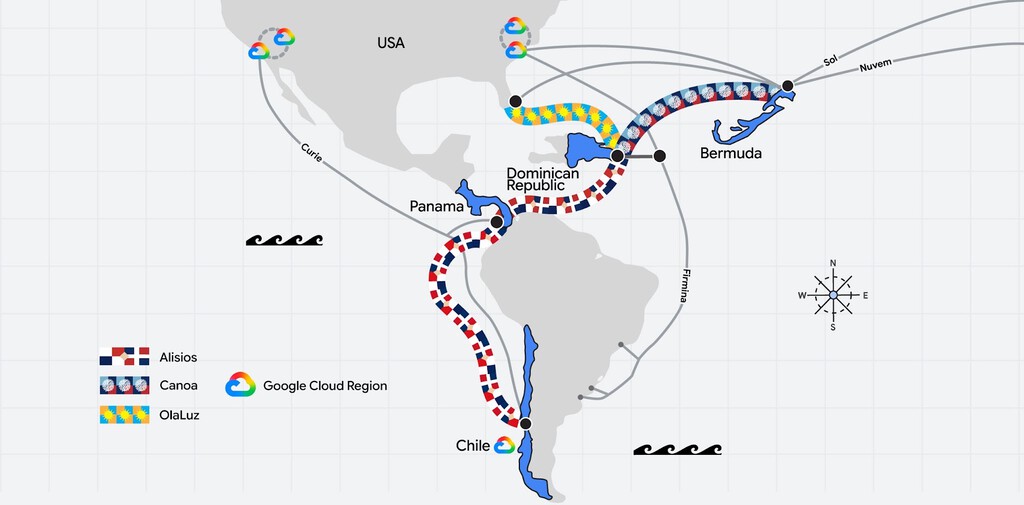
The Three Cables: Alisios, Canoa, and Olaluz
The Americas Connect project is organized into three corridors: Pacific, Caribbean, and Atlantic. Each cable serves a specific purpose and route. Alisios will connect the Pacific coast, Canoa will focus on the Caribbean, and Olaluz will span the Atlantic. Together, they will create a more resilient and diverse network.

In addition, Google will add a new branch of the Firmina cable, which was initially designed to link North and South America. This branch will also pass through the Dominican Republic, further solidifying the country's role as a key node. The exact routes are still being planned, but the impact is expected to be significant.
Dominican Republic: The New Digital Hub
The Dominican Republic is positioned to become the central node in Google's strategy. Its geographic location makes it an ideal point for connecting North and South America, as well as Europe and Africa. With the new cables, the country could see improved internet speed, reliability, and capacity, attracting businesses and investment.
This development is part of a broader trend of tech companies investing in infrastructure to support their services. Google's cloud and AI offerings require massive data transfer, and submarine cables provide the necessary bandwidth. By building these cables, Google ensures that its services can reach more users with lower latency. The background to this story is set out in Submarine Cables: 30 Years of Internet's Underwater Backbone. A related thread runs through Dominican Republic All Inclusive Family Resorts: Best Choices. Earlier coverage in FIFA President Infantino's Dominican Republic Trip Sparks Crisis shows how the argument developed.
What This Means for Latin America and the Caribbean
The new cables will not only benefit the Dominican Republic but also neighboring countries. Improved connectivity can spur economic growth, enable better access to education and healthcare, and foster innovation. However, challenges remain, such as regulatory hurdles and the need for local infrastructure to distribute the increased bandwidth. A closer look at the same subject appears in Gianni Infantino's Dominican Republic Trip: FIFA Crisis Strategy. Anyone following the wider picture can start with Best Luxury Hotels in the Dominican Republic. The same theme surfaces in 10 Essential Travel Tips to Explore the Dominican Republic, which takes a different angle.
Google's investment highlights the growing importance of digital infrastructure in the global economy. As more services move online, the demand for high-speed, reliable internet will only increase. The Americas Connect project is a step toward a more connected and equitable internet. Context on how this played out before sits in The Best SIM and eSIM Travel Cards for the Dominican Republic. A companion piece, 10 Best Things to do & Places to See in the Dominican Republic, approaches the same subject from another angle.
Key Takeaways
- Google's Americas Connect project includes three new submarine cables: Alisios, Canoa, and Olaluz.
- The Dominican Republic will become a central node, enhancing connectivity in Latin America and the Caribbean.
- Submarine cables carry over 99% of intercontinental internet traffic, making them critical infrastructure.
- The project aims to address the uneven distribution of cable networks, which currently favors North America and parts of Asia.
- Improved connectivity can drive economic growth and innovation in underserved regions.
Comparison of Cable Corridors
| Cable | Corridor | Primary Route | Key Benefit |
|---|---|---|---|
| Alisios | Pacific | Connects Pacific coast of Americas | Enhances transpacific connectivity |
| Canoa | Caribbean | Links Caribbean islands and mainland | Improves regional resilience |
| Olaluz | Atlantic | Spans Atlantic Ocean | Strengthens transatlantic links |
FAQ
What is Google's Americas Connect project?
Americas Connect is Google's initiative to build three new submarine cables—Alisios, Canoa, and Olaluz—to improve internet connectivity across the Americas, with the Dominican Republic as a central hub.
Why is the Dominican Republic important in this plan?
The Dominican Republic's geographic location makes it an ideal node for connecting North and South America, as well as Europe and Africa, enhancing its role as a digital hub.
How do submarine cables affect everyday internet users?
Submarine cables carry the majority of international internet traffic, so improvements in cable infrastructure can lead to faster, more reliable internet for users in connected regions.
What are the potential challenges for this project?
Challenges include regulatory approvals, environmental considerations, and the need for local infrastructure to distribute the increased bandwidth effectively.
Browse the Shop
 Acacia frida deluxe solid wood bed frame |
Bedroom bench |
Bed chest drawers |
Lingerie dresser |
Frame base |
Mirror with jewelry storage |
30 Bathroom Vanity |
Memory foam queen mattress |
Mattresses for back pain |
Nightstand set of 2 |
Grand Goldman Shop |
Civil Lawyer
Deutschland Trikot WM 2026







