

The Crooked Forest in Poland is one of the world's most baffling natural phenomena. Located near the town of Gryfino, this small grove of about 400 pine trees features trunks that bend sharply at the base, growing horizontally for several meters before curving back upward. No one has been able to definitively explain how or why these trees took such an unusual shape.
The story begins around 1930, when someone planted this small pine forest in a region that was then part of Germany. After Hitler, World War II, the destruction of the area, and new borders that made the territory part of Poland, the trees remain—preserving a secret that survived it all.
Find Original, High-end Home Decor that spark conversation at Grand Goldman Shop.

A Forest That Changed Countries
The setting of this story is Krzywy Las, literally the Crooked Forest, located next to Nowe Czarnowo, near the Polish city of Gryfino and the German border. When those pines were planted in the early 1930s, the town was called Greifenhagen and was part of Germany.
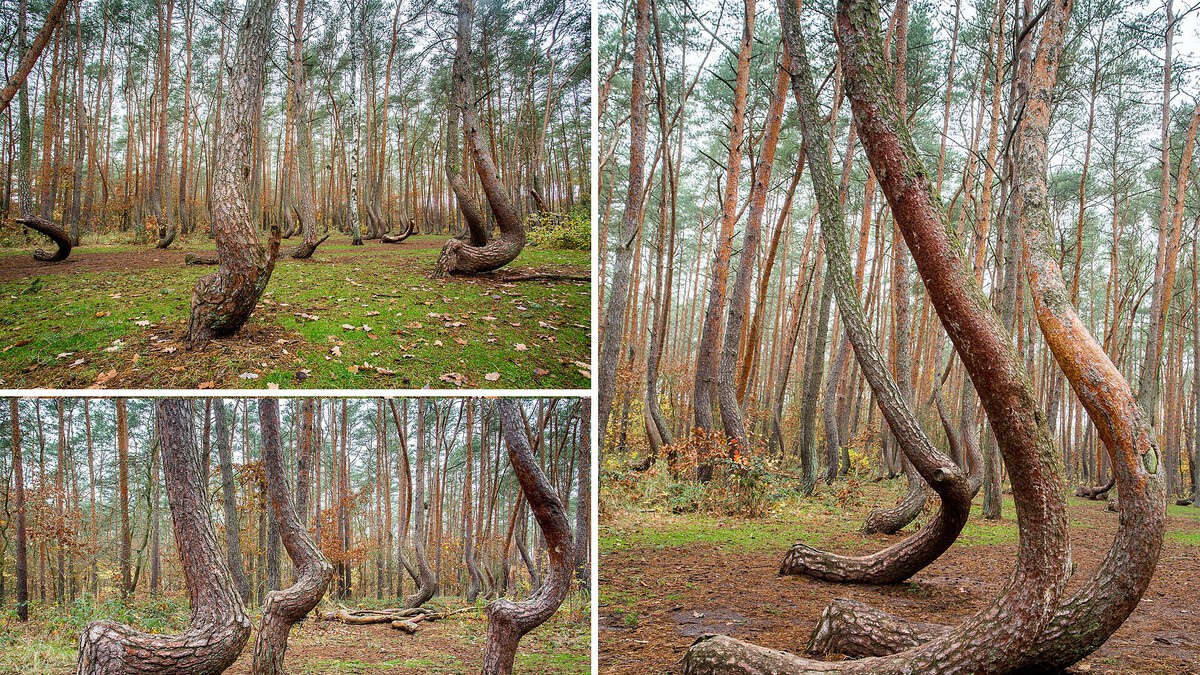
The territory belonged to the Prussian province of Pomerania, in a Europe whose borders would change radically after 1945. Today, that small forest is a protected natural monument and one of the most unusual landscapes in northwestern Poland.
The Same Curve
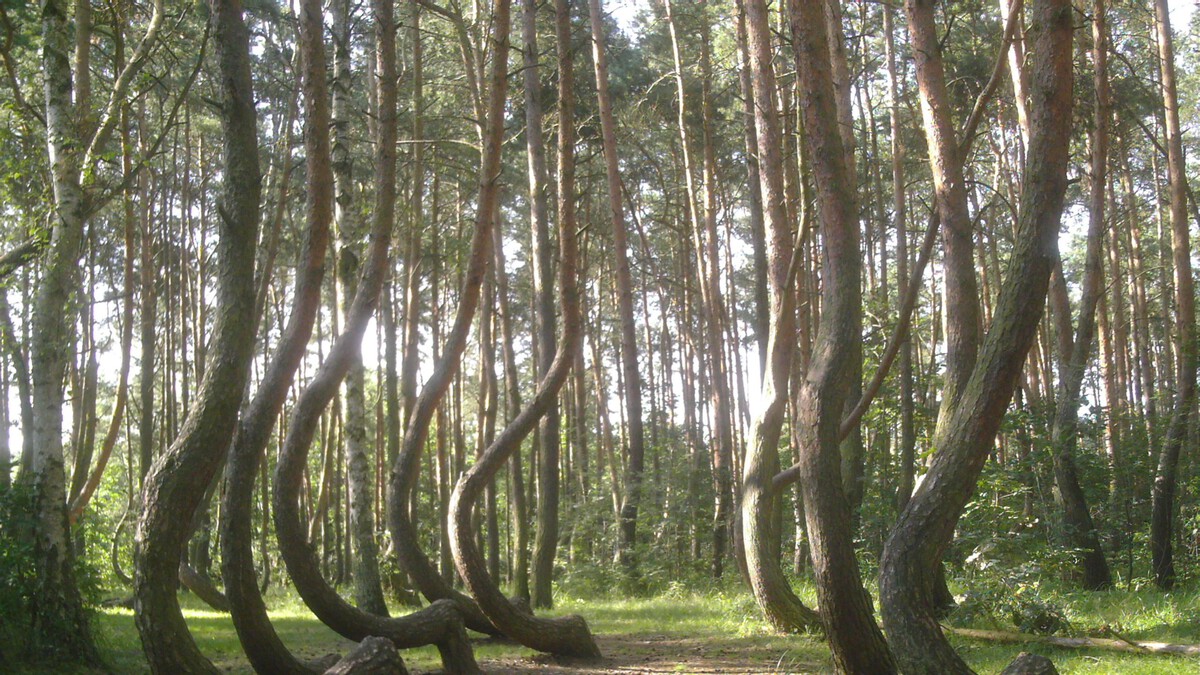
The peculiarity of Krzywy Las begins just centimeters above the ground. The trunks lean sharply, forming a curve similar to a J, extend horizontally for several meters, and then resume vertical growth. All the trees bend in the same direction—north—and share a nearly identical shape.
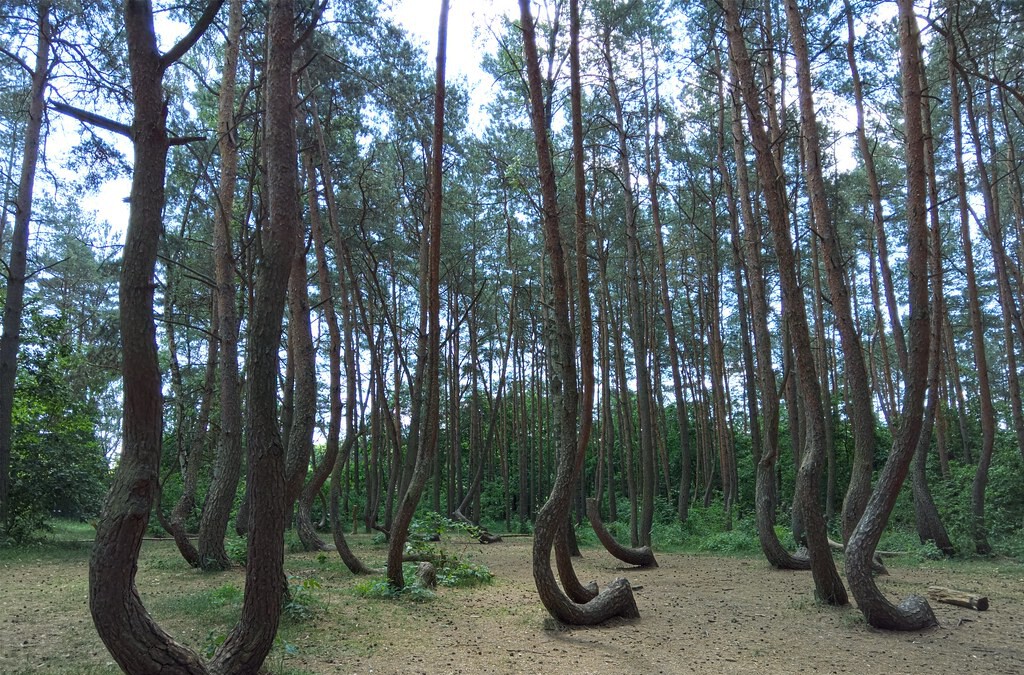
This uniformity has fueled numerous theories. Some believe the trees were deliberately manipulated by humans, perhaps to produce curved wood for furniture or shipbuilding. Others suggest that a heavy snowfall or a storm flattened the saplings when they were young, and they simply grew back upward from the damage.
What Caused the Crooked Forest?
Despite decades of study, no one has been able to prove exactly how the trees acquired their distinctive shape. The most widely accepted theory is that human intervention played a role. In the 1930s, local carpenters might have used techniques to bend the trees for specific wood products.
Another possibility is that the trees were flattened by a catastrophic event, such as a heavy snowstorm, and then recovered. However, the fact that all the trees bend in the same direction and at the same angle suggests a systematic cause rather than a random natural event.
- Human manipulation for curved wood production is the leading theory.
- Snow or storm damage to young saplings could explain the horizontal growth.
- Gravity and phototropism might have interacted after the initial bending.
- Genetic mutation is considered unlikely due to the uniformity of the curve.
- No definitive proof exists, leaving the mystery unsolved.
Why the Crooked Forest Matters
The Crooked Forest is not just a quirky tourist attraction; it is a living testament to the turbulent history of Central Europe. The trees have survived the rise and fall of the Third Reich, the devastation of war, and the redrawing of national borders.
For locals and visitors alike, the forest represents resilience and the enduring power of nature. It also serves as a reminder of how human activities—whether intentional or accidental—can leave lasting marks on the landscape.
| Aspect | Details |
|---|---|
| Location | Near Gryfino, Poland |
| Number of trees | Approximately 400 |
| Tree species | Pine |
| Planted | Early 1930s |
| Curve direction | North |
| Protection status | Natural monument |
Visiting the Crooked Forest
The forest is easily accessible from Szczecin, about 40 kilometers away, and from Berlin, roughly 120 kilometers. Visitors can walk among the trees, but they are asked to stay on designated paths to protect the fragile environment. The longer history behind the story is traced in Poland's Crooked Forest: The Mysterious Bent Pines of Gryfino.
The best time to visit is during spring or autumn when the light filters through the canopy, creating a magical atmosphere. There is no entrance fee, and the site is open year-round. The background to this story is set out in NATO Defends Territory After Russian Missile Hits Poland. A related thread runs through NATO Vows to Defend Territory After Russian Missile Hits Poland. Earlier coverage in NATO Defends Territory After Russian Missile Hits Poland: Key shows how the argument developed.
What to Watch Next
Scientists continue to study the Crooked Forest, hoping to unlock its secrets. Recent research has focused on analyzing the wood structure and comparing it with other known cases of tree deformation. A closer look at the same subject appears in Poland Bomb Plot Spy Mystery: Who Was Igor Rogov. Anyone following the wider picture can start with Poland Urges Doubled Support for Ukraine After Russian Train Attack. The same theme surfaces in Trending: latest articles, which takes a different angle.
Whether the mystery is ever solved or not, the Crooked Forest remains a fascinating destination for travelers and nature lovers. It is a place where history, nature, and mystery intertwine. Context on how this played out before sits in Lord of the Rings Lamp on Amazon: The One Ring Glow for Your Home. A companion piece, Xiaomi Pad Mini Deal: Compact 8.8-Inch Tablet for Students, approaches the same subject from another angle.
FAQ
Where is the Crooked Forest located?
The Crooked Forest is located near the town of Gryfino in northwestern Poland, close to the German border.
Why are the trees in the Crooked Forest bent?
The exact cause is unknown, but the leading theory is that humans deliberately bent the trees in the 1930s to produce curved wood for furniture or shipbuilding.
Can I visit the Crooked Forest?
Yes, the forest is open to the public year-round and is free to visit. It is about 40 kilometers from Szczecin and 120 kilometers from Berlin.
How many trees are in the Crooked Forest?
There are approximately 400 pine trees in the grove, all exhibiting the same distinctive bend.
Browse the Shop
 Acacia frida deluxe solid wood bed frame |
Bedroom bench |
Bed chest drawers |
Lingerie dresser |
Frame base |
Mirror with jewelry storage |
30 Bathroom Vanity |
Memory foam queen mattress |
Mattresses for back pain |
Nightstand set of 2 |
Grand Goldman Shop |
Civil Lawyer
Deutschland Trikot WM 2026
Acacia frida deluxe solid wood bed frame |
Bedroom bench |
Bed chest drawers |
Lingerie dresser |
Frame base |
Mirror with jewelry storage |
30 Bathroom Vanity |
Memory foam queen mattress |
Mattresses for back pain |
Nightstand set of 2 |
Grand Goldman Shop |
Civil Lawyer
Deutschland Trikot WM 2026










