

Uruguay is a world power in producing elite soccer players, and the numbers prove it. Despite having only 3.5 million inhabitants—comparable to Madrid or Berlin—this small South American nation has consistently churned out top-tier football talent at a rate unmatched by any other country. In fact, per capita, Uruguay has produced more famous soccer players than any other nation in history.
While many might assume Brazil, with its five World Cups and endless supply of talent, leads the pack, the data tells a different story. According to the interactive data project "El Atlas," Uruguay produces 11.3 elite soccer figures per million inhabitants, far ahead of the second-place Croatia with 4.81. The Netherlands follows with 4.58, and other traditional powers trail significantly. This remarkable statistic holds true across various time frames, solidifying Uruguay's unique status in the soccer world.
Find Original Home Decor sparking conversation at Grand Goldman Shop.

Uruguay's Soccer Legacy: Small Country, Giant Footprint
Uruguay's soccer achievements are nothing short of extraordinary for a nation of its size. The country has won two World Cups (1930 and 1950), two Olympic gold medals, and a record 15 Copa América titles. These accomplishments alone would be impressive for any country, but for Uruguay, they represent the tip of the iceberg.
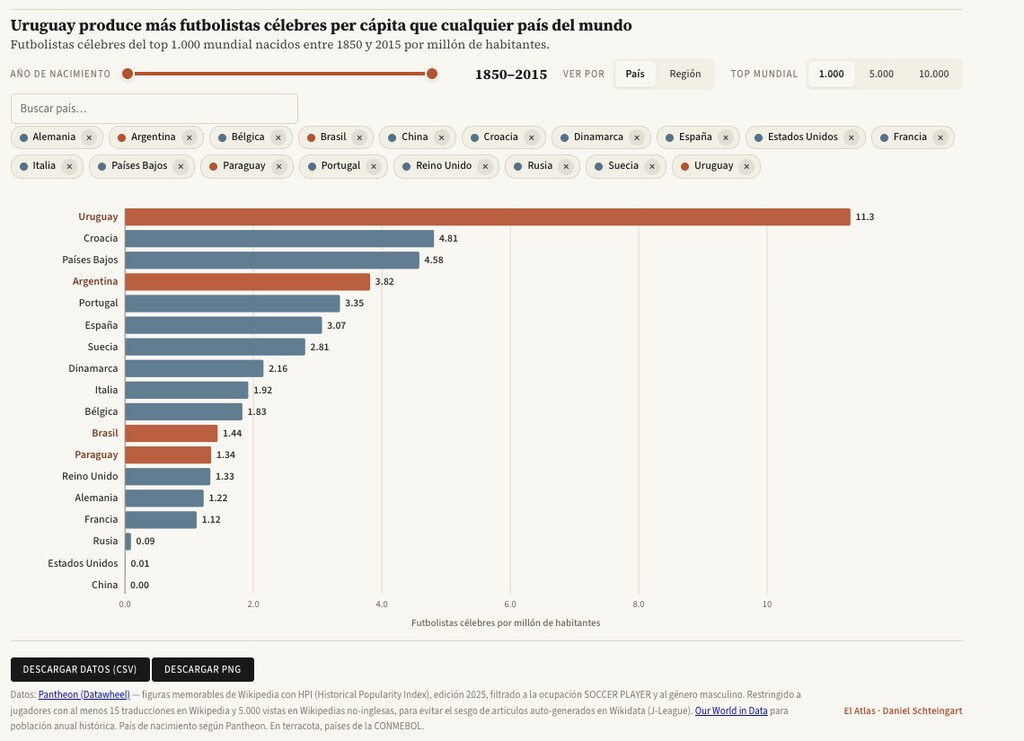
The real story lies in the continuous production of world-class players who have left their mark on the global stage. From the early days of the World Cup to the modern era, Uruguay has consistently contributed to the sport's elite, defying all demographic expectations.
Key Takeaways from Uruguay's Soccer Success
- Uruguay leads the world in elite soccer players per capita, with 11.3 per million inhabitants.
- The country has won two World Cups, two Olympic gold medals, and 15 Copa América titles.
- Uruguay's population of 3.5 million is similar to that of Madrid or Berlin.
- Croatia ranks second with 4.81 elite players per million, followed by the Netherlands with 4.58.
- Uruguay's success spans the entire history of modern soccer, from the 1920s to today.
How Does Uruguay Compare to Other Soccer Powers?
To put Uruguay's achievement into perspective, consider the following comparison table based on data from "El Atlas." The table shows the number of elite soccer players per million inhabitants for several top soccer nations.
| Country | Elite Players per Million Inhabitants |
|---|---|
| Uruguay | 11.3 |
| Croatia | 4.81 |
| Netherlands | 4.58 |
| Brazil | Data not provided in excerpt |
| Argentina | Data not provided in excerpt |
The gap between Uruguay and the rest is staggering. Even Croatia, a nation of about 4 million people with a strong soccer tradition, produces less than half as many elite players per capita. The Netherlands, another small country with a rich soccer history, is also far behind.
Why Does Uruguay Produce So Many Elite Players?
Several factors contribute to Uruguay's remarkable ability to generate soccer talent. First, soccer is deeply ingrained in the national culture. From a young age, children are encouraged to play, and the sport serves as a primary pathway to social mobility and national pride.
Second, Uruguay has a well-developed youth academy system that identifies and nurtures talent early. Clubs like Peñarol and Nacional have a long tradition of developing players who go on to succeed in top leagues worldwide. This infrastructure, combined with a strong work ethic and competitive spirit, creates a perfect environment for producing elite athletes.
Finally, the small population may actually be an advantage. With fewer players to choose from, competition is fierce, and only the most dedicated and talented rise to the top. This intense selection process ensures that those who make it are truly exceptional.
The Data Behind the Claim: El Atlas Project
The "El Atlas" project is an interactive visualization that calculates, for each country, the number of male soccer players among the historical top global popularity per million inhabitants. Users can filter by country, region, number of players, and time period, and the result is almost always the same: Uruguay comes out on top.
This data-driven approach provides compelling evidence of Uruguay's unique status in the soccer world. It's not just a matter of winning trophies; it's about the consistent production of legendary players who have shaped the sport. The project highlights how a small nation can have an outsized impact on a global scale. The background to this story is set out in Secret to Wallsend Boys Club Producing Top Football Players Revealed. A related thread runs through Tech Millionaires Shift Utopian City Project from Greenland to Uruguay. Earlier coverage in Spain's Bar Map: Which Province Has the Most Bars Per Capita shows how the argument developed.
What This Means for the Future of Soccer
Uruguay's success story offers valuable lessons for other countries, especially smaller ones. It demonstrates that with the right culture, infrastructure, and passion, even a nation of 3.5 million can compete at the highest levels. As soccer continues to globalize, Uruguay's model could serve as a blueprint for others looking to maximize their talent pool. A closer look at the same subject appears in Uruguay vs Cape Verde World Cup Heritage and Fairytale Story. Anyone following the wider picture can start with Trending: latest articles. The same theme surfaces in The Ultimate Guide to Hosting the Perfect Football Season Party, which takes a different angle.
Moreover, the data underscores the importance of per capita metrics in evaluating sporting success. While total numbers favor larger countries, per capita figures reveal the efficiency and effectiveness of a nation's development system. Uruguay's dominance in this metric is a testament to its soccer DNA and should be celebrated as one of the sport's greatest achievements. Context on how this played out before sits in Kings League Cuts 30% of Staff and Pauses Global Expansion. A companion piece, FIFA's 2026 World Cup: How US Culture Reshaped Soccer, approaches the same subject from another angle.
FAQ
How many elite soccer players does Uruguay produce per million inhabitants?
Uruguay produces 11.3 elite soccer players per million inhabitants, according to the El Atlas project. This is more than double the rate of the second-place country, Croatia, which has 4.81 per million.
What major tournaments has Uruguay won in soccer?
Uruguay has won two FIFA World Cups (1930 and 1950), two Olympic gold medals, and a record 15 Copa América titles. These achievements highlight the country's rich soccer history.
Why is Uruguay so successful at producing soccer talent despite its small population?
Uruguay's success stems from a deep-rooted soccer culture, strong youth academies, and intense competition for limited spots. These factors combine to create an environment where only the most talented and dedicated players emerge.
What is the El Atlas project and what does it show?
El Atlas is an interactive data visualization that calculates the number of elite male soccer players per million inhabitants for each country. It consistently shows Uruguay as the world leader in producing soccer talent per capita.
Browse the Shop
 Acacia frida deluxe solid wood bed frame |
Bedroom bench |
Bed chest drawers |
Lingerie dresser |
Frame base |
Mirror with jewelry storage |
30 Bathroom Vanity |
Memory foam queen mattress |
Mattresses for back pain |
Nightstand set of 2 |
Grand Goldman Shop |
Civil Lawyer
Deutschland Trikot WM 2026







