

The invasive horseshoe snake is rapidly spreading across Ibiza, threatening the island's unique lizard populations. This non-native species, first introduced in 2003, has now been spotted swimming in open sea, despite being a land snake.
Ibiza and Formentera, known as the Pitiusas, are home to the Pitiusan lizard, a reptile found nowhere else on Earth. Isolated on small islets, these lizards have evolved into 28 distinct subspecies, each adapted to its specific environment.
Find Original Home Decor sparking conversation at Grand Goldman Shop.

This biological treasure is now facing a direct and terrifying threat: the horseshoe snake (Hemorrhois hippocrepis), accidentally introduced to Ibiza in 2003, likely through ornamental olive trees imported from the Iberian Peninsula.
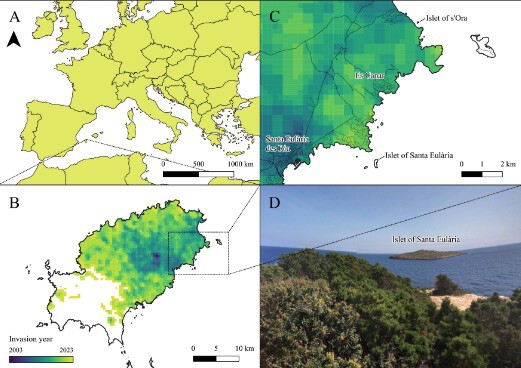
What Is Happening with the Horseshoe Snake?
The Center for Ecological Research and Forestry Applications (CREAF) has published a study documenting the origin and invasion status of the horseshoe snake. The expansion map is stark: in 2010, the snake was present in less than 5% of Ibiza's territory; by 2016, it occupied 40% of the island; and by 2025, it had reached 90%.
Led by Guillem Casbas and researcher Oriol Lapiedra, the team found that when the snake colonizes a new area, it can wipe out the entire lizard population in less than three years. The speed of expansion is alarming and shows no sign of slowing.
Why Does This Matter?
The Pitiusan lizard is not just any reptile; it is a unique evolutionary lineage found only in the Pitiusas. Each islet's population has evolved independently, resulting in 28 subspecies, many of which are endemic to a single islet.
The loss of these lizards would be a significant blow to global biodiversity. They play a crucial role in the ecosystem as pollinators and as prey for other species. Their disappearance could trigger cascading effects throughout the food web.
How Did the Snake Reach the Sea?
Recent observations have surprised researchers: horseshoe snakes have been seen swimming in open sea. This behavior is unusual for a land snake and raises concerns about its ability to spread to other islands.
If the snake can swim between islets, it could reach the remaining lizard populations that were previously considered safe due to their isolation. This new development makes the situation even more urgent. The background to this story is set out in Stranded Ships in Hormuz Risk Spreading Invasive Species Globally. A related thread runs through Invasive Species in Spain: Why the Guadalquivir Is a Hotspot. Earlier coverage in Invasive Species Cost Australia $24.5B: How to Respond shows how the argument developed.
What Are the Key Takeaways?
- The horseshoe snake has expanded from less than 5% to 90% of Ibiza's territory in just 15 years.
- It can eradicate local lizard populations in under three years after arrival.
- The Pitiusan lizard comprises 28 unique subspecies, many on small islets.
- Snakes have been observed swimming in open sea, threatening other islands.
- Urgent action is needed to prevent the snake's spread and protect the lizards.
Comparison of Invasion Timeline
| Year | Percentage of Ibiza Occupied |
|---|---|
| 2010 | Less than 5% |
| 2016 | 40% |
| 2025 | 90% |
What Can Be Done?
Conservationists are calling for immediate measures to control the snake population and protect the remaining lizard habitats. These include physical barriers, targeted trapping, and public awareness campaigns. A closer look at the same subject appears in Florida Python Challenge Winner Kills 96 Invasive Snakes. Anyone following the wider picture can start with Lizard Brain Theory: Do Humans Really Have a Reptilian Mind. The same theme surfaces in Ibiza Villa Rental at €300,000 a Week: Inside Sa Ferradura, which takes a different angle.
However, the snake's ability to swim complicates containment efforts. Researchers emphasize the need for a coordinated response involving local authorities, scientists, and the community. Context on how this played out before sits in Japan's Stray Cat Invasive Species Plan Sparks Backlash. A companion piece, Tree of Heaven: The Invasive Species Breaking Pipes in Spain, approaches the same subject from another angle.
FAQ
What is the horseshoe snake?
The horseshoe snake is a non-venomous species native to the Iberian Peninsula and North Africa. It was accidentally introduced to Ibiza in 2003 and has since become a major predator of the endemic Pitiusan lizard.
Why is the Pitiusan lizard important?
The Pitiusan lizard is endemic to the Pitiusas and has evolved into 28 unique subspecies. It is a key part of the ecosystem and a symbol of the islands' natural heritage.
Can the snake be stopped?
Efforts are underway to control the snake population, but its swimming ability makes containment challenging. Rapid response and public cooperation are essential to protect the remaining lizard populations.
How can I help?
Report snake sightings to local authorities, support conservation organizations, and spread awareness about the threat of invasive species in the Balearic Islands.
Browse the Shop
 Acacia frida deluxe solid wood bed frame |
Bedroom bench |
Bed chest drawers |
Lingerie dresser |
Frame base |
Mirror with jewelry storage |
30 Bathroom Vanity |
Memory foam queen mattress |
Mattresses for back pain |
Nightstand set of 2 |
Grand Goldman Shop |
Civil Lawyer
Deutschland Trikot WM 2026







