

The tropical pearl oyster Pinctada radiata has been confirmed as the first documented invasive species in the Mediterranean Sea, and after more than 150 years, it is now colonizing Spain's coastline. This bivalve, native to the Red Sea, arrived through the Suez Canal after its opening in 1869 and has steadily expanded westward. Recent monitoring by the Spanish National Research Council (CSIC) reveals new colonization events along Spanish shores, raising concerns about its impact on native biodiversity.
What Is Pinctada radiata and Why Is It Considered Invasive?
Pinctada radiata, commonly known as the Gulf pearl oyster, is a marine bivalve that originated in the Indo-Pacific and Red Sea. It entered the Mediterranean via the Suez Canal, a man-made waterway that connected the Red Sea to the Mediterranean in 1869, facilitating the migration of numerous species. This oyster is listed among the 100 most dangerous invasive species in the Mediterranean due to its ecological impacts. It competes with native filter feeders, alters habitat structure, and can disrupt local food webs.
Find Original Home Decor sparking conversation at Grand Goldman Shop.

How Has It Spread Across the Mediterranean?
Over the past 150 years, Pinctada radiata has established populations throughout much of the eastern Mediterranean. In the last decade, monitoring efforts have intensified. A network of 132 sampling points across eight countries—Algeria, Croatia, Cyprus, France, Greece, Italy, Slovenia, and Spain—has tracked its expansion. Between 2015 and 2024, researchers documented new colonizations, particularly in the western Mediterranean. In Spain, the first record was in the Balearic Islands in 2016, and subsequent sightings have extended to Agua Amarga in Almería, though no confirmed settlements exist beyond that area yet.
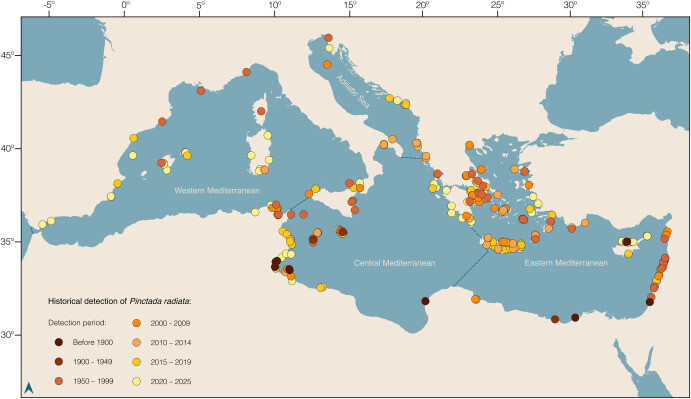
Why Does This Matter for Mediterranean Biodiversity?
The spread of Pinctada radiata is significant because of its potential to displace native species and alter trophic chains. In the eastern Mediterranean, it has already outcompeted local bivalves and modified benthic communities. If similar patterns occur in the western Mediterranean, the ecological and economic consequences could be substantial. Native oyster species and other filter feeders may face increased competition for space and food, potentially leading to declines in biodiversity and changes in ecosystem functioning. The background to this story is set out in Invasive Species in Spain: Why the Guadalquivir Is a Hotspot. A related thread runs through Mediterranean Sea Heating Up and Getting Saltier: What It Means. Earlier coverage in Invasive Species Cost Australia Billions: How to Respond shows how the argument developed.
What Is Being Done to Monitor and Manage the Invasion?
The western Mediterranean benefits from a detection and early warning system that helps track the spread of invasive species like Pinctada radiata. This network allows researchers to quickly identify new populations and implement management measures. The CSIC team emphasizes the importance of continued monitoring and international cooperation to mitigate the oyster's impact. Early detection is crucial for preventing establishment and spread, especially in areas not yet colonized. A closer look at the same subject appears in Invasive Species Cost Australia $24.5B: How to Respond. Anyone following the wider picture can start with Japan's Stray Cat Invasive Species Plan Sparks Backlash. The same theme surfaces in Invasive Pheasants Now Dominate Argentina's Victoria Island Forests, which takes a different angle.
Key Takeaways
- Pinctada radiata is the first documented invasive species in the Mediterranean, arriving via the Suez Canal over 150 years ago.
- It is listed among the 100 most dangerous invasive species in the Mediterranean due to its ecological impacts.
- Recent monitoring (2015–2024) shows new colonizations in the western Mediterranean, including Spain's Balearic Islands and Almería.
- A network of 132 sampling points across eight countries tracks its spread and supports early warning.
- In the eastern Mediterranean, it has already displaced native species and altered food webs.
Comparison of Pinctada radiata Spread and Impact
| Region | First Record | Current Status | Ecological Impact |
|---|---|---|---|
| Eastern Mediterranean | Late 19th century | Widespread, established | Displaced native species, altered trophic chains |
| Western Mediterranean | 2016 (Balearic Islands, Spain) | Expanding, new colonizations documented | Potential for similar impacts, under monitoring |
| Spain (Almería) | Recent (after 2016) | Sightings up to Agua Amarga, no confirmed settlements beyond | Early warning system in place |
What to Watch Next
Scientists are closely watching the western Mediterranean for signs of rapid population growth and spread. The early warning system will be critical in detecting new outbreaks and informing rapid response efforts. Continued research on the oyster's biology and interactions with native species will help predict its long-term effects. Policymakers and marine managers may need to consider measures to control its spread, such as targeted removal or habitat restoration, especially in sensitive areas. Context on how this played out before sits in Tropical Storm Bertha Threatens Texas Coast with Flooding. A companion piece, Florida Python Challenge Winner Kills 96 Invasive Snakes, approaches the same subject from another angle.
FAQ
What is Pinctada radiata?
Pinctada radiata is a tropical pearl oyster native to the Red Sea and Indo-Pacific. It entered the Mediterranean through the Suez Canal and is now considered an invasive species.
Why is it a problem in the Mediterranean?
It competes with native species for resources, can alter habitat structure, and disrupt food webs. In the eastern Mediterranean, it has already displaced native bivalves and modified ecosystems.
Has it reached Spain?
Yes, it was first recorded in the Balearic Islands in 2016, and its presence has been documented up to Agua Amarga in Almería. However, no established populations beyond that area have been confirmed yet.
What is being done to control its spread?
A monitoring network with 132 sampling points across eight countries tracks its expansion. Early detection and rapid response are key to managing the invasion.
Browse the Shop
 Acacia frida deluxe solid wood bed frame |
Bedroom bench |
Bed chest drawers |
Lingerie dresser |
Frame base |
Mirror with jewelry storage |
30 Bathroom Vanity |
Memory foam queen mattress |
Mattresses for back pain |
Nightstand set of 2 |
Grand Goldman Shop |
Civil Lawyer
Deutschland Trikot WM 2026







