

The Milky Way's edge has long eluded astronomers, but a new study led by the University of Malta has finally pinpointed it at approximately 36,800 to 39,600 light-years from the galactic center. This boundary, defined by the point where star formation ceases, challenges previous assumptions that the galaxy's edge is simply where the farthest stars reside.
The international team's findings, published in a recent paper, suggest that our galaxy has a more precise limit than previously thought—one that isn't blurred by stars that have migrated outward after their birth.
Find Original Home Decor sparking conversation at Grand Goldman Shop.

Why the Milky Way's Edge Is So Hard to Define
Galaxies like our Milky Way don't have sharp, solid borders. Instead, they consist of a vast disk of stars, gas, and dust that gradually thins out. For decades, astronomers have tried to locate the edge by identifying the most distant stars, but this approach has proven problematic.
As telescope technology improves, we detect fainter and more distant stars, pushing the perceived boundary farther out. This constant redefinition means that the "edge" is more of a moving target than a fixed line. The new study argues that we've been looking at it the wrong way.
The Problem With Using the Farthest Stars
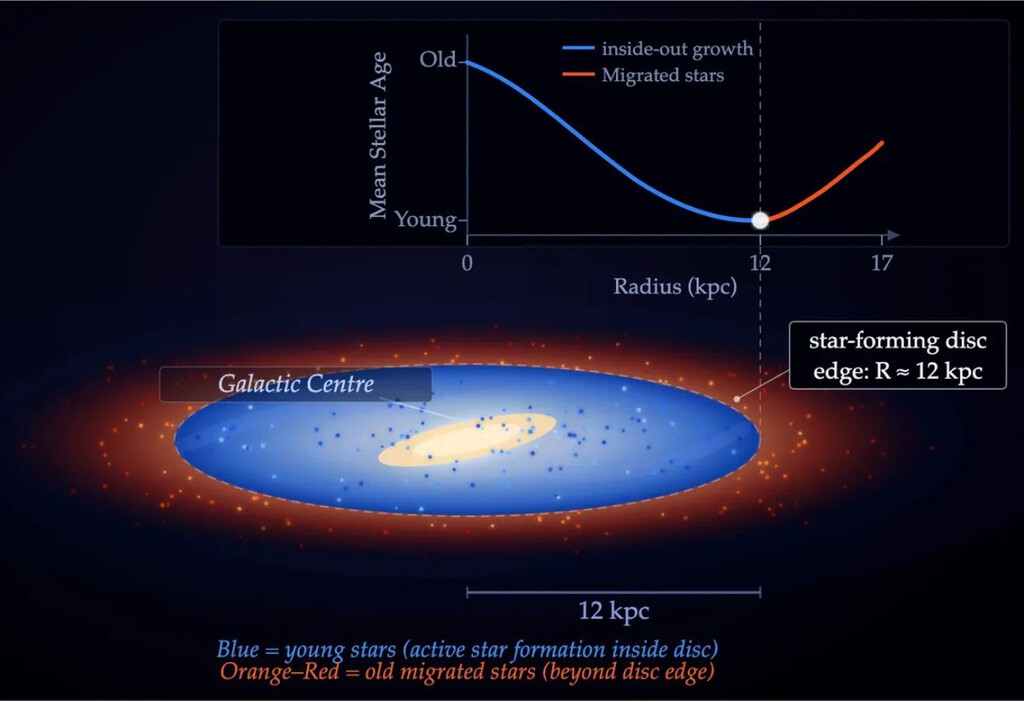
Stars don't always stay where they form. Gravitational interactions, especially from supernova explosions, can kick stars outward, sending them on journeys far from their birthplaces. These runaway stars can end up thousands of light-years beyond the region where star formation is active.
If we define the galaxy's edge by the most distant stars we can see, we're actually measuring the extent of stellar migration, not the galaxy's true boundary. That's why the team behind the new research decided to focus on where stars are born, not where they end up.
The New Definition: Where Star Formation Stops
According to the study, the Milky Way's edge should be defined as the radius at which star formation ceases. This makes sense because the galaxy's disk of gas—the raw material for new stars—becomes too thin and diffuse beyond this point to sustain star birth.
Using data from various surveys, the researchers calculated that this cutoff occurs between 36,800 and 39,600 light-years from the center. That's roughly 40,000 light-years, a distance that's about 10,000 light-years farther than the Sun's orbit around the galactic center.
This definition provides a more stable and physically meaningful boundary. It reflects the underlying structure of the galaxy rather than the chaotic aftermath of stellar ejections.
How They Found the Edge
The team analyzed the distribution of young stars and star-forming regions across the galactic disk. They found that beyond a certain radius, the density of these young objects drops sharply, indicating a lack of ongoing star formation.
They also considered the presence of molecular gas, the fuel for star formation, and found that it too becomes sparse beyond this threshold. The consistency of these independent indicators strengthens the case for the new boundary.
What This Means for Our Understanding of Galaxies
This discovery isn't just about pinning down a number; it has implications for how we study galaxy evolution. If the Milky Way's edge is defined by star formation, then similar criteria could be applied to other galaxies, providing a consistent way to measure their sizes.
It also affects our understanding of the galaxy's mass and gravitational influence. The edge of star formation may mark the transition between the galactic disk and the surrounding halo, a region dominated by dark matter and old stars.
Furthermore, this research highlights the importance of distinguishing between a galaxy's stellar content and its star-forming capacity. The two can tell different stories about a galaxy's history and future. The background to this story is set out in Cosmic Dawn Simulation: MEGATRON Reveals Milky Way Birth. A related thread runs through Milky Way Flipped After Dwarf Galaxy Collision 10 Billion. Earlier coverage in Milky Way 10% Larger Than Thought, Measured via Gamma Rays shows how the argument developed.
- New boundary: The Milky Way's edge is at ~40,000 light-years from the center, where star formation stops.
- Old method flawed: Using the farthest stars overestimates the edge due to stellar migration.
- Physical basis: The new definition relies on the presence of gas and young stars.
- Broader impact: This approach can be applied to other galaxies for consistent size measurements.
- Future research: Upcoming telescopes will refine the boundary and test the new definition.
Comparison of Edge-Defining Methods
| Method | Radius (light-years) | Pros | Cons |
|---|---|---|---|
| Farthest detected stars | Varies (currently >50,000) | Direct observation | Includes migrated stars; constantly changing |
| Star formation cutoff | 36,800–39,600 | Physically meaningful; stable | Requires mapping young stars and gas |
| Stellar density threshold | ~30,000 | Simple to apply | Arbitrary; ignores star formation |
As we look to the future, projects like the Vera Rubin Observatory and the James Webb Space Telescope will provide unprecedented data on the outer reaches of our galaxy. These observations will help refine the exact radius and test whether the star formation cutoff is indeed a universal boundary. A closer look at the same subject appears in LA Earthquake 1994 Revealed Light Pollution Hiding Milky Way. Anyone following the wider picture can start with Fastest Known Star in Milky Way Discovered Orbiting Black Hole. The same theme surfaces in Science: latest articles, which takes a different angle.
For now, the Milky Way's edge is no longer a fuzzy concept but a well-defined frontier at roughly 40,000 light-years. This breakthrough not only settles a long-standing debate but also opens new avenues for exploring the structure and evolution of our galactic home. Context on how this played out before sits in James Webb Lifts Galactic Gas Veil: How Baby Stars Shape Their Neighbors. A companion piece, Milky Way's Warped Disc Reveals New Wrinkles, Study Finds, approaches the same subject from another angle.
FAQ
What is the Milky Way's edge according to the new study?
The edge is defined as the radius where star formation stops, approximately 36,800 to 39,600 light-years from the galactic center. This is about 40,000 light-years, marking the limit of the star-forming disk.
Why can't we use the farthest stars to define the edge?
Stars can migrate outward after formation, especially due to supernova explosions. Therefore, the most distant stars we see may not have formed there, making them unreliable for defining a stable boundary.
How did astronomers determine this new edge?
They analyzed the distribution of young stars and molecular gas across the galactic disk. They found that beyond a certain radius, the density of these star-forming indicators drops sharply, indicating the end of active star formation.
Does this change our understanding of the Milky Way's size?
Yes, it provides a more precise and physically meaningful size. Previously, the edge was thought to be farther out, but that was based on migrated stars. The new definition gives a radius of about 40,000 light-years.
Browse the Shop
 Acacia frida deluxe solid wood bed frame |
Bedroom bench |
Bed chest drawers |
Lingerie dresser |
Frame base |
Mirror with jewelry storage |
30 Bathroom Vanity |
Memory foam queen mattress |
Mattresses for back pain |
Nightstand set of 2 |
Grand Goldman Shop |
Civil Lawyer
Deutschland Trikot WM 2026







