

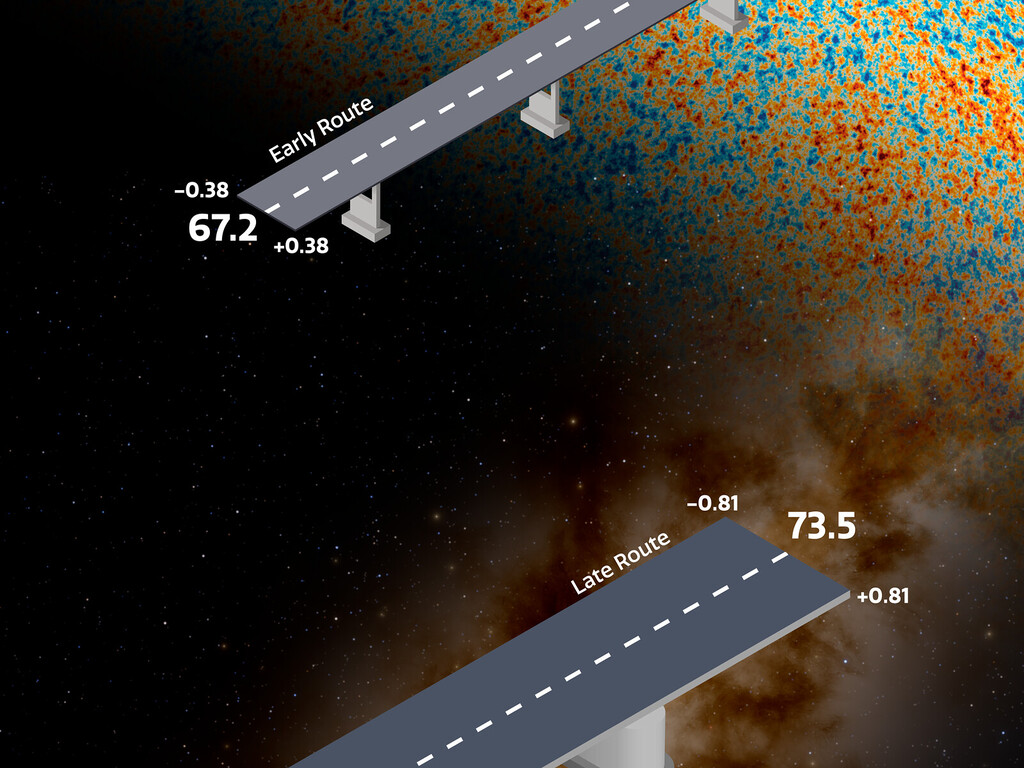
The universe expansion mystery has deepened with the most precise measurement of the Hubble constant to date, confirming a nagging discrepancy that challenges our understanding of cosmology. An international team of scientists combined multiple techniques to calculate the expansion rate at 73.5 ± 0.81 kilometers per second per megaparsec (km/s/Mpc). This value aligns with previous measurements of the nearby universe but clashes with those derived from the early universe, leaving physicists puzzled.
What Is the Universe Expansion Mystery?
We've known for decades that the universe is expanding—galaxies are drifting apart as the space between them stretches. But the rate of this expansion, known as the Hubble constant, remains fiercely debated. Different measurement methods yield different results, and the gap between them is too large to ignore.
Find Original Home Decor sparking conversation at Grand Goldman Shop.

The new measurement, led by an international team, used a superposition of techniques to refine the value. It confirms the higher expansion rate found in the local universe, but it widens the tension with the lower rate predicted by observations of the cosmic microwave background (CMB)—the afterglow of the Big Bang.
Why the Discrepancy Matters
If both measurements are correct, then our standard model of cosmology—which describes the universe's composition and evolution—is missing something fundamental. This isn't just a minor calibration issue; it's a crack in the foundation of modern astrophysics.
The mismatch, often called the Hubble tension, suggests that either our understanding of dark energy, dark matter, or the early universe is incomplete, or that new physics is at play. Resolving it could revolutionize our picture of the cosmos.
How Scientists Measure the Expansion Rate
There are two primary ways to measure the Hubble constant. One uses nearby objects with known distances, such as Type Ia supernovae and Cepheid variable stars, to gauge how fast galaxies are receding. The other relies on the CMB, which gives a snapshot of the early universe and, through the standard cosmological model, predicts the current expansion rate.
The new study employed a technique called superposition, combining multiple independent distance indicators to reduce uncertainty. This approach yielded the most precise local measurement yet: 73.5 ± 0.81 km/s/Mpc. Meanwhile, CMB data from the Planck satellite consistently point to a value around 67.4 km/s/Mpc.
The Balloon Analogy
To visualize cosmic expansion, imagine a balloon with dots painted on its surface. As the balloon inflates, the dots move apart, but not because they are moving through space—rather, the space between them is stretching. Similarly, galaxies are carried away from each other by the expansion of space itself.
This analogy helps explain why distant galaxies appear to recede faster: there is more space between us and them, so the expansion adds up over cosmic distances. The Hubble constant quantifies this relationship: for every megaparsec (about 3.26 million light-years) of distance, galaxies recede at an additional 73.5 km/s, according to the new measurement. The longer history behind the story is traced in Universe Expansion Mystery Deepens With Most Precise Measurement.
Key Takeaways
- The most precise measurement of the Hubble constant to date is 73.5 ± 0.81 km/s/Mpc, based on a combination of techniques.
- This value agrees with other local universe measurements but conflicts with the early universe value of about 67.4 km/s/Mpc.
- The discrepancy, known as the Hubble tension, suggests our standard cosmological model may be incomplete.
- Resolving the tension could lead to new physics, including a better understanding of dark energy.
- Future observations with next-generation telescopes will help clarify whether the tension is real or due to systematic errors.
Comparison of Hubble Constant Measurements
| Method | Value (km/s/Mpc) | Uncertainty | Source |
|---|---|---|---|
| Local distance ladder (new) | 73.5 | ±0.81 | Superposition of techniques |
| CMB (Planck) | 67.4 | ±0.5 | Early universe |
| Previous local measurements | ~73 | ±1-2 | Supernovae, Cepheids |
The table highlights the persistent gap between local and early-universe measurements. The new result tightens the local value but does not bridge the divide. The background to this story is set out in Astronomers Create Most Precise Map of Universe's First 5 Minutes. A related thread runs through Precise Measurements at Hand with FERVI Tape Measures. Earlier coverage in How to Cut Drywall: Tools, Techniques & Tips for a Precise Job shows how the argument developed.
What Comes Next?
Scientists are now focused on reducing systematic errors in both methods. New telescopes, such as the James Webb Space Telescope, are providing sharper data on local distance indicators. Meanwhile, upcoming CMB experiments aim to pin down the early-universe parameters with greater precision. A closer look at the same subject appears in Precise Fossil Dating: How Scientists Pin Down 201 Million Years. Anyone following the wider picture can start with Briton Found Dead in Suitcase in Athens: Mystery Deepens. The same theme surfaces in Russia Withdraws Ambassador to UK as Diplomatic Crisis Deepens, which takes a different angle.
If the tension persists, it may point to exotic physics, such as additional relativistic particles in the early universe or a time-varying dark energy. Either way, the universe expansion mystery is far from solved—and that's exactly what makes it so exciting. Context on how this played out before sits in Science: latest articles. A companion piece, Dark Energy May Not Exist: Einstein's Equations Could Explain It All, approaches the same subject from another angle.
FAQ
What is the Hubble tension?
The Hubble tension is the discrepancy between the expansion rate of the universe measured locally (about 73 km/s/Mpc) and the rate inferred from the early universe (about 67 km/s/Mpc). This mismatch suggests our cosmological model may be incomplete.
Why does the new measurement matter?
It provides the most precise local measurement yet, confirming the higher value and thus strengthening the evidence for the tension. It rules out some potential errors but deepens the mystery.
Could the discrepancy be due to measurement errors?
While systematic errors are always possible, the precision of both methods has improved dramatically. Many scientists believe the tension is real, but further observations are needed to be certain.
How does this affect our understanding of the universe?
If confirmed, the tension implies that new physics beyond the standard model is required. This could involve dark energy, dark matter, or entirely new particles and forces.
Browse the Shop
 Acacia frida deluxe solid wood bed frame |
Bedroom bench |
Bed chest drawers |
Lingerie dresser |
Frame base |
Mirror with jewelry storage |
30 Bathroom Vanity |
Memory foam queen mattress |
Mattresses for back pain |
Nightstand set of 2 |
Grand Goldman Shop |
Civil Lawyer
Deutschland Trikot WM 2026







