

LaLiga IP blocking has returned with the new football season, and with it a familiar side effect: mass IP address blocks aimed at curbing illegal IPTV broadcasts. On Saturday, August 15, just before the first afternoon match, blocks began to activate again and grew to a peak of around 550 blocked IPs near midnight. Cloudflare was once again one of the most affected infrastructures.
The problem is that an IP address does not equal a website. Services like Cloudflare act as shared proxies: a single IP can be used simultaneously by thousands of unrelated domains. So when that entire IP is blocked because it theoretically hosts a service illegally streaming matches, access to all websites sharing that infrastructure also disappears.
Find Original Home Decor sparking conversation at Grand Goldman Shop.

Why IP Blocking Is a Blunt Instrument
Blocking an IP address is a crude technical measure. In shared hosting environments, one IP can serve many domains, so blocking it affects all of them. OONI summarized the difference well: blocking an IP on Cloudflare or SquareSpace can affect many domains at once, but doing so with certain Amazon or Akamai services usually has a much more localized impact.
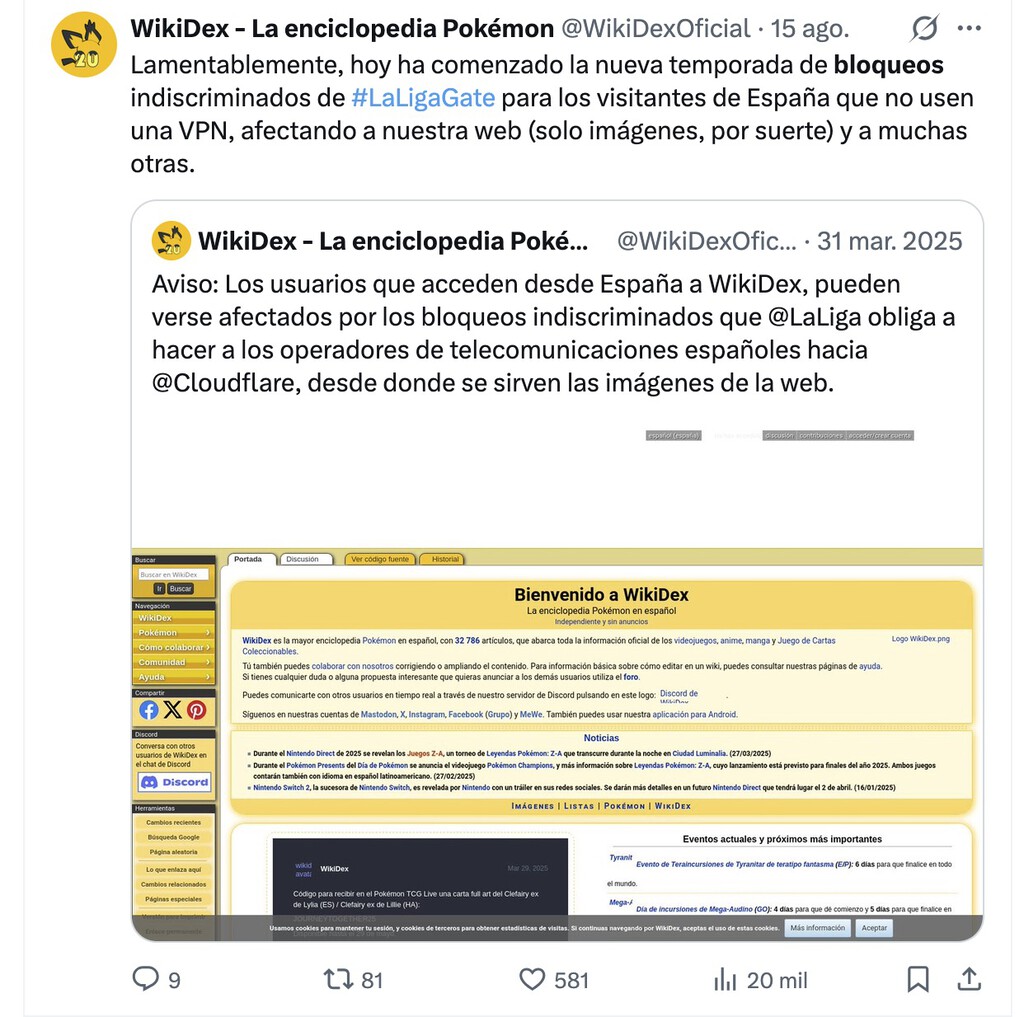
This is not a new phenomenon. For years, digital rights advocates have warned that IP blocking is an imprecise tool that often catches legitimate content in its net. The return of LaLiga is a reminder that this "tragic tradition" in Spain is far from resolved.

Collateral Damage: WikiDex and Others
WikiDex, a Pokémon encyclopedia, was one of the affected sites and reported problems with its service. This case illustrates how a site completely unrelated to football can go offline because it shares an IP with a service that is being targeted. The damage is not just technical but also reputational and financial for the site owners.
Other legitimate businesses and platforms can suffer similar fates. When an IP is blocked, users see errors, pages fail to load, and trust erodes. For small site owners, this can mean lost revenue and frustrated visitors.
How IP Blocking Works and Why It Fails
ISPs implement blocks by preventing traffic to specific IP addresses. This is often done in response to court orders or agreements with rights holders. However, the technical reality is that pirates can easily shift to new IPs, while legitimate sites cannot change their infrastructure overnight.
Moreover, the blocklists are often generated automatically and may not be thoroughly vetted. Mistakes happen, and when they do, the collateral damage is immediate and widespread.
The Role of Cloudflare and Shared Hosting
Cloudflare provides CDN and DDoS protection services to millions of websites. Its shared IPs are a prime target for broad blocks because they host both legitimate and potentially infringing content. Blocking Cloudflare IPs is like using a sledgehammer to crack a nut—it affects everyone on that IP, not just the intended target.
Alternatives exist, such as blocking specific domains or URLs, but these are more resource-intensive and require cooperation from intermediaries. Rights holders argue that IP blocking is faster and more effective, but the collateral damage is a price they seem willing to pay.
What This Means for Website Owners and Users
If you run a website that shares IPs with other services, you are vulnerable. During football matches, your site could become inaccessible through no fault of your own. Users may not understand why, and your business could suffer.
For users, the blocks mean unexpected outages. You might try to visit a favorite site and find it unreachable, with no explanation. This erodes trust in the internet as a reliable platform.
- Shared IPs are a single point of failure—blocking one can take down thousands of sites.
- Collateral damage is common—WikiDex and other non-football sites have been hit.
- Pirates adapt quickly—blocks are often ineffective at stopping illegal streams.
- Legitimate businesses suffer—lost revenue and reputation damage.
- Technical alternatives exist—domain or URL blocking is more precise but harder to implement.
Comparison of Blocking Methods
| Method | Precision | Impact on Legitimate Sites | Ease of Implementation |
|---|---|---|---|
| IP Blocking | Low | High (shared IPs) | Easy |
| Domain Blocking | Medium | Low | Moderate |
| URL Blocking | High | Very Low | Difficult |
| DNS Blocking | Medium | Low | Moderate |
The table shows why IP blocking is popular among rights holders—it's easy—but it comes at a high cost to legitimate sites. More precise methods exist but require more effort and cooperation.
The Future of Anti-Piracy Measures
As piracy evolves, so must anti-piracy measures. Dynamic blocking, where IPs are blocked only during match times, is one approach, but it still affects shared IPs. Better coordination between rights holders and intermediaries could reduce collateral damage.
Legislators should also consider the impact on fundamental rights. Blocking access to information, even unintentionally, raises freedom of expression concerns. A balanced approach is needed. The background to this story is set out in Spanish Game Dev's Server Blocked by LaLiga IP Bans During Matches. A related thread runs through England World Cup Heartbreak: A Tale of Familiar Disappointment. Earlier coverage in PHP2Shell Vulnerability: How Cloudflare Shielded 40% of the Internet shows how the argument developed.
What to Watch Next
With the season underway, more blocks are likely. Keep an eye on reports from affected sites and digital rights organizations. If you own a website, consider whether your hosting setup makes you vulnerable to collateral blocks. A closer look at the same subject appears in Technology: latest articles. Anyone following the wider picture can start with Spain Blocks Archive.today: What the Government Order Means. The same theme surfaces in Google's Submarine Cable Plan Makes Dominican Republic Digital Hub, which takes a different angle.
The return of LaLiga IP blocking is a reminder that the fight against piracy often comes at a cost to the open internet. Until more precise methods are adopted, this sad tradition will continue. Context on how this played out before sits in Bill Gates Email Hoax: How a Student Prank Promised $1,000.
FAQ
What is LaLiga IP blocking?
LaLiga IP blocking refers to the practice of blocking IP addresses to prevent illegal IPTV broadcasts of football matches. It often affects shared IPs, causing collateral damage to legitimate websites.
Why does IP blocking affect legitimate websites?
Because many websites share the same IP address, especially through services like Cloudflare. Blocking one IP can take down thousands of unrelated sites.
Was WikiDex affected by these blocks?
Yes, WikiDex, a Pokémon encyclopedia, reported problems during the blocks. It is an example of collateral damage to a site unrelated to football.
What are the alternatives to IP blocking?
Alternatives include domain blocking, URL blocking, and DNS blocking. These are more precise but may be harder to implement or require more cooperation.
Browse the Shop
 Acacia frida deluxe solid wood bed frame |
Bedroom bench |
Bed chest drawers |
Lingerie dresser |
Frame base |
Mirror with jewelry storage |
30 Bathroom Vanity |
Memory foam queen mattress |
Mattresses for back pain |
Nightstand set of 2 |
Grand Goldman Shop |
Civil Lawyer
Deutschland Trikot WM 2026







