

Donald Trump's AI Moon claim has reignited a debate about lunar sovereignty, but the legal reality is clear: the Moon cannot belong to any nation. In a recent post on Truth Social, Trump suggested that the Moon should be American because the U.S. was the first to land there—and possibly the second, too. The statement, delivered with his signature bravado, ignores a fundamental piece of international law that has governed space for over five decades.
The 1967 Outer Space Treaty, signed by 62 countries including the United States, explicitly prohibits any nation from claiming sovereignty over celestial bodies. Today, 118 nations are party to the treaty, which declares space the province of all mankind. Trump's assertion isn't just provocative—it's legally baseless. Yet it raises important questions about how space law applies to modern ambitions and whether loopholes could be exploited.
Find Original, High-end Home Decor that spark conversation at Grand Goldman Shop.
What Trump Said About the Moon
Trump's remarks came via a post on Truth Social, where he has increasingly shared AI-generated images. According to the source article, he argued that because the U.S. was first to land on the Moon, it should be American territory. He also hinted that the U.S. might be the second country to return, given the current state of space exploration.
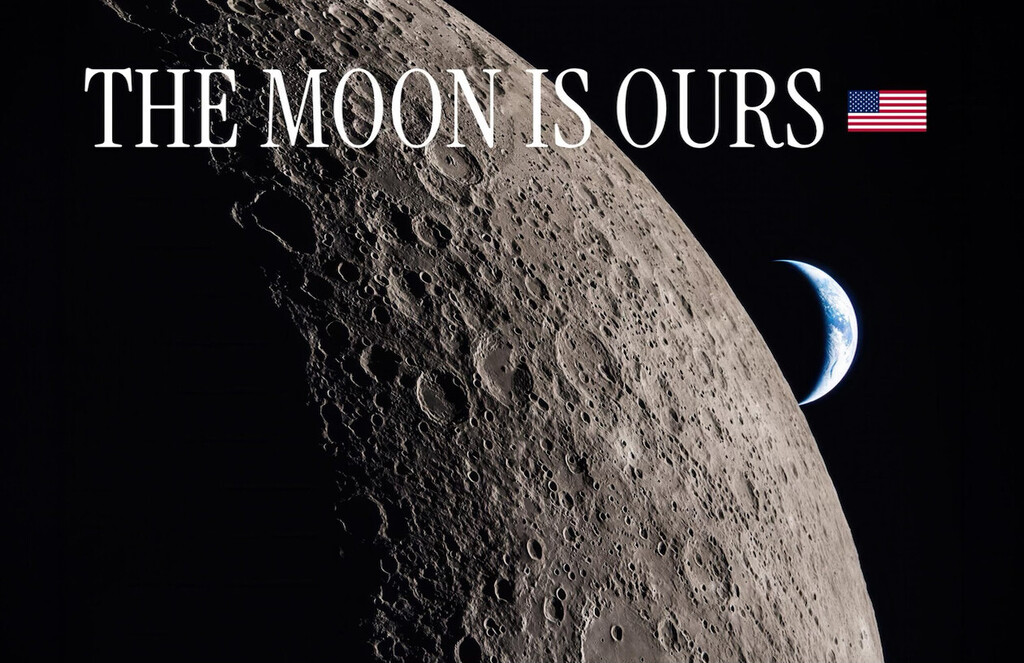
The logic is simple but flawed: first to arrive doesn't mean ownership. The Outer Space Treaty was designed precisely to prevent such claims. It states that the Moon and other celestial bodies are not subject to national appropriation by claim of sovereignty, by means of use or occupation, or by any other means. In other words, planting a flag doesn't grant ownership—it's a symbolic gesture.
Trump's post is part of a pattern. Since he learned to generate images with AI, his Truth Social feed has featured bizarre visuals: himself destroying Iran with a hammer, chatting with George Washington in the Oval Office, and walking alongside a captured alien. These posts blur the line between political commentary and science fiction, making it hard to take his Moon claim seriously—yet the underlying issue of space governance is very real.
The Outer Space Treaty: A Barrier to Lunar Claims
The Outer Space Treaty (formally the Treaty on Principles Governing the Activities of States in the Exploration and Use of Outer Space, including the Moon and Other Celestial Bodies) was adopted by the United Nations in 1967. It has been ratified by 118 countries, including all major spacefaring nations. Its core principles are clear:
- No national appropriation: Article II prohibits claims of sovereignty over the Moon or any other celestial body.
- Peaceful use: The Moon and other bodies must be used exclusively for peaceful purposes.
- Free access: All states have the right to explore and use space without discrimination.
- International responsibility: States are responsible for their national activities in space, including those by private companies.
- Environmental protection: States must avoid harmful contamination of space and celestial bodies.
These principles have been remarkably durable, but they are not without ambiguity. The treaty doesn't explicitly address resource extraction or property rights for private entities, which has led to debates about whether companies could claim ownership of materials they mine. However, the prohibition on national sovereignty is unambiguous—no country can claim the Moon as its territory.
Why Trump's Claim Is Legally Impossible
Trump's suggestion that the Moon should be American directly contradicts Article II of the Outer Space Treaty. The United States is a signatory and has consistently upheld the treaty's principles, even as it pursues ambitious space programs. For Trump to claim lunar sovereignty would require withdrawing from the treaty—a move that would isolate the U.S. internationally and undermine decades of space cooperation.
Moreover, the treaty's provisions are considered customary international law, meaning they bind all nations, even those that haven't signed. So even if the U.S. tried to reinterpret the treaty, it would face significant legal and diplomatic hurdles. The Moon Agreement of 1979, which sought to prevent commercial exploitation of lunar resources, has only 18 parties, but the Outer Space Treaty remains the foundational framework.
Trump's argument also overlooks the fact that the U.S. is not the only country with lunar ambitions. China, Russia, and India have all made strides in lunar exploration. China's Chang'e missions have successfully landed on the Moon, and Russia has announced plans for a lunar base. If the U.S. were to claim sovereignty, it would set off a dangerous race for territorial claims, destabilizing space security.
The AI Factor: Truth Social's Fantasies
Trump's Moon claim is inseparable from his embrace of AI-generated imagery. The source article notes that his Truth Social posts have become increasingly surreal, featuring edited images that place him in absurd scenarios. These posts are entertaining but also concerning: they blur the line between reality and fiction, potentially misleading followers about factual matters.
In the case of the Moon, the AI-generated images may be tongue-in-cheek, but the underlying claim is not. Trump has a history of making statements that challenge established norms, and his base often takes him seriously. The risk is that his followers might believe the U.S. has a legitimate claim to the Moon, undermining public understanding of space law.
This isn't the first time AI has been used to spread misleading information. Deepfakes and AI-generated content are increasingly prevalent in politics, raising concerns about misinformation. Trump's posts are a high-profile example of how AI can be used to create alternate realities—and how those realities can shape public discourse. The longer history behind the story is traced in 300 TeV Photon Challenges Einstein's Lorentz Invariance.
What Happens Next? Legal Loopholes and Future Conflicts
While the Outer Space Treaty prohibits national sovereignty, it does have loopholes. For instance, it doesn't explicitly ban private property rights, which has led to speculation that companies could claim ownership of lunar land. The Artemis Accords, a U.S.-led effort to establish norms for lunar exploration, attempt to address these gaps by promoting transparency and interoperability. However, they are not legally binding and have been signed by only a handful of countries. The background to this story is set out in Ukraine Starlink Disruptions Persist Despite Trump Claim. A related thread runs through Falklands Sovereignty: Why the Islands Cannot Remain British Fore. Earlier coverage in Best Recent Sci-Fi Fantasy Horror Books Reviewed shows how the argument developed.
Another loophole is the treaty's silence on resource extraction. The U.S. Commercial Space Launch Competitiveness Act of 2015 allows American companies to own resources they extract from asteroids and the Moon, which some argue is a violation of the treaty's spirit. This gray area could become a flashpoint as commercial lunar activities increase. A closer look at the same subject appears in Best Recent Science Fiction, Fantasy and Horror Books. Anyone following the wider picture can start with Penny Wong Slams Hanson's Monoculture Vision as Melancholic Fantasy. The same theme surfaces in AI-Generated Images: Expert Answers on Photography Ethics, which takes a different angle.
Trump's claim, while legally unfounded, highlights the need for clearer international rules. As more countries and companies reach for the Moon, the potential for conflict grows. The Outer Space Treaty provides a foundation, but it may need updating to address modern challenges. Until then, claims of lunar sovereignty will remain in the realm of science fiction—or AI-generated fantasy. Context on how this played out before sits in AI-Generated Images: Why Photojournalism Ethics Matter Now. A companion piece, Brazil Sovereignty Under Threat: Trump Tariffs on Imports, approaches the same subject from another angle.
FAQ
Can any country claim the Moon as its territory?
No. The 1967 Outer Space Treaty prohibits any nation from claiming sovereignty over the Moon or other celestial bodies. Article II explicitly states that space is not subject to national appropriation by any means. This principle is binding on all signatories, including the United States.
What did Trump actually say about the Moon?
According to the source article, Trump posted on Truth Social that the Moon should be American because the U.S. was the first to land there. He also suggested the U.S. might be the second to return. The post was accompanied by AI-generated imagery, consistent with his recent social media activity.
Are there loopholes in the Outer Space Treaty?
Yes, the treaty has ambiguities, particularly regarding private property rights and resource extraction. It doesn't explicitly ban companies from owning materials they mine, which has led to debates about commercial lunar activities. However, national sovereignty claims remain clearly prohibited.
How does AI play into Trump's Moon claim?
Trump has been using AI to generate surreal images on Truth Social, including ones related to his Moon claim. These posts blend political commentary with science fiction, potentially misleading followers about legal realities. The use of AI amplifies the reach of such claims but doesn't change their legal validity.
Browse the Shop
 Acacia frida deluxe solid wood bed frame |
Bedroom bench |
Bed chest drawers |
Lingerie dresser |
Frame base |
Mirror with jewelry storage |
30 Bathroom Vanity |
Memory foam queen mattress |
Mattresses for back pain |
Nightstand set of 2 |
Grand Goldman Shop |
Civil Lawyer
Deutschland Trikot WM 2026







