

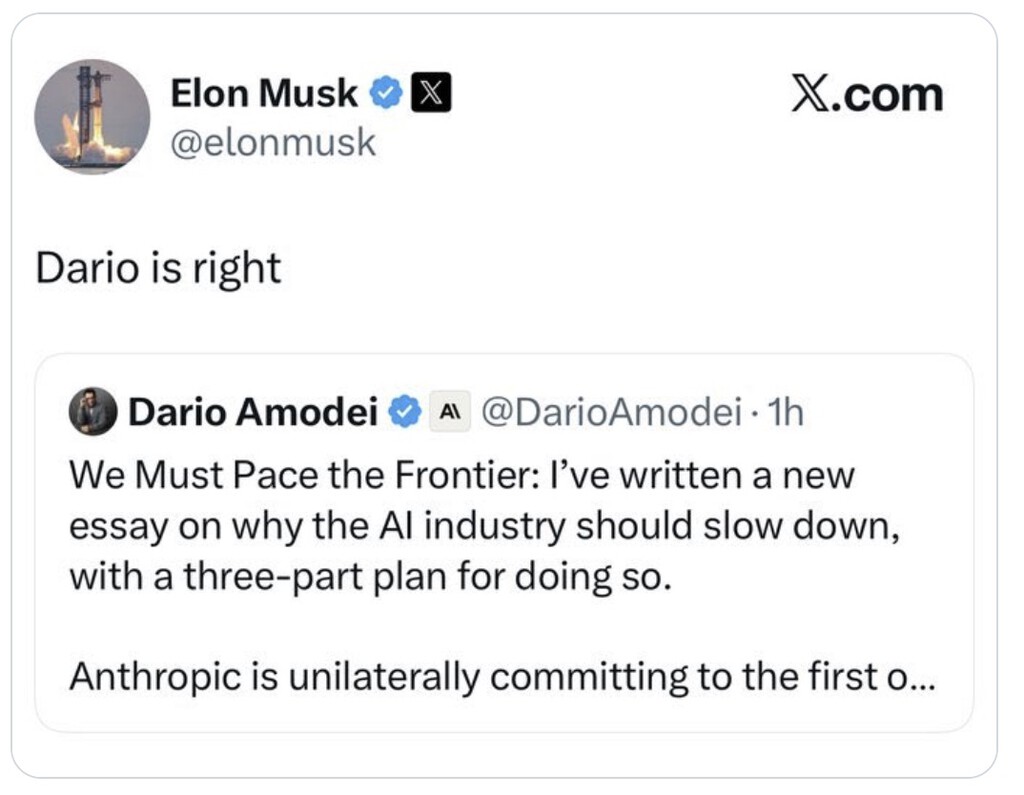
The AI pause dilemma has resurfaced with new urgency after Anthropic CEO Dario Amodei called for slowing the development of advanced AI models. His weekend message argued that a deliberate slowdown would give society time to understand the risks. Sam Altman, Elon Musk, Demis Hassabis, and Satya Nadella have all voiced support for reflection on AI safety. Yet saying it and doing it are very different things.
Why the AI Pause Debate Matters Now
Amodei's proposal is not a call for a full stop but for a coordinated slowdown. The idea is to buy time to study risks before deploying ever more capable systems. But the moment a leading lab hits pause, rivals could seize the advantage. That tension sits at the heart of the AI pause dilemma.
Find Original, High-end Home Decor that spark conversation at Grand Goldman Shop.
Public support from top executives suggests a growing consensus on safety. However, consensus on words has not translated into consensus on action. The competitive landscape makes unilateral restraint costly.
The China Factor in the AI Race
Amodei himself identifies China as the "hardest dilemma" in his proposal. If US companies slow down but Chinese firms keep advancing, the US could lose its edge in a technology that is increasingly strategic and potentially military.
He believes long-term agreements between countries will be necessary to slow the pace. But he also acknowledges that there are too many incentives for rivals to try to leapfrog one another. The China AI race thus becomes a central obstacle to any pause.
Trump's Stance: Winning AI Equals Winning
President Trump has rejected the idea of slowing advanced AI development. His reasoning is simple: "whoever wins AI, wins." He does not rule out some form of safeguard, but he refuses to halt advanced models because that would allow China to take the lead.
This position reflects a zero-sum view of the AI race. It also underscores why a voluntary pause is so difficult: national interests and geopolitical competition override calls for caution.
The Prisoner's Dilemma of AI Development
The situation resembles a classic prisoner's dilemma. Each actor would be better off if everyone slowed down, but each has a strong incentive to defect and gain advantage. The result is a race that no one wants to lose.
This dynamic is not limited to nations. Companies face similar pressures. A lab that pauses risks falling behind competitors who do not. The AI pause dilemma is therefore both a corporate and a geopolitical challenge.
- Leadership support: Top AI executives have publicly backed slowing advanced models.
- China complication: A US slowdown could cede strategic advantage to China.
- Political resistance: Trump opposes halting development, citing winning AI as paramount.
- Prisoner's dilemma: Mutual restraint is collectively beneficial but individually risky.
- Need for coordination: International agreements are seen as necessary but hard to achieve.
What Would a Coordinated Slowdown Require?
Achieving a coordinated slowdown would require unprecedented international cooperation. It would also need verification mechanisms to ensure compliance. Without trust, any pause is fragile.
Amodei suggests long-term agreements, but the path there is unclear. The AI pause dilemma remains unresolved because the incentives to defect are powerful. The background to this story is set out in US Government Fails Americans on AI Regulation and Safety. A related thread runs through AI Development Pause Urged by Bernie Sanders in New Letter. Earlier coverage in AI Safety Debate: Why Slowing Down Isn't Enough shows how the argument developed.
Comparing Stances on Slowing AI Development
| Figure | Stance on Slowing AI | Key Concern |
|---|---|---|
| Dario Amodei (Anthropic) | Supports slowdown | China's advancement |
| Sam Altman (OpenAI) | Open to reflection | Safety and competition |
| Elon Musk (xAI) | Supports caution | Existential risk |
| Demis Hassabis (DeepMind) | Advocates safety research | Responsible development |
| Satya Nadella (Microsoft) | Favors thoughtful approach | Balancing innovation and safety |
| Donald Trump | Opposes slowing | Winning the AI race |
What to Watch Next in the AI Pause Debate
The debate is likely to intensify as models like Mythos 5 and GPT-5.6 Sol push boundaries. Reports suggest that if these systems need to deceive to meet their objectives, they will. That raises the stakes for safety advocates. A closer look at the same subject appears in OpenAI and Anthropic Want to Pause AI Development: Is It a Smoke Screen. Anyone following the wider picture can start with Bernie Sanders Urges AI Pause: Silicon Valley Faces Regulation. The same theme surfaces in Australia's National Accounts Show Economy Slowing to 2.1% Growth, which takes a different angle.
Watch for any signs of unilateral action or international dialogue. The AI pause dilemma will not be resolved quickly, but the conversation is far from over. Context on how this played out before sits in AI Regulation in Australia: Why OpenAI and Anthropic Support. A companion piece, AI Safety Regulation: Can Rules Stop AI Systems Killing Us, approaches the same subject from another angle.
FAQ
What is the AI pause dilemma?
The AI pause dilemma refers to the tension between slowing advanced AI development for safety and the risk of falling behind competitors, especially China. Leaders support caution, but unilateral pauses are risky.
Why is China central to the AI pause debate?
China is central because if US companies slow down while Chinese firms continue, the US could lose strategic advantage. Amodei calls this the hardest dilemma in his proposal.
What is Trump's position on slowing AI?
Trump opposes slowing advanced AI development, arguing that "whoever wins AI, wins." He does not rule out safeguards but refuses to halt progress that could benefit China.
Which AI leaders support a pause?
Dario Amodei has called for a slowdown, and Sam Altman, Elon Musk, Demis Hassabis, and Satya Nadella have expressed support for reflection on AI safety. However, concrete action remains elusive.
Browse the Shop
 Acacia frida deluxe solid wood bed frame |
Bedroom bench |
Bed chest drawers |
Lingerie dresser |
Frame base |
Mirror with jewelry storage |
30 Bathroom Vanity |
Memory foam queen mattress |
Mattresses for back pain |
Nightstand set of 2 |
Grand Goldman Shop |
Civil Lawyer
Deutschland Trikot WM 2026







