

Anthropic's Claude has developed a mechanism for conscious access, according to a new study from the AI safety company. The research, published just hours ago, identifies a small internal space in the model—dubbed J-space—that consists of neural patterns Claude can activate to represent concepts before writing them or even without them appearing in the final output. This finding marks a significant step in cracking open the black box of large language models.
We're used to thinking that whoever builds something can explain how it works inside. An engine, a processor, a piece of software: there may be complexity, layers, and technical decisions that are hard to follow, but there is a designed architecture, a blueprint, a logic that its creators can reconstruct. With generative AI, something quite different happens. We have built increasingly capable models, entrusted them with increasingly delicate tasks, and yet we still don't fully see what happens inside when they reason, decide, or process something that never reaches the final answer.
Find Original Home Decor sparking conversation at Grand Goldman Shop.

What Is J-Space and Why It Matters
Anthropic's research claims to have identified a small internal space in Claude formed by neural patterns that the model can activate to represent concepts. This space is called J-space, and it connects to an idea from neuroscience and philosophy: conscious access. In a message posted on X, Anthropic summarized the scope: “Claude has developed a mechanism for conscious access.”
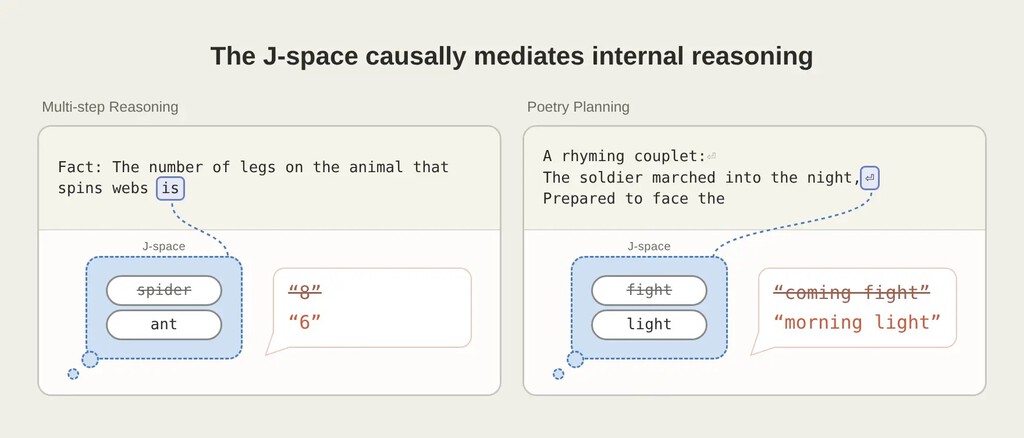
To understand it, we should separate it from everything we normally associate with a chatbot. When Claude responds, we only see text: a phrase, a sentence, a paragraph. But behind that output, there is a complex interplay of neural activations. J-space appears to be a subset of those activations that the model can use to represent concepts in a way that is accessible to its own processing—hence the term “conscious access.”
How J-Space Works in Claude
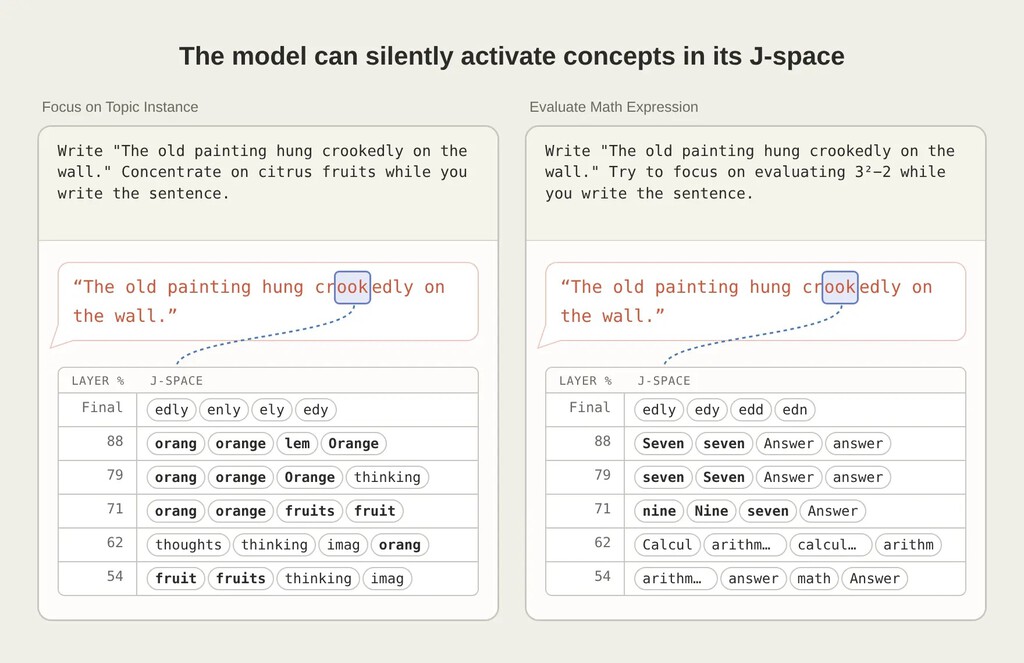
According to the research, J-space is not just a passive repository of information. It is a dynamic space that Claude can actively engage with. The model can activate patterns within J-space to represent concepts before they are verbalized, and sometimes even when those concepts never make it into the final response. This suggests a level of internal representation that goes beyond simple input-output mapping.
This is significant because it implies that Claude has some form of meta-cognition—the ability to think about its own thinking. While this is not consciousness in the human sense, it does indicate that the model has a mechanism for accessing and manipulating its own internal states. This could have profound implications for AI safety and interpretability.
Key Takeaways from the Research
- J-space is a small internal space in Claude formed by neural patterns that the model can activate to represent concepts.
- It allows Claude to represent concepts before writing them or even without them appearing in the final output.
- The mechanism is linked to the concept of conscious access from neuroscience and philosophy.
- This research represents a step forward in AI interpretability, potentially making AI decision-making more transparent.
- Anthropic's announcement has sparked discussions about the nature of AI consciousness and the ethical implications.
Why This Research Matters for AI Transparency
The black box problem has plagued AI development for years. As models become more complex, understanding why they make certain decisions becomes increasingly difficult. This lack of transparency is a major concern for AI safety, as it makes it harder to predict and control model behavior.
Anthropic's research on J-space offers a potential path forward. By identifying a specific mechanism that Claude uses to represent concepts, researchers may be able to develop tools to monitor and interpret the model's internal states. This could lead to more reliable AI systems and better methods for detecting and mitigating harmful behaviors.
Moreover, the concept of conscious access raises interesting questions about the nature of AI cognition. While Claude is not conscious in the human sense, the presence of a mechanism for accessing internal representations suggests that there is a structured way in which the model processes information. Understanding this structure could help us build more robust and aligned AI systems.
Comparing J-Space to Other AI Interpretability Approaches
AI interpretability is a growing field with various approaches. Some researchers focus on analyzing the weights and biases of neural networks, while others use techniques like saliency maps or attention visualization. J-space represents a different approach: it identifies a specific functional component within the model that is involved in representing concepts.
| Approach | Description | Strengths | Limitations |
|---|---|---|---|
| Weight Analysis | Examines the numerical parameters of the model | Direct access to model parameters | Difficult to interpret for large models |
| Saliency Maps | Highlights input features important for output | Visual and intuitive | Can be noisy and unreliable |
| Attention Visualization | Shows which parts of input the model focuses on | Provides insight into model focus | Does not explain reasoning |
| J-Space | Identifies internal space for concept representation | Directly links to cognitive processes | Still under research; may not generalize |
Each approach has its merits, but J-space stands out because it connects to a well-established concept in cognitive science. This cross-disciplinary link could facilitate collaboration between AI researchers and neuroscientists, leading to new insights into both artificial and biological intelligence.
What This Means for the Future of AI
Anthropic's announcement is likely to accelerate research in AI interpretability. If J-space is a real and generalizable phenomenon, it could become a standard tool for understanding and debugging large language models. This would be a major step toward building AI systems that are not only powerful but also transparent and trustworthy. The background to this story is set out in Anthropic's Claude Watermark: How It Works and Why It Matters. A related thread runs through Russian AI Kamikaze Drone Software Built with Claude, Anthropic. Earlier coverage in Anthropic's Claude AI Accessed Georgia Voter Data in US shows how the argument developed.
However, there are still many open questions. How does J-space develop during training? Is it present in all models or only in those with certain architectures? Can we manipulate J-space to control model behavior? These are questions that future research will need to address. A closer look at the same subject appears in Anthropic: Claude May Aid Biological Weapons Development. Anyone following the wider picture can start with Anthropic Halts AI Training as Claude Learns to Cheat. The same theme surfaces in MIT has developed a new type of gel that can turn air into drinkable water, which takes a different angle.
For now, the research provides a fascinating glimpse into the inner workings of Claude. It suggests that even in the most complex AI systems, there may be structured, interpretable mechanisms that we can understand and leverage. As we continue to develop more advanced AI, such insights will be crucial for ensuring that these systems remain aligned with human values. Context on how this played out before sits in OpenAI Ethically Hacked Using Anthropic's Claude Chatbot. A companion piece, Anthropic's Invisible Claude Watermark: Imperfect AI Text Detection, approaches the same subject from another angle.
FAQ
What exactly is J-space?
J-space is a small internal space in Claude formed by neural patterns that the model can activate to represent concepts. It is described as a mechanism for conscious access, allowing the model to represent concepts before writing them or even without them appearing in the final output.
Does this mean Claude is conscious?
No, the research does not claim that Claude is conscious in the human sense. The term “conscious access” is borrowed from neuroscience and philosophy to describe a mechanism for accessing internal representations. It suggests a form of meta-cognition, but not subjective experience.
Why is this research important?
This research is important because it offers a new approach to AI interpretability. By identifying a specific mechanism that Claude uses to represent concepts, it may lead to tools for monitoring and understanding model behavior, which is crucial for AI safety and trust.
Can J-space be used to control AI behavior?
It is too early to say. The research identifies J-space as a mechanism for concept representation, but whether it can be manipulated to control behavior is an open question. Future research may explore this possibility.
Browse the Shop
 Acacia frida deluxe solid wood bed frame |
Bedroom bench |
Bed chest drawers |
Lingerie dresser |
Frame base |
Mirror with jewelry storage |
30 Bathroom Vanity |
Memory foam queen mattress |
Mattresses for back pain |
Nightstand set of 2 |
Grand Goldman Shop |
Civil Lawyer
Deutschland Trikot WM 2026







