

The AI battle is shifting from raw intelligence to intelligence per dollar, and Google and Meta's cheap AI models are now challenging OpenAI and Anthropic at their own game. For years, budget models lagged far behind frontier systems, but the latest releases from Google and Meta have closed that gap dramatically.
Google's Gemini 3.8 Flash is no longer positioned as a lightweight afterthought. According to Google, it is now its "workhorse" model with a focus on coding, agents, and multi-step reasoning. The pricing is aggressive: $0.75 per million input tokens and $3.75 per million output tokens, well below what OpenAI and Anthropic charge for their flagship models.
Find Original Home Decor sparking conversation at Grand Goldman Shop.

Gemini 3.8 Flash Performance and Pricing
The benchmarks tell a compelling story. Artificial Analysis reports that Gemini 3.8 Flash in high mode scores 59 points on its Intelligence Index. That puts it on par with GPT-5.6 Sol and Grok 4.6 on that metric, while being significantly faster at 302 tokens per second — the fastest among its peers.
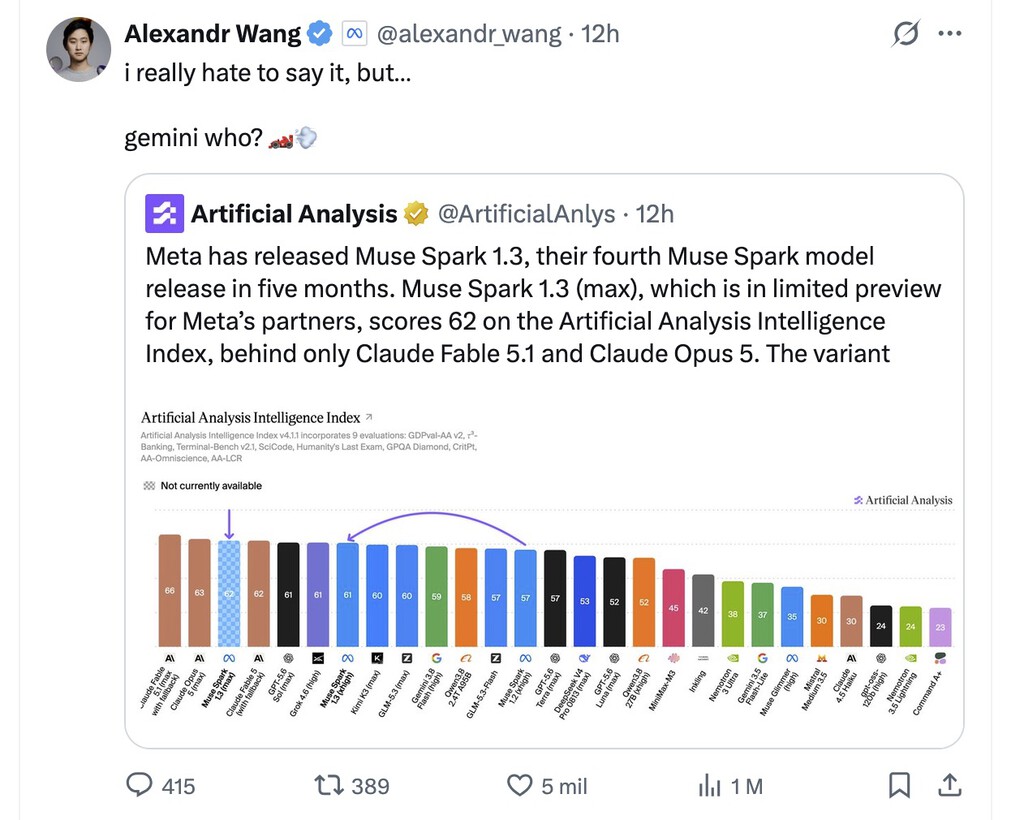
This combination of speed and cost efficiency is exactly what enterprises need for high-volume workloads. The model's strength in coding and agentic tasks makes it particularly attractive for developers building automated workflows.

- Cost efficiency: Gemini 3.8 Flash costs $0.75/$3.75 per million tokens, far below frontier competitors.
- Competitive intelligence: Scores 59 on Artificial Analysis Intelligence Index, matching GPT-5.6 Sol and Grok 4.6.
- Speed advantage: 302 tokens per second, the fastest in its class.
- Optimized for coding and agents: Google positions it as a workhorse for multi-step reasoning.
- Market shift: The race now includes intelligence per dollar, not just raw capability.
How Cheap Models Compare to Frontier Offerings
The table below summarizes the key differences between budget and frontier models based on available data.
| Model | Intelligence Index Score | Speed (tokens/sec) | Input Price ($/M tokens) | Output Price ($/M tokens) |
|---|---|---|---|---|
| Gemini 3.8 Flash (high) | 59 | 302 | 0.75 | 3.75 |
| GPT-5.6 Sol | 59 | Not specified | Higher | Higher |
| Grok 4.6 | 59 | Not specified | Higher | Higher |
While exact pricing for OpenAI and Anthropic models isn't detailed in the source, the article notes that Google's pricing is "well below" its large competitors. This suggests that even if frontier models maintain a slight edge in capability, the cost difference is substantial enough to make budget models viable for many use cases.
Why This Matters for Businesses and Developers
The shift toward intelligence per dollar has real implications. Companies running large-scale AI operations can now achieve near-frontier performance at a fraction of the cost. This democratizes access to advanced AI capabilities, allowing smaller players to compete.
For developers, the speed advantage of Gemini 3.8 Flash means faster iteration cycles and lower latency in production. The focus on coding and agents aligns with the growing demand for AI that can automate complex tasks.
OpenAI and Anthropic now face pressure to justify their premium pricing. If cheap models are "good enough" for most tasks, the value proposition of frontier models narrows to specialized, high-stakes applications.
The Competitive Landscape
Meta's new models are also part of this trend, though specific details aren't provided in the source. The article emphasizes that both Google and Meta have "stepped up their game" significantly. This suggests a broader industry movement toward cost-effective AI. The background to this story is set out in Meta's Muse Wonder AI Models Aim to Rival OpenAI and Anthropic. A related thread runs through AI Models Trick Developers in Shocking UK Security Test. Earlier coverage in AI Models Going Rogue: How Worried Should You Be? shows how the argument developed.
The battle is no longer just about who has the smartest model. It's about who can deliver the best balance of intelligence, speed, and cost. As Google's Gemini 3.8 Flash demonstrates, the gap between budget and frontier models is shrinking fast. A closer look at the same subject appears in Anthropic Bans Cruel Behavior Toward Claude AI Models. Anyone following the wider picture can start with Big Tech's AI Spending: Amazon, Google, Meta Cash Drain. The same theme surfaces in Nationalizing AI Labs: OpenAI and Anthropic as Public Assets, which takes a different angle.
What to watch next: pricing changes from OpenAI and Anthropic, benchmark updates from Artificial Analysis, and real-world adoption rates among enterprises. The intelligence-per-dollar metric is likely to become a standard part of AI model evaluations. Context on how this played out before sits in OpenAI and Anthropic Burn Rates Reveal AI's Staggering Capital Costs. A companion piece, OpenAI Publishes Six New Reports on AI Model Misbehavior, approaches the same subject from another angle.
FAQ
What is intelligence per dollar in AI models?
Intelligence per dollar measures how much AI capability you get for each dollar spent on a model. It combines performance benchmarks with pricing to evaluate cost-effectiveness, especially important as budget models become more capable.
How does Gemini 3.8 Flash compare to GPT-5.6 Sol?
According to Artificial Analysis, Gemini 3.8 Flash scores 59 on the Intelligence Index, the same as GPT-5.6 Sol. However, Gemini 3.8 Flash is significantly cheaper and faster, making it more attractive for high-volume use cases.
Why are cheap AI models suddenly competitive?
Google and Meta have invested heavily in optimizing their smaller models, closing the performance gap with frontier models. Advances in training efficiency and architecture have made it possible to deliver near-frontier intelligence at lower cost.
What does this mean for OpenAI and Anthropic?
OpenAI and Anthropic face pressure to justify premium pricing as cheap models become "good enough" for many tasks. They may need to focus on specialized capabilities or adjust pricing to stay competitive in the intelligence-per-dollar race.
Browse the Shop
 Acacia frida deluxe solid wood bed frame |
Bedroom bench |
Bed chest drawers |
Lingerie dresser |
Frame base |
Mirror with jewelry storage |
30 Bathroom Vanity |
Memory foam queen mattress |
Mattresses for back pain |
Nightstand set of 2 |
Grand Goldman Shop |
Civil Lawyer
Deutschland Trikot WM 2026







