

A Spanish art teacher from Vélez-Málaga has undertaken the monumental task of rewriting Don Quixote entirely in Gothic calligraphy by hand. Manuel Marín Navarro, who teaches artistic drawing, calls the project “a madness,” but he has already dedicated six years, seven months, and 24 days to it—and he's not finished yet.
The work involves copying all 344,000 words of Miguel de Cervantes' masterpiece, letter by letter, in ink on paper. Marín Navarro spends between seven and eight hours a day on the project, which he describes as the legacy of a lifetime. When completed, the book is expected to weigh around 20 kilograms.
Find Original Home Decor sparking conversation at Grand Goldman Shop.

Why Rewrite Don Quixote in Gothic Calligraphy?
Marín Navarro's motivation goes beyond mere transcription. He views the project as a way to honor the literary giant that is Don Quixote, often considered the greatest novel ever written. By using Gothic script—a style characterized by its ornate, angular letters—he aims to create a unique artifact that bridges medieval craftsmanship and Renaissance literature.
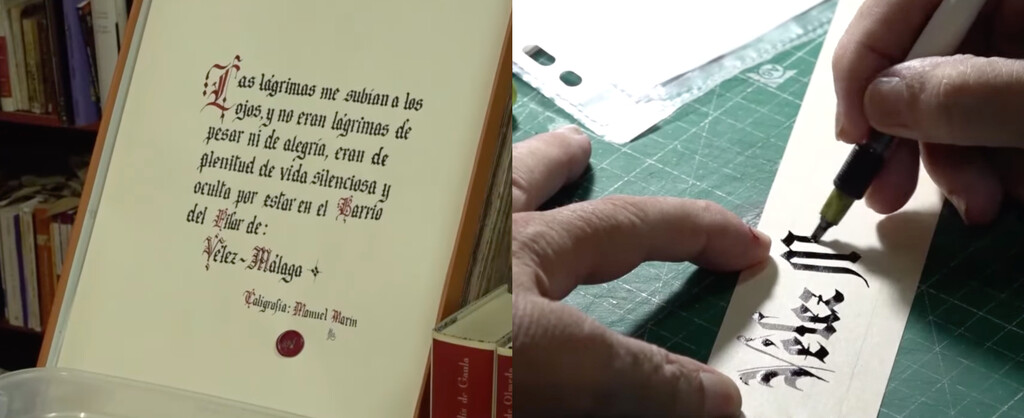
The teacher's dedication is reminiscent of medieval monks who painstakingly copied manuscripts. However, unlike those anonymous scribes, Marín Navarro is creating a one-of-a-kind piece that he believes holds significant monetary value.
The €1 Million Valuation: How Is It Calculated?
Marín Navarro arrived at the €1 million price tag through simple arithmetic. He added up the hours, days, and years spent on the project and estimated a salary equivalent to what a medieval copyist would earn in today's market. “I'm not even counting the artistic value,” he says.
The calculation reflects the immense labor involved: over six years of daily work, totaling thousands of hours. At a rate comparable to a skilled artisan's wage, the sum quickly climbs into six figures, and Marín Navarro believes the final product's uniqueness justifies the million-euro estimate.
What Makes This Don Quixote Edition Unique?
This isn't a printed edition or a digital file. It's a completely handmade manuscript, with every letter formed by hand using a calligraphic pen. The Gothic script itself is rarely used for modern texts, making the project a rare blend of historical technique and literary content.
The physical scale is also remarkable: at 20 kilograms, the finished book will be a hefty tome, likely requiring special binding and handling. Marín Navarro plans to bind it himself, adding another layer of craftsmanship.
The Challenges of Hand-Copying a Masterpiece
Copying Don Quixote by hand is not just physically demanding but also mentally taxing. Marín Navarro must maintain concentration for hours, ensuring each letter is perfectly formed. The Gothic script's complexity—with its thick strokes and sharp angles—adds to the difficulty. Context on how this played out before sits in Spanish Teacher Handwrites Don Quixote in Gothic Script, Valued at €1M.
He also has to manage the sheer volume of text. With 2.1 million characters to reproduce, the project requires meticulous planning and pacing. Marín Navarro works on large sheets of paper, which will eventually be bound into volumes. The background to this story is set out in The Real 'Place in La Mancha' Behind Don Quixote Finally Has a Name. A related thread runs through Trending: latest articles.
Who Is Manuel Marín Navarro?
Manuel Marín Navarro is an art teacher in Vélez-Málaga, a town in southern Spain. His background in artistic drawing has equipped him with the skills needed for precise calligraphy. He sees the project as a personal legacy, something he will leave behind for future generations. Earlier coverage in Stolen 18th-Century Painting and Relic Found in Squatted House shows how the argument developed. A closer look at the same subject appears in Adolf Wölfli: The Schizophrenic Artist Who Created 25,000 Pages.
Despite the project's scale, Marín Navarro remains committed. He compares his daily routine to a monastic discipline, isolating himself to focus on the work. “It's a dream,” he says, “but also a sacrifice.” Anyone following the wider picture can start with Samsung The Frame LS03F 50-Inch QLED TV Deal: Art Meets 4K. The same theme surfaces in The Bear Comes Home: An Overlooked Gem for Adult Readers, which takes a different angle.
Key Takeaways
- Manuel Marín Navarro is rewriting Don Quixote entirely in Gothic calligraphy by hand.
- The project has taken over six years and is not yet complete.
- He estimates the final manuscript is worth €1 million, based on labor hours.
- The finished book will weigh around 20 kilograms and be bound by hand.
- Marín Navarro views the work as his life's legacy.
Comparing the Original and the Handwritten Edition
| Aspect | Original Don Quixote (1605/1615) | Marín Navarro's Handwritten Edition |
|---|---|---|
| Script | Printed in Spanish Golden Age typography | Gothic calligraphy, handwritten |
| Production time | Months (printing) | Over 6 years (ongoing) |
| Weight | ~1 kg (modern paperback) | ~20 kg (estimated) |
| Uniqueness | Millions of copies | One-of-a-kind manuscript |
| Estimated value | Market price of book | €1 million (author's estimate) |
FAQ
How long has Manuel Marín Navarro been working on this project?
He has been working on it for six years, seven months, and 24 days as of the latest report, and he has not yet finished.
Why does he value the manuscript at €1 million?
He calculated the value based on the hours worked and an estimated salary equivalent to that of a medieval copyist in today's market.
Will the handwritten Don Quixote be for sale?
Marín Navarro has not explicitly stated it is for sale, but he has valued it at €1 million, suggesting he considers it a valuable asset.
What is Gothic calligraphy?
Gothic calligraphy is a style of writing that originated in medieval Europe, characterized by thick, angular letters and ornate flourishes. It was commonly used in manuscripts before the Renaissance.
Browse the Shop
 Acacia frida deluxe solid wood bed frame |
Bedroom bench |
Bed chest drawers |
Lingerie dresser |
Frame base |
Mirror with jewelry storage |
30 Bathroom Vanity |
Memory foam queen mattress |
Mattresses for back pain |
Nightstand set of 2 |
Grand Goldman Shop |
Civil Lawyer
Deutschland Trikot WM 2026







