Meteen naar de content
Grand Goldman

How Much Is $1,000 a Month Invested for 30 Years 2025

Investing $1,000 a month for 30 years is one of the most effective ways to build long-term wealth and achieve financial independence. With consistent monthly investments and the power of compound interest, your money has decades to grow, turning a manageable contribution into a substantial investment portfolio.

But how much could that really be worth after 30 years? The answer depends on several key factors—interest rate, investment strategy, and market returns.

If you invest $1,000 per month with an average annual return of 7%, your total contributions of $360,000 could grow to over $1.2 million thanks to compounding. This demonstrates why long-term investing in stocks, index funds, or retirement accounts such as a 401(k) or IRA can significantly amplify your wealth over time. The earlier you start, the greater your compound growth, since returns start generating their own returns year after year.

Understanding how to maximize your investment returns involves balancing risk tolerance, choosing diversified asset allocations, and staying consistent—even during market fluctuations. This guide breaks down exactly how much $1,000 invested monthly for 30 years could grow under various scenarios, helping you design a winning investment plan. Whether you’re saving for retirement, financial freedom, or future generational wealth, consistent investing remains one of the smartest moves you can make.


Intellectia AI ReviewŠŠGrand Goldman

Try the #1 AI Investment Platform for Free: Intellectia


The Power of Consistent Monthly Investing

Investing a consistent amount every month can significantly grow your wealth over time. One such scenario involves investing $1,000 each month for 30 years. But how much could you actually accumulate in that period? This article will walk you through the process of calculating the growth of your monthly investment and explore the factors that influence your wealth accumulation.

Consistently setting aside a portion of your income is a key element of any financial strategy. Monthly savings can be an effective way to build wealth over time, especially when combined with a solid investment strategy.


Understanding Dollar-Cost Averaging

Regular investments, such as monthly contributions, leverage the power of dollar-cost averaging. This strategy involves investing a fixed amount regularly, which helps mitigate the effects of market volatility by purchasing more shares when prices are low and fewer when prices are high. Over time, this can lead to substantial growth.


The Role of Compound Interest

One of the most compelling aspects of investing is compound interest, which allows your investment to grow exponentially as you earn returns on both your initial principal and the accumulated interest over time.

Consider your $1,000 monthly investment. Initially, your contributions may seem to grow slowly. However, as the interest compounds, the growth accelerates. This compounding effect is what makes long-term investing so powerful.


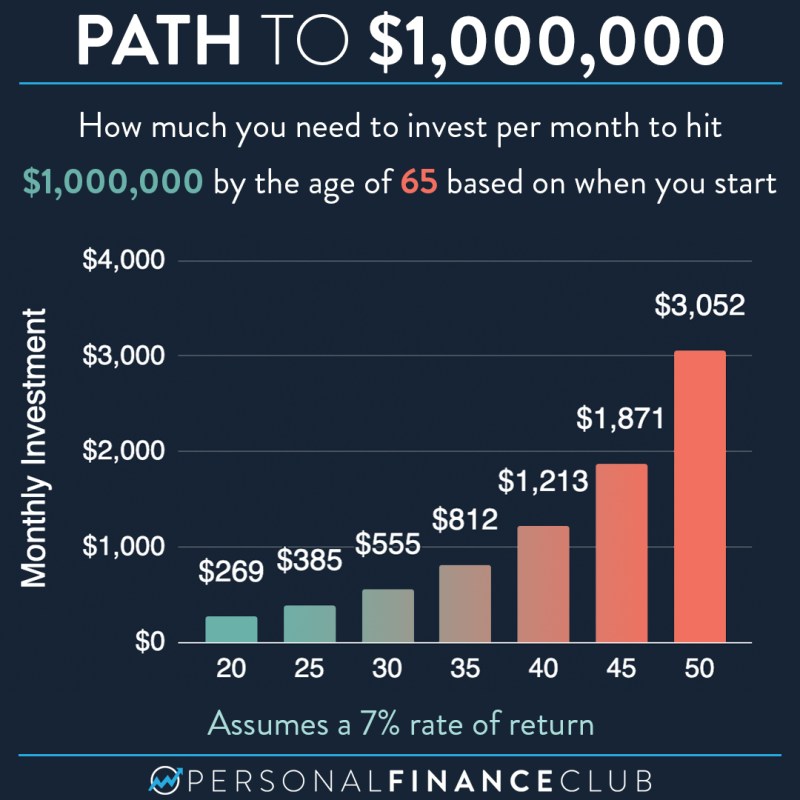
How much do I need to invest every month to become a millionaire? - Blog  Posts - Personal Finance Club


How to Calculate the Future Value of Monthly Investments

To understand how much your $1,000 monthly investment could grow over 30 years, you need to consider several factors, including the expected rate of return and the frequency of compounding.

Future Value Formula

The formula to calculate the future value of monthly investments is:

FV=P×(1+r)n1rFV = P \times \frac{{(1 + r)^n - 1}}{r}

Where:

  • FV = Future value of the investment

  • P = Monthly investment amount

  • r = Monthly interest rate (annual rate divided by 12)

  • n = Total number of contributions (months)

While the formula provides a theoretical understanding, using an investment growth calculator with monthly contributions can simplify the process. These tools allow you to input your monthly savings, expected return rate, and investment duration to quickly calculate potential growth.


Key Factors That Influence Investment Growth

Several variables affect the growth of your investments. Understanding these can help you make informed decisions about your investment strategy.

Rate of Return

The rate of return is a critical factor in determining how much your investment will grow. Historically, stocks have provided higher returns compared to bonds or savings accounts. However, higher returns often come with increased risk.

Inflation

Inflation erodes purchasing power over time, meaning your investments need to outpace inflation to preserve your wealth. Consider this when choosing your investment strategy.

Fees

Fees associated with investment products or advisors can significantly impact your overall returns. It's essential to understand and minimize these costs where possible.


Guides

Best Beginner Investment Platform | How Much Money Do I Need to Invest Make 3000 a Month | How to Make 1000 a Month by Investing | How Much is 1000 a Month Invested for 30 Years | Should I Use Robinhood or Fidelity | Robinhood Review


Example Calculation: $1,000 per Month for 30 Years at 7% Return

Let’s calculate the growth of a $1,000 monthly investment over 30 years with an average annual return of 7%, compounded monthly.

P=1,000P = 1,000 r=0.07120.00583r = \frac{0.07}{12} \approx 0.00583 n=30×12=360n = 30 \times 12 = 360 FV=1,000×(1+0.00583)36010.00583FV = 1,000 \times \frac{{(1 + 0.00583)^{360} - 1}}{0.00583}

After calculating, the future value of your investment would be approximately $1,220,000.


How to Invest in Stocks: 2025 Beginner's Guide - NerdWallet


Strategies to Maximize Long-Term Investment Growth

Diversify Your Portfolio

Diversification involves spreading your investments across various asset classes to reduce risk and volatility. A well-diversified portfolio can help achieve more stable returns over time.

Stay Invested Through Market Fluctuations

Investing is a long-term game. While market downturns can be unsettling, staying invested through the ups and downs is crucial for compounding growth. Attempting to time the market can lead to missed opportunities.

Review and Adjust Regularly

Your financial goals and market conditions may change over time. Regularly review your investment strategy and adjust it as needed to stay on track.


How Much Is $1,000 a Month Invested for 30 Years ? - My Conclusion

Investing $1,000 a month for 30 years can lead to substantial wealth accumulation, thanks to the power of compound interest. By understanding the factors that influence investment growth and employing smart strategies, you can enhance your financial future. Whether you're just starting or looking to optimize your current investment plan, the key is consistency and informed decision-making.

Remember, consulting with a financial advisor can provide personalized guidance tailored to your unique financial situation.


Intellectia AI ReviewŠŠGrand Goldman

Try the #1 AI Investment Platform for Free: Intellectia | Intellectia AI Review


Frequently Asked Questions (FAQ)

How much will I have if I invest $1,000 a month for 30 years?

Assuming a 7% annual return compounded monthly, you would accumulate roughly $1.22 million over 30 years.

What if my investment return is lower or higher than 7%?

At a 5% return, you’d have about $836,000. At a 10% return, your investment could grow to around $2.26 million. The rate of return significantly affects long-term results.

Is it better to invest monthly or yearly?

Investing monthly provides the advantage of dollar-cost averaging, which helps smooth out market volatility and builds discipline through consistent contributions.

Can I retire with $1,000 monthly investments?

Yes—depending on your total expenses and lifestyle, $1,000 monthly contributions can form a strong retirement foundation, especially if started early and combined with other savings or income streams.

What’s the safest way to invest $1,000 a month?

For balanced growth and safety, consider a diversified mix of index funds, ETFs, or target-date retirement funds matched to your risk tolerance and time horizon.


Michael Goldman
Author

Michael Goldman

Michael is an award-winning online reporter and content writer with over a decade of experience covering technology, business, and digital culture. His investigative features have been published in leading outlets such as Wired, The Verge, and Forbes, earning him recognition for accuracy and depth.


Financiën

How to Make $1,000 a Month by Investing

Learning how to make $1000 a month by investing is one of the most achievable financial goals for anyone looking to build passive income and attain financial freedom. Whether you’re new to investing or refining...

How Much Money Do I Need to Invest to Make $3,000 a Month?

If you’ve ever wondered how much money you need to invest to make $3,000 a month, you’re not alone. Building passive income is one of the most sought-after financial goals for those pursuing financial...

Should I Use Robinhood or Fidelity for Investing? (Comparison)

Choosing between Robinhood and Fidelity can be a pivotal decision for any investor, whether you’re just starting out or managing a diverse investment portfolio. Both platforms offer unique strengths, but cater to different types of traders and investing...

Robinhood Review: Is it Worth It for Investing ? (What I Found)

The rise of commission-free trading has completely changed how people invest, and Robinhood has been at the center of that revolution. Launched in 2013, Robinhood quickly became one of the most popular investment apps in the...

11 Best Investment Platforms for Beginners (Reviews)

Getting started with investing can feel overwhelming, especially with so many online trading platforms, robo-advisors, and brokerage apps competing for your attention. As someone who has spent years analyzing financial markets and testing different investment tools, I know that...

Intellectia AI Review: De Waarheid Over AI-gestuurd Handelen

Als een ervaren financieel analist en AI-technologie enthousiasteling, heb ik jaren besteed aan het verkennen van de kruising tussen kunstmatige intelligentie en investeringsstrategieën. Toen ik voor het eerst Intellectia AI...

Verschillen Tussen Indexfondsen en ETF's: Welke Zijn Beter?

Naarmate de wereld van investeringen bekender wordt, rijzen er meer vragen over sommige concepten die specifiek zijn voor dit gebied, zoals het verschil tussen indexfondsen en ETF's. Dit betekent het...

Wat zijn Inverse Indexfondsen? (Uitgebreide Gids)

Inverse indexfondsen zijn beleggingsmodellen die hetzelfde gedrag van een specifieke aandelenmarktindex repliceren, maar dan omgekeerd. Dat wil zeggen, als deze index een opwaartse trend heeft, zal het fonds ook een...

7 Tips om Snel Geld te Besparen: Stapsgewijze Gids

We weten al dat de eerste stap naar het bereiken van financiële onafhankelijkheid is om genoeg geld te hebben geïnvesteerd om inkomen te genereren dat al onze uitgaven dekt. Maar...

Hoe een Noodfonds te Creëren: Stapsgewijze Gids

Het aanleggen van een noodfonds zou bijna een verplichting moeten zijn voor iedereen die hetzelfde levensstandaard wil behouden, ongeacht de onvoorziene gebeurtenissen en financiële tegenslagen die van tijd tot tijd...

Hoe een beleggingsfonds / indexfonds te erven en minder belasting te betalen

Wat is een beleggingsfonds? Hoe zou het mij ten goede komen als ik een van de erfgenamen was? Ik zal dit en andere vragen in detail uitleggen in dit artikel....

Hoe Geld te Besparen Bij een Inkomen van 1.000 Euro (7 Tips)

Hoe kan ik geld besparen dat ik verdien als het weinig of beperkt is? Of je nu een student bent die bij je ouders woont of een ouder, ik weet...

Wat is financiële zuinigheid en hoe pas je het toe in je leven

Financiële vrijheid is de afgelopen jaren door veel investeerders en adviseurs breed gepromoot; er zijn verschillende wegen en strategieën om dit te bereiken, waarvan financiële zuinigheid er één is. Financiële...

5 Tips om uw gezinsbudget beter te organiseren

Wil je weten hoe je je uitgaven efficiënter kunt beheersen? Weet je wat je zou moeten prioriteren als het gaat om sparen? Maak je geen zorgen, want in dit artikel...

Hoe te Investeren Tijdens een Recessie: Wat Je Moet Weten

In dit artikel leg ik uit hoe ik investeer in tijden van recessie om mijn geld te vermenigvuldigen, en welke kansen ik denk dat we voor ons zullen hebben en...

Is er een "bubble" in indexfondsen? Wat je moet weten

Michael Burry, the renowned investor known for his accurate prediction of the 2008 financial crisis featured in the film " The Big Short," has expressed concern about a potential significant...