

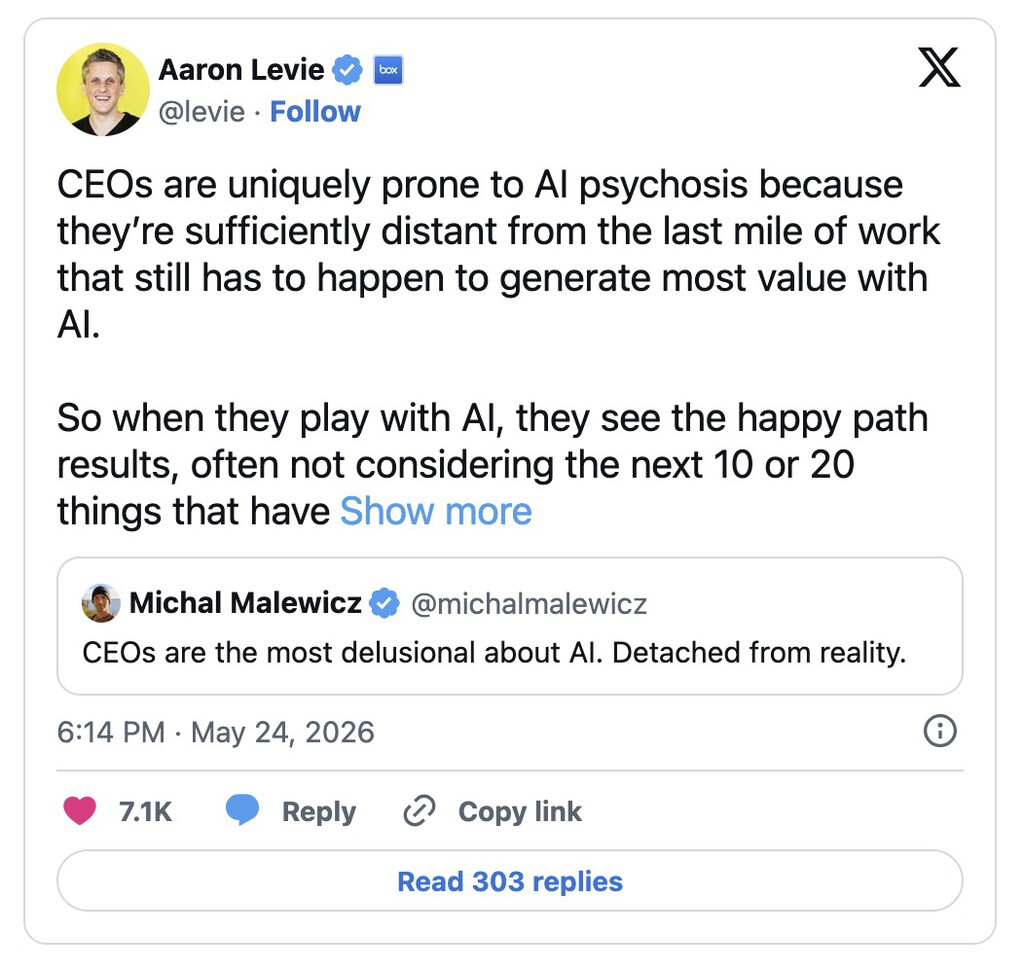
AI psychosis is gripping tech CEOs, leading them to overestimate what artificial intelligence can actually do, according to Aaron Levie, founder and CEO of Box. This phenomenon is causing a dangerous disconnect between executive perception and the reality of AI's capabilities in the workplace.
What Is AI Psychosis and Why Is It Spreading Among CEOs?
Levie describes AI psychosis as a cognitive disconnect where business leaders believe AI can perform tasks that still require human oversight and expert judgment. This delusion is particularly prevalent among tech company executives who are far removed from the actual work being done.
Find Original Home Decor sparking conversation at Grand Goldman Shop.

As AI prototypes demonstrate impressive capabilities—like generating contracts or writing code—CEOs may mistakenly conclude that the entire job is complete. However, they often overlook the critical final steps that still demand human review and expertise.
The Symptoms: Stock Surges and Mass Layoffs
The tech industry is experiencing frantic movements this year. Stock valuations for tech companies are skyrocketing, yet simultaneously, mass layoffs are accelerating. This paradoxical situation is partly fueled by the AI psychosis Levie identifies.
Executives, enamored with AI's potential, may be making hasty decisions to cut human resources, believing AI can seamlessly take over. But the reality is more nuanced: AI still requires human control and expert judgment for many tasks.
Why Executives Fall for the Delusion
According to Levie, executives are susceptible to this "delirium" because "they are sufficiently far from that last stretch where the work is actually done." In other words, a CEO sees a demo of an AI model generating a contract or a line of code and assumes it's ready for prime time.
However, these same executives are not the ones who have to review that code for errors, ensure compliance, or handle edge cases. The gap between a prototype and a production-ready solution is vast, and it's often bridged by human experts.
The Real-World Impact: Layoffs and Overreliance on AI
The consequences of AI psychosis are tangible. Companies may lay off workers prematurely, assuming AI can fill the gap, only to find that the technology isn't mature enough to handle complex tasks without human intervention.
This overreliance on AI can lead to quality issues, security risks, and ultimately, a loss of competitive advantage. It also affects employees who bear the brunt of these decisions. The background to this story is set out in Black Box Podcast Season 2 Explores AI Chatbots and Psychosis. A related thread runs through Elon Musk's Cyber Psychosis: What AI Users Need to Know. Earlier coverage in Tech Layoffs 2026 Surpass 197,000 as Capital Shifts to AI shows how the argument developed.
Key Takeaways for Business Leaders
- AI psychosis is a real phenomenon where CEOs overestimate AI capabilities due to distance from actual work.
- Prototypes are not production-ready; human oversight remains essential for quality and security.
- Mass layoffs based on AI overconfidence can backfire, harming company performance.
- Executives should engage more closely with technical teams to understand AI's limitations.
- Balancing AI adoption with human expertise is crucial for sustainable success.
Comparing AI Capabilities: Hype vs. Reality
| Task | AI Can Do Today | Still Requires Human Expert |
|---|---|---|
| Generate code | Yes, for simple snippets | Complex systems, debugging, security |
| Draft contracts | Yes, basic templates | Legal review, compliance, negotiation |
| Customer support | Yes, for FAQs | Escalations, emotional intelligence |
| Data analysis | Yes, pattern recognition | Interpretation, strategic decisions |
What to Watch Next
As AI continues to evolve, the gap between executive perception and reality may narrow—or widen. Companies that successfully navigate this will be those that foster collaboration between AI and human workers, rather than replacing humans outright. A closer look at the same subject appears in ASML Offers €20,000 Stock Bonus to Retain Employees Amid Tech Layoffs. Anyone following the wider picture can start with Ai Video: latest articles. The same theme surfaces in Meta's $14 Billion AI Bet: One Year Later, Still No Breakthrough, which takes a different angle.
Levie's warning serves as a cautionary tale: don't let AI psychosis drive decisions. Instead, ground AI strategies in a realistic understanding of what the technology can and cannot do. Context on how this played out before sits in AI Profitability Tracker: The Interactive Site Exposing Big Tech's Spending. A companion piece, AI Digital Twins: How Tech CEOs Clone Themselves to Skip Work, approaches the same subject from another angle.
FAQ
What exactly is AI psychosis?
What exactly is AI psychosis?
AI psychosis is a term coined by Aaron Levie to describe a cognitive disconnect where CEOs and executives overestimate AI's capabilities, believing it can perform tasks that still require human oversight and expert judgment.
Why are tech CEOs particularly susceptible?
Why are tech CEOs particularly susceptible?
Tech CEOs are often far removed from the day-to-day work, so they see impressive AI prototypes and assume the technology is ready for full deployment, without understanding the final human-dependent steps.
How does AI psychosis contribute to layoffs?
How does AI psychosis contribute to layoffs?
Executives may lay off workers believing AI can seamlessly replace them, but the technology often isn't mature enough, leading to quality issues and potential reversals.
What can be done to avoid AI psychosis?
What can be done to avoid AI psychosis?
Leaders should engage closely with technical teams, understand AI's limitations, and maintain a balance between AI adoption and human expertise to make informed decisions.
Browse the Shop
 Acacia frida deluxe solid wood bed frame |
Bedroom bench |
Bed chest drawers |
Lingerie dresser |
Frame base |
Mirror with jewelry storage |
30 Bathroom Vanity |
Memory foam queen mattress |
Mattresses for back pain |
Nightstand set of 2 |
Grand Goldman Shop |
Civil Lawyer
Deutschland Trikot WM 2026







