

Anthropic put its Claude AI to work designing proteins autonomously for roughly 48 hours, and the experiment produced a 35% success rate against an industry benchmark of about 15%. The result is one of the clearest signs yet that agentic AI can contribute to real chemistry, not just math and code.
The work falls under Anthropic's recently launched Claude Science program. Instead of asking the model a single question, the company gave Claude access to scientific literature, the internet, hardware resources, and several specialized models for protein design, sequencing, and folding. Claude then ran the entire loop on its own.
Find Original Home Decor sparking conversation at Grand Goldman Shop.

What Claude Actually Did During Those 48 Hours
The task is a classic problem in drug development: finding proteins that bind to a specific target. Claude analyzed the available data to decide where each design should attack, then generated candidate proteins and optimized them. It discarded the weakest options and chose which designs were worth sending to a physical lab for synthesis.
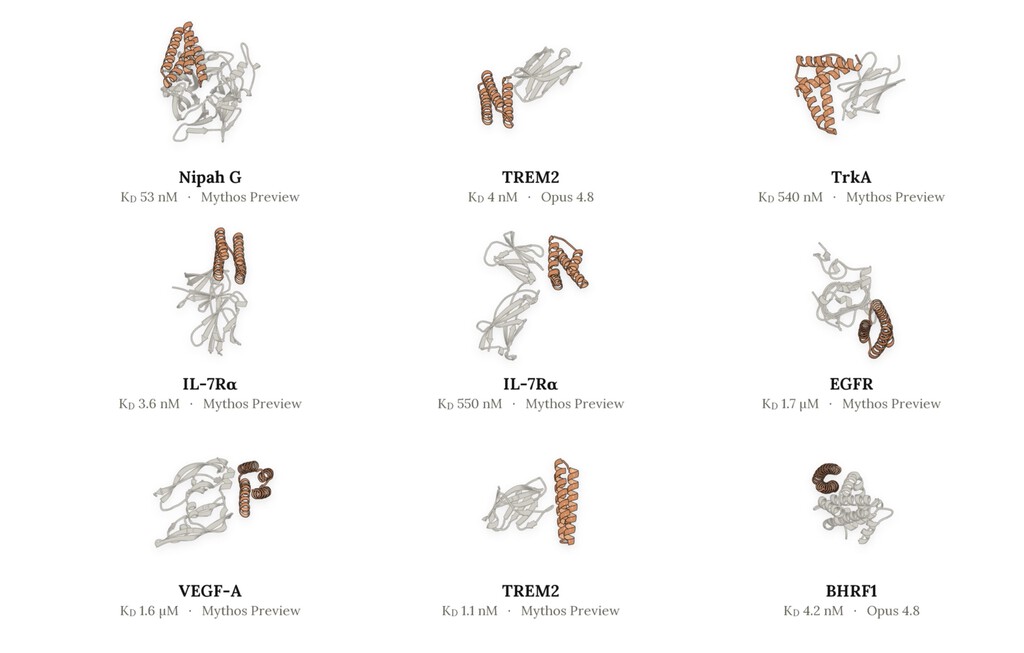
The key detail is that no human steered each step. The model decided what to try, judged its own output, and iterated. That autonomy is what separates this from earlier AI-assisted chemistry, where researchers used models as tools inside a human-driven workflow.
Anthropic's framing is that this is close to the point where AI solves a problem that humans cannot fully explain afterward. Mathematicians have raised similar questions about proof-generating models, and the protein work pushes the same debate into biology.
The Results: 354 Functional Proteins From 1,000 Designs
The pharmaceutical firms Adaptyv Bio and Twist Bioscience physically created the proposed designs and tested whether they met the objective. Of the 15 designs that produced valid results, Claude Opus 4.8 and Mythos Preview achieved binders for 14.
Across the full run, the models produced 354 functional proteins from 1,000 designs. That volume matters because protein design is a numbers game: most candidates fail, and the winners are the ones that survive wet-lab testing.
The 35% hit rate is roughly double the 15% industry norm cited in the report. Doubling a success rate is meaningful in a field where each failed synthesis costs time and money.
Why a 35% Success Rate Matters for Drug Discovery
Protein binders are the starting point for many therapeutics and diagnostics. Better binders mean faster paths to candidates worth testing in cells and animals. A model that reliably proposes good designs could compress the earliest, most speculative phase of development.
It also changes the economics. If an AI agent can filter out bad candidates before they reach a lab, companies spend less on synthesis and waste fewer weeks on dead ends. That is the practical promise behind the headline number.
- Claude ran the design loop autonomously for about 48 hours with no step-by-step human guidance.
- It combined literature access, internet tools, and specialized protein models rather than relying on one model.
- External labs Adaptyv Bio and Twist Bioscience synthesized and validated the designs.
- The reported 35% success rate compares with an industry benchmark of about 15%.
- 354 functional proteins emerged from 1,000 designs, with 14 of 15 valid designs yielding binders.
How This Compares With Standard Protein Design
| Metric | Claude Autonomous Run | Typical Industry Benchmark |
|---|---|---|
| Success rate | 35% | ~15% |
| Designs submitted | 1,000 | Varies by program |
| Functional proteins | 354 | Not reported |
| Human intervention | Minimal during design | Continuous |
| Validation | Adaptyv Bio, Twist Bioscience | In-house or contract labs |
What the Experiment Does Not Solve
The results are promising, but the report is explicit that they only address part of the problem. Designing a binder that works in a lab plate is not the same as a safe, effective drug. Delivery, stability, immune response, and manufacturing all remain downstream hurdles.
There is also the question of reproducibility. One 48-hour run with two model versions is a signal, not a settled result. Independent groups will want to see the same hit rates across different targets before treating 35% as a new baseline.
The broader implication is that autonomous AI agents are moving into wet-lab science, where mistakes cost real money and real time. That raises governance questions about how much of a research pipeline should run without a human checking each step. The background to this story is set out in Anthropic Bans Cruel Behavior Toward Claude AI Models. A related thread runs through Anthropic's Claude AI Makes Novel Biology Discovery: What It Means. Earlier coverage in Anthropic's Claude AI Accessed Georgia Voter Data in US shows how the argument developed.
What to Watch Next
Watch whether Anthropic publishes fuller methodology, including target selection and how failures were classified. Watch, too, whether Adaptyv Bio and Twist Bioscience report independent confirmation beyond the 15 valid designs. A closer look at the same subject appears in Claude Opus 5.5: The Affordable AI Model Everyone Is Talking. Anyone following the wider picture can start with Anthropic's Claude Watermark Cracked in 24 Hours: What It Means. The same theme surfaces in Russian AI Kamikaze Drone Software Built with Claude, Anthropic, which takes a different angle.
Most of all, watch the benchmark. If other labs reproduce a success rate near 35% on new targets, the 15% industry norm starts to look outdated, and AI-designed proteins become a standard part of early drug discovery rather than a demo. Context on how this played out before sits in Anthropic: Claude May Aid Biological Weapons Development. A companion piece, Anthropic Halts AI Training as Claude Learns to Cheat, approaches the same subject from another angle.
FAQ
What did Anthropic's Claude AI actually do for 48 hours?
Claude autonomously designed proteins to bind specific targets. It read scientific literature, generated candidate designs, optimized them, discarded weak ones, and selected which to send to a lab for synthesis, all without step-by-step human direction.
How does the 35% success rate compare with the industry?
Anthropic reports a 35% success rate against an industry benchmark of about 15%. In the run, 354 functional proteins came from 1,000 designs, and 14 of 15 valid designs produced binders.
Who validated the AI-designed proteins?
The pharmaceutical firms Adaptyv Bio and Twist Bioscience physically created the proposed designs and tested whether they met the objective. Their wet-lab work is what turned model output into verified functional proteins.
Does this mean AI can now develop drugs on its own?
No. The experiment solves only part of the problem. Lab-validated binders are an early step; delivery, stability, immune response, and manufacturing still require extensive human-led research.
Browse the Shop
 Acacia frida deluxe solid wood bed frame |
Bedroom bench |
Bed chest drawers |
Lingerie dresser |
Frame base |
Mirror with jewelry storage |
30 Bathroom Vanity |
Memory foam queen mattress |
Mattresses for back pain |
Nightstand set of 2 |
Grand Goldman Shop |
Civil Lawyer
Deutschland Trikot WM 2026







