

Big Tech AI spending reached unprecedented levels in 2025, with Amazon, Microsoft, Google, and Meta collectively announcing a capital expenditure (capex) of $725 billion. That's a staggering 77% increase over last year's $410 billion, according to financial reports. The massive investment underscores the fierce race to dominate artificial intelligence, but it's also raising concerns about the financial health of these tech giants.
The numbers are eye-popping, but they come with a worrying consequence: free cash flow—the lifeblood of any business—has plummeted. As these companies pour billions into AI infrastructure, their ability to generate excess cash has shrunk to levels not seen since 2014. This shift could have significant implications for investors and the broader tech ecosystem.
Find Original Home Decor sparking conversation at Grand Goldman Shop.

The AI Spending Spree: A Race to the Top
Amazon, Microsoft, Google, and Meta have long been cash-generating machines, consistently delivering strong revenue and profit growth. They've accumulated exceptional cash reserves, but now they're deploying that money into an AI arms race that shows no signs of slowing. The capex figures for 2025 are a testament to their commitment to staying ahead.
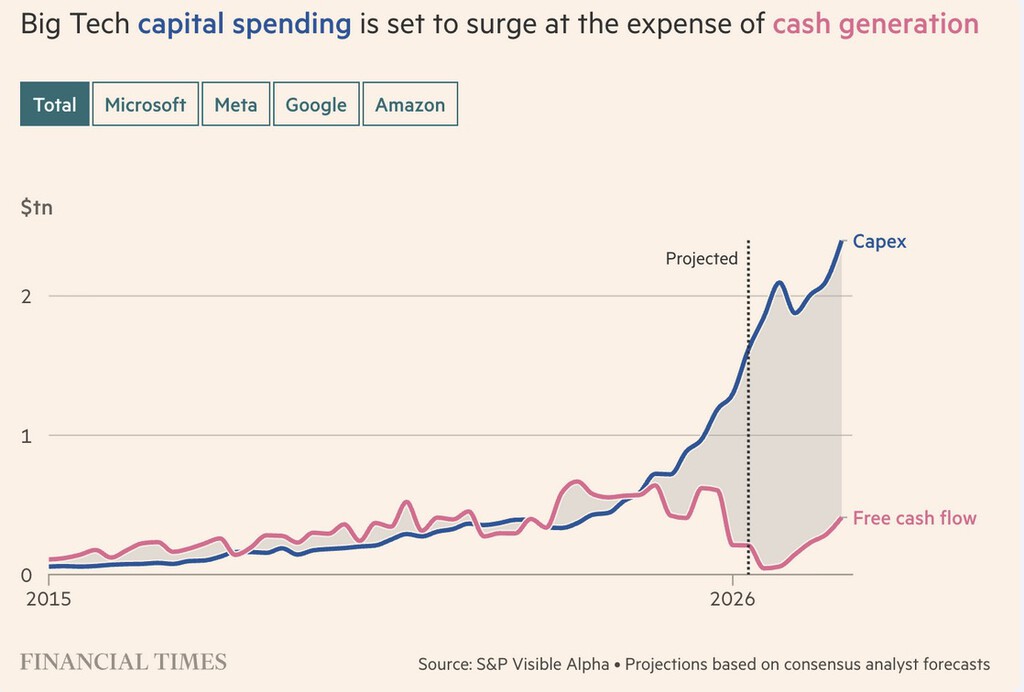
Amazon leads the pack in this spending spree, but all four companies are investing heavily in data centers, custom chips, and AI research. The goal is to build the infrastructure needed to train and run increasingly complex AI models, from large language models to autonomous systems. This spending is not just about keeping up with each other; it's about positioning for a future where AI is expected to permeate every aspect of business and society.
Why Such Massive Investments?
The surge in AI spending is driven by several factors. First, the potential of AI is enormous, with applications ranging from healthcare to finance to entertainment. Companies that lead in AI could capture significant market share and create new revenue streams. Second, the technology is evolving rapidly, requiring constant investment to stay competitive. Finally, there's a fear of missing out—no tech giant wants to be left behind in what many see as the next industrial revolution.
However, these investments are not without risk. AI is still in its early stages, and it's unclear which approaches will ultimately succeed. The massive capex could weigh on profitability if the returns don't materialize as expected.
The Cash Flow Crunch
The most immediate impact of this spending binge is the dramatic decline in free cash flow. Before the pandemic, these companies averaged around $45 billion in free cash flow. Now, that figure is projected to fall to just $4 billion in the third quarter of 2025, according to the Financial Times. This is a startling drop that highlights the scale of the investments.
Free cash flow is crucial because it provides the flexibility to invest in new opportunities, pay dividends, buy back stock, or weather economic downturns. A sharp decline could limit these companies' ability to return capital to shareholders or fund other strategic initiatives. It also raises questions about the sustainability of such high levels of spending.
What This Means for Investors
Investors are watching closely. While they generally support investments in growth areas like AI, they also expect disciplined capital allocation. The plummeting free cash flow could lead to increased scrutiny of these companies' spending plans. If returns on AI investments don't materialize soon, shareholders might push back.
Moreover, the decline in cash flow could affect these companies' credit ratings and borrowing costs. Although they still have strong balance sheets, a prolonged period of negative free cash flow could erode their financial cushion.
Amazon Leads the Charge
Among the Big Tech giants, Amazon is the biggest spender. The company has long been known for its heavy investments in infrastructure, and it's now channeling billions into AI. Amazon Web Services (AWS), its cloud computing arm, is a key beneficiary, as it provides the backbone for many AI workloads.
Amazon's capex for 2025 is expected to be the highest among the four, reflecting its broad ambitions in AI, from e-commerce recommendations to cloud-based AI services. Microsoft, Google, and Meta are also investing heavily, but Amazon's scale gives it a unique position.
Comparison of Big Tech AI Investments
Here's a breakdown of the announced capex and key focus areas for each company:
| Company | 2025 Capex (Approx.) | Key AI Focus Areas |
|---|---|---|
| Amazon | ~$200 billion | AWS AI services, custom chips, logistics AI |
| Microsoft | ~$180 billion | Azure AI, OpenAI partnership, Copilot |
| ~$170 billion | Google Cloud AI, Gemini models, TPUs | |
| Meta | ~$175 billion | AI research, metaverse AI, Llama models |
Note: Figures are approximate and based on public announcements.
Key Takeaways
- Big Tech's combined AI capex for 2025 is $725 billion, a 77% increase from 2024.
- Free cash flow has plummeted to levels not seen since 2014, with projections of just $4 billion in Q3 2025.
- Amazon leads in spending, followed closely by Microsoft, Google, and Meta.
- The investments are driven by the need to stay competitive in AI, but they carry financial risks.
- Investors are concerned about the impact on profitability and capital returns.
What to Watch Next
As we move further into 2025, several factors will determine whether this spending spree pays off. First, look for tangible AI products and services that generate revenue. Companies that can demonstrate real-world applications and customer adoption will be rewarded. Second, monitor free cash flow trends. If cash flow continues to decline, it could signal trouble ahead. The background to this story is set out in Big Tech's AI Spending: Amazon, Google, Meta Cash Drain. A related thread runs through Google Revenue Soars 12th Quarter – AI Spending Drives Growth. Earlier coverage in Apple and Amazon Rising Revenues Signal AI Spending Concerns shows how the argument developed.
Third, watch for regulatory scrutiny. Governments are increasingly interested in AI and Big Tech's dominance, and heavy spending could attract antitrust attention. Finally, keep an eye on the competitive landscape. Smaller players and startups are also innovating in AI, and the giants' massive investments might not guarantee success. A closer look at the same subject appears in Apple and Amazon Revenues Rise Amid AI Spending Concerns. Anyone following the wider picture can start with Premier League Transfer Spending Soars Past £1.4 Billion This. The same theme surfaces in Premier League Spending Soars: £1.4bn Summer Outlay Widens Gap, which takes a different angle.
The AI race is far from over, and the spending is likely to continue. But the financial implications are becoming harder to ignore. For now, Big Tech is betting big on AI, and the world is watching to see if it pays off. Context on how this played out before sits in Apple and Amazon Earnings Beat Expectations Amid AI Spending. A companion piece, Meta's $18B Settlement: Why Big Tech Regulation Falls Short, approaches the same subject from another angle.
FAQ
What is driving the massive AI spending by Big Tech?
The spending is driven by the need to stay competitive in the rapidly evolving AI field, the potential for significant future revenue, and the fear of being left behind. Companies are investing in data centers, custom chips, and AI research to build the infrastructure needed for advanced AI models.
How does the decline in free cash flow affect these companies?
A decline in free cash flow limits these companies' financial flexibility. It reduces their ability to invest in other areas, return capital to shareholders, or weather economic downturns. It also raises questions about the sustainability of their spending and could lead to increased scrutiny from investors.
Which company is spending the most on AI?
Amazon is currently the biggest spender, with an estimated capex of around $200 billion for 2025. Microsoft, Google, and Meta are also investing heavily, with figures ranging from $170 billion to $180 billion.
What are the risks of such high AI investments?
The main risks include the uncertainty of returns on AI investments, potential profitability pressures, and the possibility of a cash crunch if spending outpaces revenue growth. Additionally, regulatory and competitive risks could impact the success of these investments.
Browse the Shop
 Acacia frida deluxe solid wood bed frame |
Bedroom bench |
Bed chest drawers |
Lingerie dresser |
Frame base |
Mirror with jewelry storage |
30 Bathroom Vanity |
Memory foam queen mattress |
Mattresses for back pain |
Nightstand set of 2 |
Grand Goldman Shop |
Civil Lawyer
Deutschland Trikot WM 2026







