

Terafab, Elon Musk's proposed chip manufacturing plant, would be larger than the Pentagon, Apple Park, and Giga Texas combined. The project, spanning roughly 100 million square feet (about 9.3 million square meters), is a colossal facility that aims to integrate multiple semiconductor production stages under one roof.
If there's anyone who thinks big today, it's Elon Musk. The billionaire is a polarizing figure who generates as much admiration as criticism, but his ambition remains spectacular. Terafab is his latest venture, and it's a massive chip fabrication plant that dwarfs other mega-buildings.
Find Original Home Decor sparking conversation at Grand Goldman Shop.

Terafab's Unprecedented Scale
To grasp Terafab's size, it helps to compare it with other well-known structures. The Pentagon, Apple Park, Giga Texas, and the Mall of America are all enormous, but Terafab would occupy more surface area than all four combined.
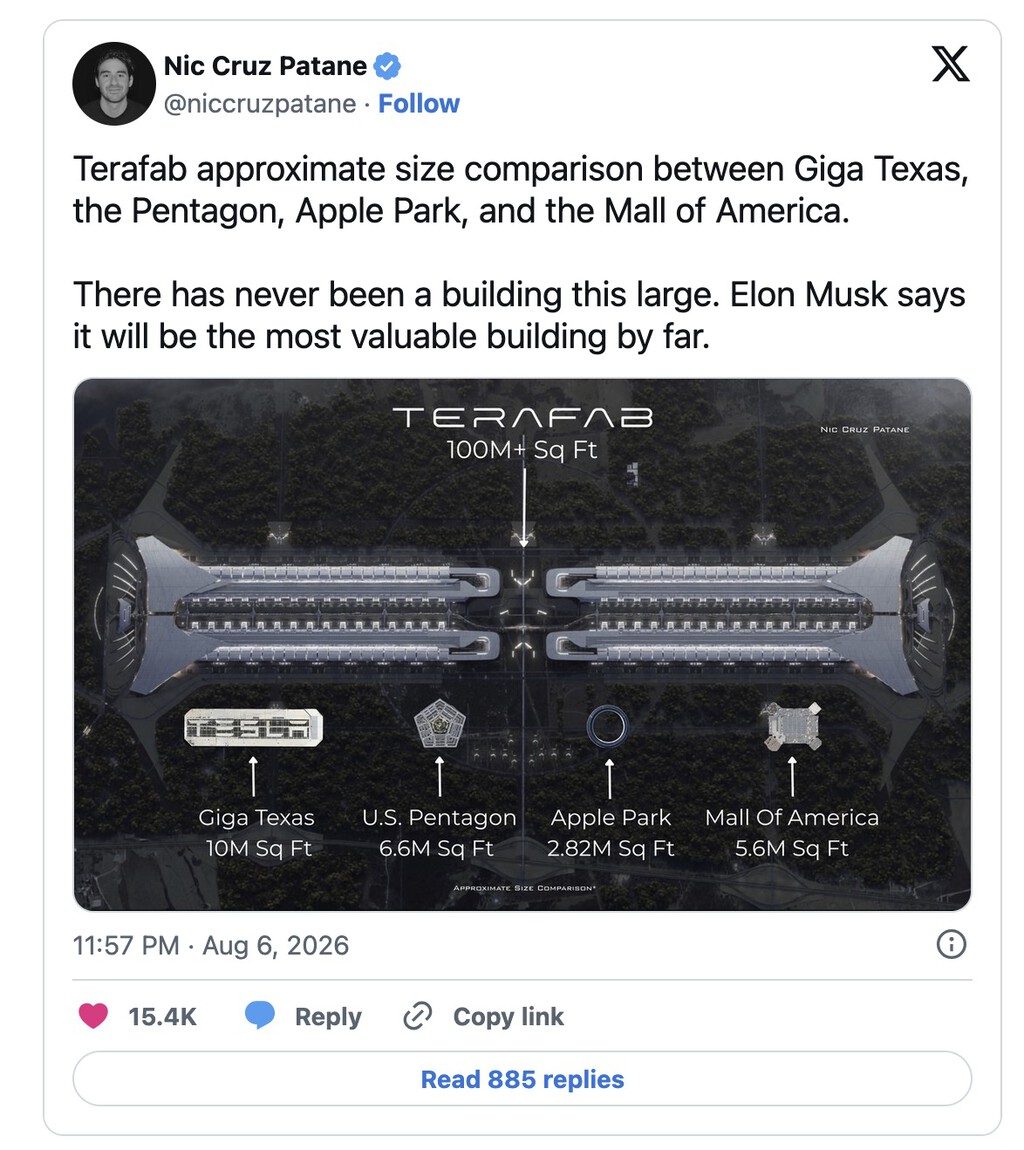
Popular science communicator Nic Cruz Patane recently highlighted these comparisons, showing just how small those landmarks appear next to Terafab. The numbers are staggering: Giga Texas covers about 10 million square feet, while the Mall of America spans 5.6 million square feet. Terafab's 100 million square feet is in a league of its own.
However, as with many mega-projects, especially those announced in Saudi Arabia, there's many a slip between cup and lip. The vision is grand, but execution remains to be seen.
What Terafab Will Actually Do
Terafab won't just be a gigantic factory. SpaceX describes it as an attempt to integrate photolithography mask design, logic and memory chip fabrication, advanced packaging, and testing all under one roof.
This vertical integration could streamline production and reduce dependencies on external suppliers. Tesla needs these chips for its vehicles and Optimus robots, while SpaceX requires them for its future infrastructure.
The facility's scope suggests a strategic move to secure semiconductor supply, which has been a bottleneck for many tech companies. By controlling the entire process, Musk aims to accelerate innovation and production.
Why This Matters for Tesla and SpaceX
Tesla's electric vehicles and Optimus humanoid robots rely heavily on advanced chips. As Tesla pushes towards full autonomy and robotics, the demand for specialized semiconductors will only grow.
SpaceX, meanwhile, needs chips for its satellite internet network, Starlink, and future space missions. A dedicated fabrication plant could give both companies a competitive edge.
The integration of design and manufacturing under one roof could also lead to faster iteration and cost savings. However, building such a facility is a massive undertaking that requires enormous capital and expertise.
Challenges and Skepticism
Despite the ambitious vision, Terafab faces significant hurdles. Semiconductor fabrication is incredibly complex and capital-intensive. Building a plant of this scale would take years and billions of dollars.
Moreover, the chip industry is highly competitive, with established players like TSMC and Intel dominating the market. Musk's venture would need to attract top talent and develop cutting-edge processes to compete.
There's also the question of location. No site has been announced, and environmental and logistical factors could pose challenges. The project's sheer size means it would have a substantial impact on local infrastructure and resources. The background to this story is set out in Intel Joins Elon Musk Terafab Project With SpaceX Tesla and xAI. A related thread runs through Elon Musk Documentary Reveals Six Shocking Truths. Earlier coverage in Elon Musk Unveils World's First Flying Car at Tesla Event shows how the argument developed.
Key Takeaways
- Terafab would cover 100 million square feet, surpassing the combined area of the Pentagon, Apple Park, Giga Texas, and Mall of America.
- The facility aims to integrate mask design, chip fabrication, packaging, and testing under one roof.
- Tesla and SpaceX would be primary beneficiaries, securing chips for vehicles, robots, and space infrastructure.
- Significant financial, technical, and logistical challenges remain before the project becomes reality.
How Terafab Compares to Other Mega-Structures
The table below illustrates the scale of Terafab relative to other famous buildings. A closer look at the same subject appears in Defund Elon Musk: Why Billionaire Power Threatens Democracy. Anyone following the wider picture can start with Elon Musk Joins Pete Hegseth's Project Meridian Warfare Taskforce. The same theme surfaces in UK EV Battery Gigafactory Expansion Shelved Amid JLR Talks, which takes a different angle.
| Structure | Area (million sq ft) | Area (million sq m) |
|---|---|---|
| Terafab | 100 | 9.3 |
| Pentagon | 6.5 | 0.6 |
| Apple Park | 2.8 | 0.26 |
| Giga Texas | 10 | 0.93 |
| Mall of America | 5.6 | 0.52 |
As the table shows, Terafab's area is an order of magnitude larger than any of these structures. Even Giga Texas, one of the largest factories in the world, is only a tenth of Terafab's size. Context on how this played out before sits in Elon Musk Attacks Filmmaker Alex Gibney Over Documentary. A companion piece, Elon Musk Becomes Biggest Political Donor of 2026 Midterms, approaches the same subject from another angle.
FAQ
What is Terafab?
Terafab is a proposed chip manufacturing plant by Elon Musk, designed to integrate photolithography mask design, logic and memory chip fabrication, advanced packaging, and testing under one roof. It would be the largest facility of its kind, spanning about 100 million square feet.
How big is Terafab compared to other buildings?
Terafab's area is larger than the Pentagon, Apple Park, Giga Texas, and the Mall of America combined. Its 100 million square feet dwarf Giga Texas's 10 million square feet and the Pentagon's 6.5 million square feet.
Why does Tesla need its own chip factory?
Tesla requires advanced chips for its electric vehicles and Optimus robots. By having its own fabrication plant, Tesla could secure supply, reduce dependency on external suppliers, and potentially accelerate innovation in autonomous driving and robotics.
Is Terafab actually being built?
As of now, Terafab is still in the conceptual phase. No construction timeline or location has been announced. Given the scale and complexity, it would likely take years to materialize, if it happens at all.
While Terafab remains a bold vision, its realization would mark a significant shift in semiconductor manufacturing. For now, it stands as a testament to Elon Musk's ambition to control every aspect of his companies' supply chains.
Browse the Shop
 Acacia frida deluxe solid wood bed frame |
Bedroom bench |
Bed chest drawers |
Lingerie dresser |
Frame base |
Mirror with jewelry storage |
30 Bathroom Vanity |
Memory foam queen mattress |
Mattresses for back pain |
Nightstand set of 2 |
Grand Goldman Shop |
Civil Lawyer
Deutschland Trikot WM 2026







