

White dwarfs aren't always white, according to a new study that reveals some of these stellar remnants could appear green, pink, or purple to the human eye. The research, from the University of Warwick, challenges the long-held assumption that these dense objects are uniformly white.
Using previously collected spectra and a computer model that simulates human color perception, scientists found that while most white dwarfs would indeed look white, a significant minority would display striking hues. This discovery offers a new perspective on how we visualize and understand these exotic objects.
Find Original, High-end Home Decor that spark conversation at Grand Goldman Shop.

Why White Dwarfs Aren't Always White
White dwarfs are the exposed cores of dead stars, typically about the size of Earth but with the mass of the Sun. They are incredibly dense and hot, and their color is determined by their temperature. However, the name "white dwarf" is somewhat misleading, as it implies a uniform white appearance.
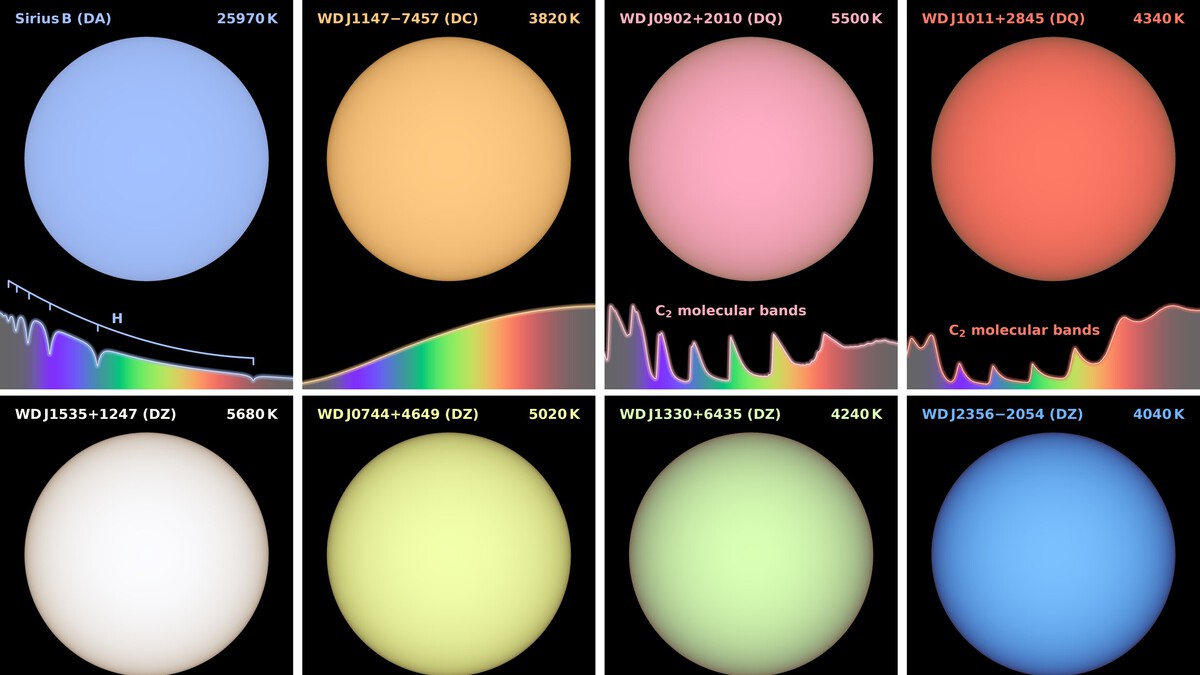
The new study shows that the color of a white dwarf depends on its temperature and atmospheric composition. Just as a heated metal changes color from red to yellow to blue, a white dwarf's spectrum shifts with temperature. But because these objects are so far away, we can't see them directly; we rely on spectroscopy to infer their properties.
The Warwick team took spectra from the Sloan Digital Sky Survey and passed them through a model that mimics the human eye's response to light. This allowed them to predict what color each white dwarf would appear if viewed up close.
What Colors Do White Dwarfs Show?
According to the study, the majority of white dwarfs would appear white or bluish-white, consistent with their high temperatures. However, a subset would exhibit more vibrant colors:
- Green: Some white dwarfs with specific temperature ranges would appear green due to the way our eyes perceive their light.
- Pink and Purple: Others would show pink or purple hues, especially if their spectra have certain absorption features.
- Blue and Yellow: A few would appear blue or yellow, depending on their exact temperature and composition.
These colors arise because the human eye doesn't perceive all wavelengths equally. The model accounted for this by weighting the spectrum according to the sensitivity of our cone cells.
The Science Behind Stellar Colors
Stellar color is fundamentally linked to temperature. Cooler stars appear red, while hotter stars appear blue. This is governed by Wien's law, which states that the peak wavelength of radiation emitted by a blackbody is inversely proportional to its temperature.
For white dwarfs, temperatures range from about 4,000 K to over 100,000 K. The hottest ones emit mostly in the ultraviolet, but their visible light appears blue-white. Cooler ones emit more red light. However, the human eye's response complicates matters: a spectrum that peaks in the green might appear white if it also contains enough red and blue.
| White Dwarf Type | Temperature Range (K) | Expected Color |
|---|---|---|
| Hot | 10,000–100,000 | Blue-white |
| Medium | 6,000–10,000 | White |
| Cool | 4,000–6,000 | Yellow to red |
| Special cases | Varies | Green, pink, purple |
The table summarizes the general relationship, but the study highlights that exceptions exist due to atmospheric composition and other factors.
Implications for Astronomy
This research matters because it affects how astronomers classify and interpret white dwarf observations. If some white dwarfs have distinct colors, it could influence the selection of targets for future studies. It also provides a more accurate picture for public outreach and education.
Moreover, understanding the color of white dwarfs can help in identifying unusual objects. For instance, a green white dwarf might indicate a peculiar composition or a binary system interaction. The study's model could be applied to other stellar objects to predict their visual appearance.
While the findings are fascinating, they don't change the fundamental physics of white dwarfs. They simply remind us that human perception is a filter through which we view the universe.
What to Watch Next
Future surveys like the Vera Rubin Observatory's LSST will discover millions of new white dwarfs. Applying this color model to those data could reveal more colorful specimens. Additionally, the James Webb Space Telescope can observe white dwarfs in infrared, providing complementary information.
Citizen science projects might also benefit, as volunteers could help classify white dwarf colors from images. The study's authors plan to refine their model by including more spectra and improving the eye model.
FAQ
Why are white dwarfs called white if they can be other colors?
The name "white dwarf" was coined historically because the first ones discovered appeared white. It's a misnomer, similar to how "red giant" doesn't cover all giants. The new study confirms that while most are white, some have distinct colors.
Can we see these colors with the naked eye?
No, white dwarfs are too faint and far away to discern color without a telescope. Even through a telescope, they usually appear as tiny points of light. The colors are inferred from spectra and models.
How did scientists determine the colors?
They used previously measured spectra and passed them through a computer model that simulates how the human eye's cone cells respond to different wavelengths. This allowed them to calculate the perceived color.
Does this change our understanding of stellar evolution?
Not fundamentally. The colors are a result of temperature and composition, which are already well-studied. However, it provides a new way to visualize and communicate these objects.
For more context on this story, see Zenith Star 33 mm 2015, spring in full color and Indigenous Astronomy Exhibition Shares Star Knowledge Across. Earlier reporting on the same theme includes Science: latest articles and Nobel Prize in Chemistry Awarded for Mirror-Image Molecules.
For the latest development on this topic, see White Dwarfs Aren't Always White: New Study Reveals Colorful Stars.
For the latest development on this topic, see Over 6,000 Exoplanets Found, But None Like Earth: PLATO Telescope.
Browse the Shop
 Acacia frida deluxe solid wood bed frame |
Bedroom bench |
Bed chest drawers |
Lingerie dresser |
Frame base |
Mirror with jewelry storage |
30 Bathroom Vanity |
Memory foam queen mattress |
Mattresses for back pain |
Nightstand set of 2 |
Grand Goldman Shop |
Civil Lawyer
Deutschland Trikot WM 2026
Acacia frida deluxe solid wood bed frame |
Bedroom bench |
Bed chest drawers |
Lingerie dresser |
Frame base |
Mirror with jewelry storage |
30 Bathroom Vanity |
Memory foam queen mattress |
Mattresses for back pain |
Nightstand set of 2 |
Grand Goldman Shop |
Civil Lawyer
Deutschland Trikot WM 2026










