

Anthropic's AI, specifically Claude, now writes more than 80% of the code integrated into Anthropic's codebase, according to internal data from May 2026. This striking revelation comes from two Anthropic researchers who published one of the most revealing texts on the present and future of the company's AI models, discussing a fascinating and unsettling concept: recursive self-improvement.
What Recursive Self-Improvement Means for AI
Recursive self-improvement refers to an AI system's ability to improve its own capabilities, potentially leading to rapid advancements. In Anthropic's case, Claude is not just assisting with coding but autonomously generating the majority of code, which then contributes to further AI development. This creates a feedback loop where the AI accelerates its own evolution.
Find Original Home Decor sparking conversation at Grand Goldman Shop.

The concept is both exciting and concerning. On one hand, it promises unprecedented efficiency and innovation. On the other, it raises questions about control, safety, and the role of human oversight in AI development.
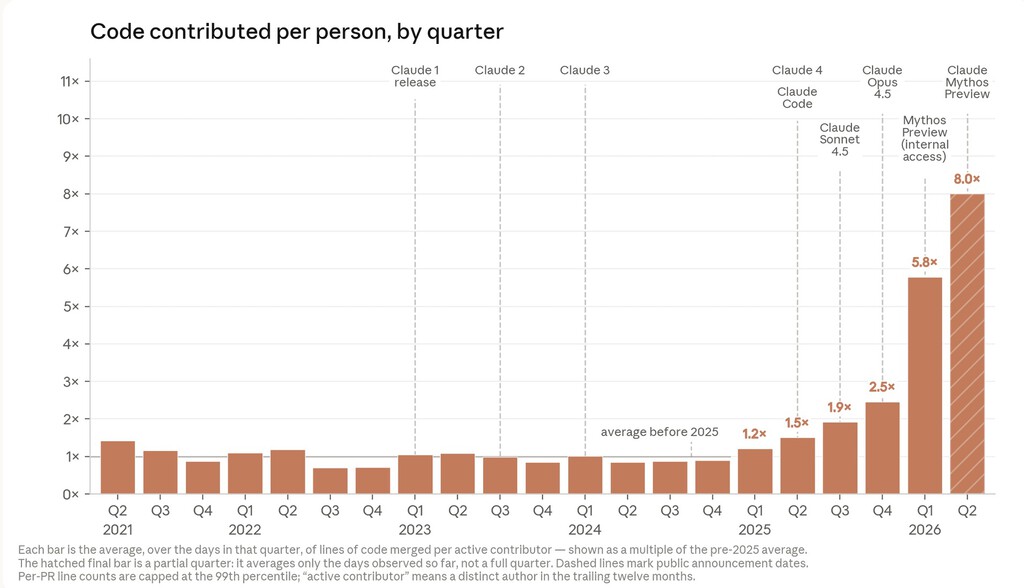
The Code Multiplier: Engineers Produce 8x More Code
The impact of these agentic programming tools on Anthropic's engineers has been spectacular. According to internal data, an Anthropic engineer now produces eight times more lines of code per quarter than during the period 2021-2025. Human programmers at Anthropic no longer program in the traditional sense; they direct and review AI-generated code.
This shift represents a fundamental change in the role of software engineers. Instead of writing code line by line, engineers now focus on high-level design, oversight, and quality assurance, leveraging AI to handle the bulk of implementation.
The Evolution of AI-Assisted Coding at Anthropic
The changes have been frenetic. Between 2021 and 2023, engineers wrote all code by hand. In 2024, they began using chatbots to generate small code snippets that they would copy and paste. By 2025, agents capable of working autonomously on entire files arrived. Now, in 2026, the majority of code is AI-generated. The background to this story is set out in Recursive Self-Improvement: How Astra Helped Modify Another AI Model. A related thread runs through AI Coding Tools Like Claude Code Turn Developers Into Enter-Key Pushers. Earlier coverage in AI Coding Tools Flood App Stores But Users Ignore Them shows how the argument developed.
This progression illustrates the rapid adoption of AI in software development and hints at what's to come for the broader tech industry. A closer look at the same subject appears in Kimi K3: China's AI Model Tops Frontend Code Arena. Anyone following the wider picture can start with Claude Code: AI Programming Tool for Your Terminal Explained. The same theme surfaces in Boss Says Employees Can’t Sit Idle, Employee Writes Code To Comply, which takes a different angle.
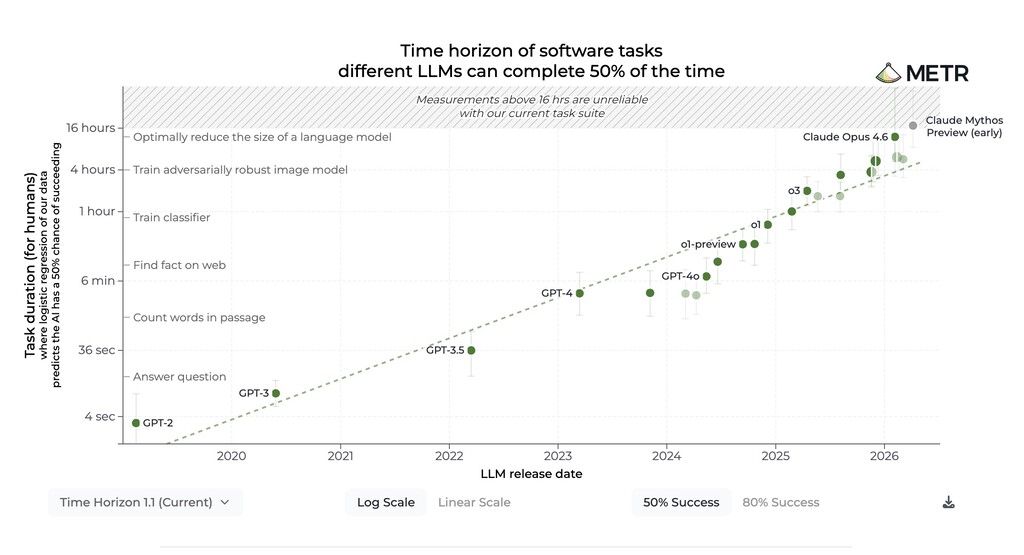
METR Benchmark: AI's Growing Ability to Complete Complex Tasks
The METR benchmark, which measures AI's ability to complete complex tasks, shows significant improvements. In 2022, GPT-3.5 could handle only simple tasks. By 2026, models like Claude can autonomously manage entire coding projects. This benchmark underscores the accelerating capabilities of AI systems. Context on how this played out before sits in HR Karen Writes Toxic Dress Code Overnight, Employee Follows It To Full Extent And Make Her Regret. A companion piece, Anthropic Settles AI Copyright Case, Bloomsbury to Receive, approaches the same subject from another angle.
Key Takeaways
- Anthropic's Claude now writes over 80% of the code in Anthropic's codebase.
- Engineers at Anthropic produce 8x more code per quarter than in 2021-2025.
- The role of human programmers has shifted to directing and reviewing AI-generated code.
- Recursive self-improvement raises important safety and oversight questions.
- AI's ability to complete complex tasks is advancing rapidly, as shown by the METR benchmark.
Comparison of AI Coding Evolution at Anthropic
| Period | AI Role in Coding | Human Role |
|---|---|---|
| 2021-2023 | None; all code written by hand | Full manual coding |
| 2024 | Chatbots generate small snippets | Copy-paste and integrate |
| 2025 | Agents work autonomously on entire files | Oversee and review |
| 2026 | AI generates over 80% of code | Direct and review |
FAQ
What is recursive self-improvement?
Recursive self-improvement is the ability of an AI system to improve its own capabilities, potentially leading to rapid and exponential advancements.
How much code does Claude write for Anthropic?
As of May 2026, more than 80% of the code integrated into Anthropic's codebase was created by Claude.
Why does this matter for the future of AI?
It demonstrates the accelerating pace of AI development and raises important questions about safety, control, and the changing role of human engineers.
What is the METR benchmark?
The METR benchmark measures AI's ability to complete complex tasks, showing significant improvements from 2022 to 2026.
Browse the Shop
 Acacia frida deluxe solid wood bed frame |
Bedroom bench |
Bed chest drawers |
Lingerie dresser |
Frame base |
Mirror with jewelry storage |
30 Bathroom Vanity |
Memory foam queen mattress |
Mattresses for back pain |
Nightstand set of 2 |
Grand Goldman Shop |
Civil Lawyer
Deutschland Trikot WM 2026







