

The James Webb Space Telescope has delivered a significant blow to the hope of finding habitable planets in the TRAPPIST-1 system. New observations reveal that the two innermost planets, TRAPPIST-1b and TRAPPIST-1c, lack atmospheres, dampening enthusiasm for the entire system as a candidate for extraterrestrial life.
TRAPPIST-1, a cool red dwarf star located about 40 light-years away, hosts seven Earth-sized rocky planets. Since their discovery, astronomers have studied this system intently because its compact nature offers a unique laboratory for understanding planetary evolution and potential habitability.
Find Original Home Decor sparking conversation at Grand Goldman Shop.

Why TRAPPIST-1 Was So Promising
The TRAPPIST-1 system is remarkable because all seven planets orbit extremely close to their star, with their orbits packed into a region smaller than Mercury's orbit around the Sun. This proximity means that several planets sit in the habitable zone—the region where temperatures could allow liquid water to exist on a rocky surface.
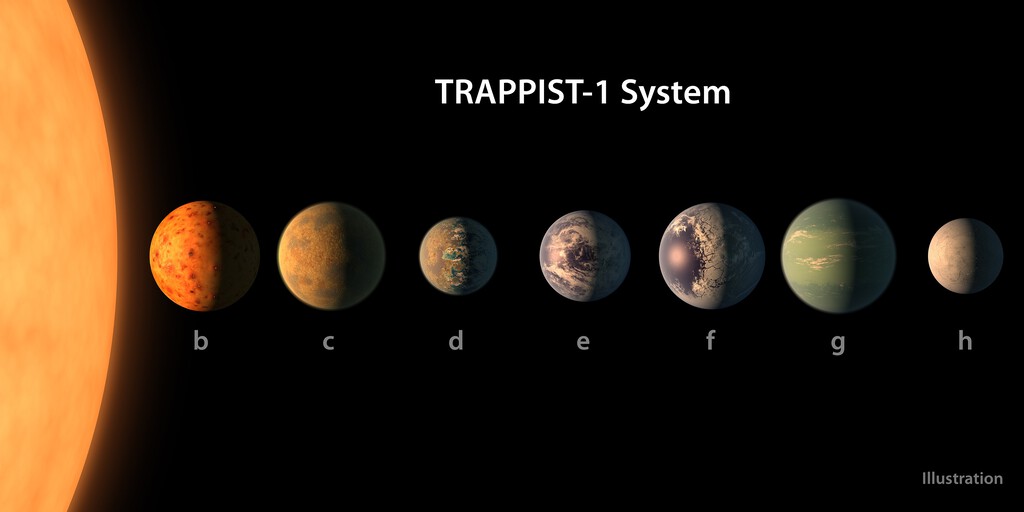
Moreover, the star's dimness makes it easier to study the planets' atmospheres via transit spectroscopy. When a planet passes in front of its star, starlight filters through any atmosphere, creating spectral fingerprints that telescopes can detect. This made TRAPPIST-1 a prime target for atmospheric studies.
What James Webb Found
An international team of astronomers used the James Webb Space Telescope's powerful infrared instruments to measure the thermal radiation emitted by TRAPPIST-1b and TRAPPIST-1c. By analyzing the intensity of infrared light, they created thermal maps of the planets' surfaces.
The results showed that neither planet has a substantial atmosphere. Without an atmosphere to redistribute heat, the planets likely have stark temperature differences between their day and night sides. This finding is particularly disappointing because both planets are relatively close to the star and were expected to be rocky worlds.
The team suggests that any atmospheres these planets might have had in the past were likely stripped away by the intense radiation and stellar winds from TRAPPIST-1 itself. Red dwarf stars are known for violent flares and high levels of ultraviolet radiation, which can erode planetary atmospheres over time.
Implications for Habitability
The lack of atmospheres on TRAPPIST-1b and c doesn't bode well for the other planets in the system. If the innermost planets have been stripped bare, the outer planets may have suffered similar fates, although they are farther from the star and might be less affected.
However, scientists caution that this doesn't rule out habitability entirely. The outer planets, particularly TRAPPIST-1e, f, and g, are in the habitable zone and could still possess atmospheres. Future observations with James Webb will target these planets to assess their atmospheric conditions.
Even if the planets lack atmospheres, they still offer valuable insights into planetary formation and evolution. Studying how TRAPPIST-1's radiation affects its planets helps astronomers understand the conditions around red dwarfs, which are the most common type of star in the galaxy.
What This Means for Exoplanet Research
The TRAPPIST-1 results highlight the challenges of finding habitable worlds around red dwarfs. These stars are ubiquitous, but their intense activity may make it difficult for planets to retain atmospheres. This has implications for the search for life beyond Earth. The background to this story is set out in James Webb Corrects Hubble's Exoplanet WASP-94A b Atmosphere Data. A related thread runs through Earth-Like Exoplanet with Atmosphere Found 49 Light Years Away. Earlier coverage in James Webb Finds Cold Lava Exoplanet HD 3167 b With Atmosphere shows how the argument developed.
On the bright side, James Webb's ability to detect and characterize atmospheres on small rocky planets is a major step forward. The telescope's precision allows astronomers to test hypotheses about planetary atmospheres with unprecedented detail. A closer look at the same subject appears in James Webb Space Telescope Maps 164,000 Galaxies in Epic Cosmic Survey. Anyone following the wider picture can start with James Webb Analyzes Exoplanet LHS 3844b Surface Heat. The same theme surfaces in Over 6,000 Exoplanets Found, But None Like Earth: PLATO Telescope, which takes a different angle.
As the team continues to observe the remaining TRAPPIST-1 planets, we can expect more answers—and perhaps new surprises—about this intriguing system. Context on how this played out before sits in Earth-Like Exoplanet Found with Atmosphere in Habitable Zone. A companion piece, Astronomer Vivien Parmentier on Mysterious Winds on Seven Exoplanets, approaches the same subject from another angle.
Key Takeaways
- James Webb found no atmosphere on TRAPPIST-1b and TRAPPIST-1c, the two innermost planets.
- TRAPPIST-1 is a red dwarf star with seven Earth-sized planets, several in the habitable zone.
- Stellar radiation from the star likely stripped the planets of their atmospheres.
- Outer planets may still have atmospheres and will be studied next.
- The findings underscore the challenges of habitability around red dwarfs.
TRAPPIST-1 Planets at a Glance
| Planet | Orbital Period (days) | Distance from Star (AU) | Status |
|---|---|---|---|
| TRAPPIST-1b | 1.51 | 0.011 | No atmosphere detected |
| TRAPPIST-1c | 2.42 | 0.016 | No atmosphere detected |
| TRAPPIST-1d | 4.05 | 0.022 | To be studied |
| TRAPPIST-1e | 6.10 | 0.029 | Habitable zone; to be studied |
| TRAPPIST-1f | 9.21 | 0.038 | Habitable zone; to be studied |
| TRAPPIST-1g | 12.35 | 0.047 | Habitable zone; to be studied |
| TRAPPIST-1h | 18.77 | 0.062 | To be studied |
FAQ
What did the James Webb Telescope discover about TRAPPIST-1?
James Webb found that the two innermost planets, TRAPPIST-1b and TRAPPIST-1c, lack atmospheres. This was determined by analyzing their thermal radiation, which showed no evidence of atmospheric heat redistribution.
Why is the lack of atmosphere on TRAPPIST-1b and c significant?
It reduces the likelihood that other planets in the system are habitable, as the same stellar radiation that stripped these planets could have affected the others. However, outer planets may still have atmospheres.
Could TRAPPIST-1 planets still support life?
While the inner planets are likely barren, the outer planets in the habitable zone (e, f, g) might retain atmospheres and could potentially support life. Future observations will determine their atmospheric conditions.
What's next for TRAPPIST-1 research?
Astronomers will use James Webb to study the remaining planets, especially those in the habitable zone, to see if they have atmospheres. These observations will help us understand the habitability of planets around red dwarfs.
Browse the Shop
 Acacia frida deluxe solid wood bed frame |
Bedroom bench |
Bed chest drawers |
Lingerie dresser |
Frame base |
Mirror with jewelry storage |
30 Bathroom Vanity |
Memory foam queen mattress |
Mattresses for back pain |
Nightstand set of 2 |
Grand Goldman Shop |
Civil Lawyer
Deutschland Trikot WM 2026







