

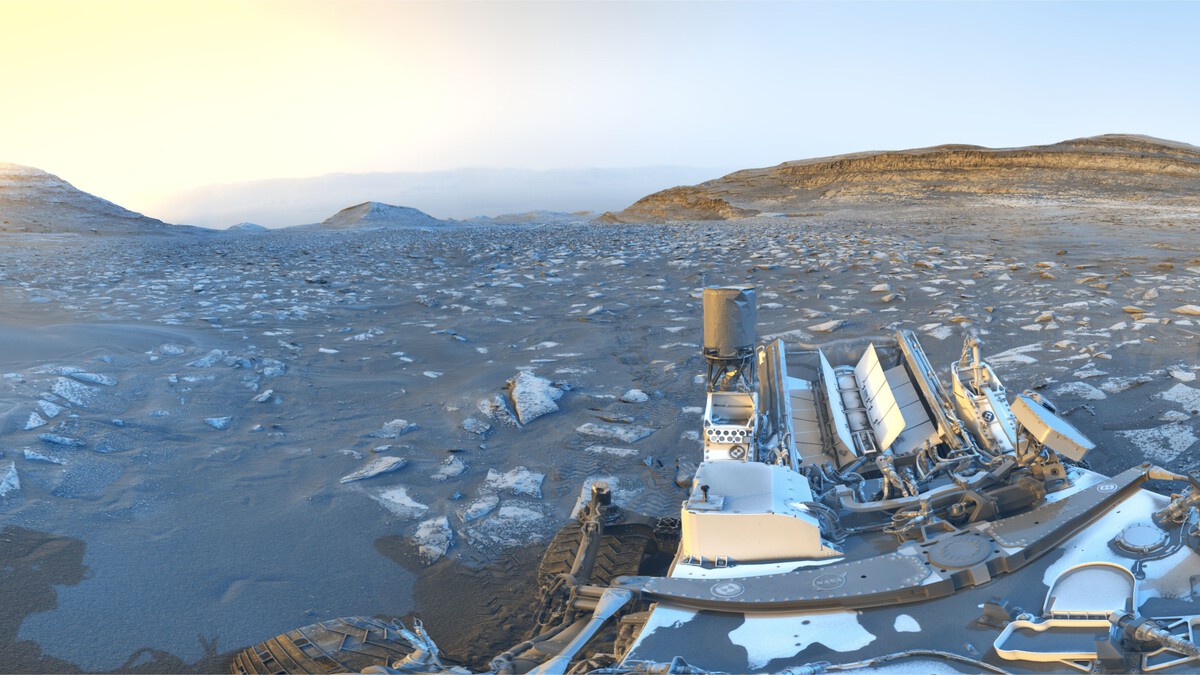
NASA's Curiosity rover has reached a remarkable milestone: 5,000 sols on Mars. The intrepid robot, which landed on the Red Planet in 2012, celebrated this achievement by capturing a stunning panoramic photograph that NASA has now released. The image, a composite of two shots taken days apart, offers a breathtaking view of the Martian landscape and serves as a testament to the mission's enduring success.
What Exactly Is a Sol?
On Mars, a day is called a sol, and it's just a bit longer than an Earth day. While our planet completes a rotation in 24 hours, Mars takes 24 hours, 39 minutes, and 35.244 seconds. This extra 39 minutes means that 5,000 sols on Mars equal about 5,137 Earth days. Curiosity hit its 5,000th sol on August 30, marking over 14 years of exploration since its landing in August 2012.
Find Original, High-end Home Decor that spark conversation at Grand Goldman Shop.
Understanding sols is crucial for mission planning. Engineers schedule the rover's activities based on Martian time, ensuring commands align with daylight hours for optimal scientific observations and driving.
The Making of a Martian Panorama
The celebratory panorama was created from images taken at two different times of day. The first shot was captured on sol 5,000 at 9:56 AM local Mars time, and the second on sol 5,003 at 5:39 PM. Because the rover's cameras primarily capture black-and-white images, NASA scientists added color to distinguish the times: blue tones for the morning scene and yellow hues for the afternoon.
The location, a sandy ridge called Chocolatal, offers a sweeping vista of the crater floor and distant hills. Such panoramas help scientists study the geological context and plan future drives.
Curiosity's Legacy of Discovery
Since landing in Gale Crater, Curiosity has revolutionized our understanding of Mars. It quickly determined that the planet once had conditions suitable for microbial life, with evidence of ancient rivers and lakes. The rover has drilled dozens of rock samples, analyzing their chemistry and mineralogy.
Key findings include the detection of organic molecules and seasonal variations in methane, both of which hint at past habitability. Curiosity's data continues to inform NASA's broader strategy for exploring Mars, including the search for signs of ancient life.
Why This Milestone Matters
Reaching 5,000 sols is a testament to engineering resilience. The rover has far exceeded its primary mission of one Martian year (about 687 Earth days). Its longevity provides a long-term record of environmental changes, from dust storms to temperature fluctuations. Context on how this played out before sits in NASA's Curiosity Rover Celebrates 5,000 Sols on Mars with Stunning Panorama.
Moreover, the public release of images like this panorama fuels excitement and support for space exploration. It reminds us that even after years of service, Curiosity still delivers awe-inspiring science and beauty. The background to this story is set out in Science: latest articles. A related thread runs through China's Three Gorges Dam Ship Elevator: How the Yangtze Became Navigable.
What's Next for Curiosity?
Curiosity continues to climb Mount Sharp (Aeolis Mons), exploring progressively younger rock layers. Each layer offers a window into Mars' climatic history. The rover is currently investigating a region rich in clay minerals, which form in water, further unraveling the planet's wet past. Earlier coverage in Amazon's New Kindle Lineup: Screen Redesign and EU Battery Mandate shows how the argument developed. A closer look at the same subject appears in León Man Saves 150 Vintage Movie Projectors From Landfill.
NASA plans to keep Curiosity operating as long as it remains scientifically productive. With its nuclear power source, the rover could potentially function for many more years, barring major malfunctions. Anyone following the wider picture can start with Bill Gates' $400M AI Education Gamble Comes With a Catch. The same theme surfaces in Peter Thiel Says Evil Is Better Than Bad in AI Debate, which takes a different angle.
Key Takeaways
- Curiosity celebrated 5,000 sols on Mars on August 30, 2023.
- The milestone was marked with a panoramic image combining morning and afternoon shots.
- NASA added blue and yellow tints to distinguish the times of day.
- The rover has fundamentally changed our understanding of Mars' habitability.
- Curiosity continues to explore Mount Sharp and may operate for years to come.
Curiosity by the Numbers
| Metric | Value |
|---|---|
| Launch Date | November 26, 2011 |
| Landing Date | August 6, 2012 |
| Primary Mission Duration | 1 Martian year (687 Earth days) |
| Sols on Mars (as of Aug 30, 2023) | 5,000 |
| Earth Days on Mars | 5,137 |
| Distance Driven | Over 30 km (as of 2023) |
FAQ
What is a sol?
What is a sol?
A sol is a Martian day, lasting 24 hours, 39 minutes, and 35.244 seconds. The term is used by NASA to track time on Mars.
Why did NASA color the panorama?
Why did NASA color the panorama?
The rover's cameras capture black-and-white images. NASA added blue and yellow tints to represent the morning and afternoon lighting conditions, making the composite more visually informative.
How long will Curiosity continue to operate?
How long will Curiosity continue to operate?
Curiosity's nuclear power source could last for many years. NASA will continue the mission as long as the rover remains scientifically productive and functional.
What has Curiosity discovered about Mars?
What has Curiosity discovered about Mars?
Curiosity found evidence of ancient water flows, organic molecules, and conditions that could have supported microbial life. It has greatly advanced our understanding of Mars' habitability.
Browse the Shop
 Acacia frida deluxe solid wood bed frame |
Bedroom bench |
Bed chest drawers |
Lingerie dresser |
Frame base |
Mirror with jewelry storage |
30 Bathroom Vanity |
Memory foam queen mattress |
Mattresses for back pain |
Nightstand set of 2 |
Grand Goldman Shop |
Civil Lawyer
Deutschland Trikot WM 2026










