

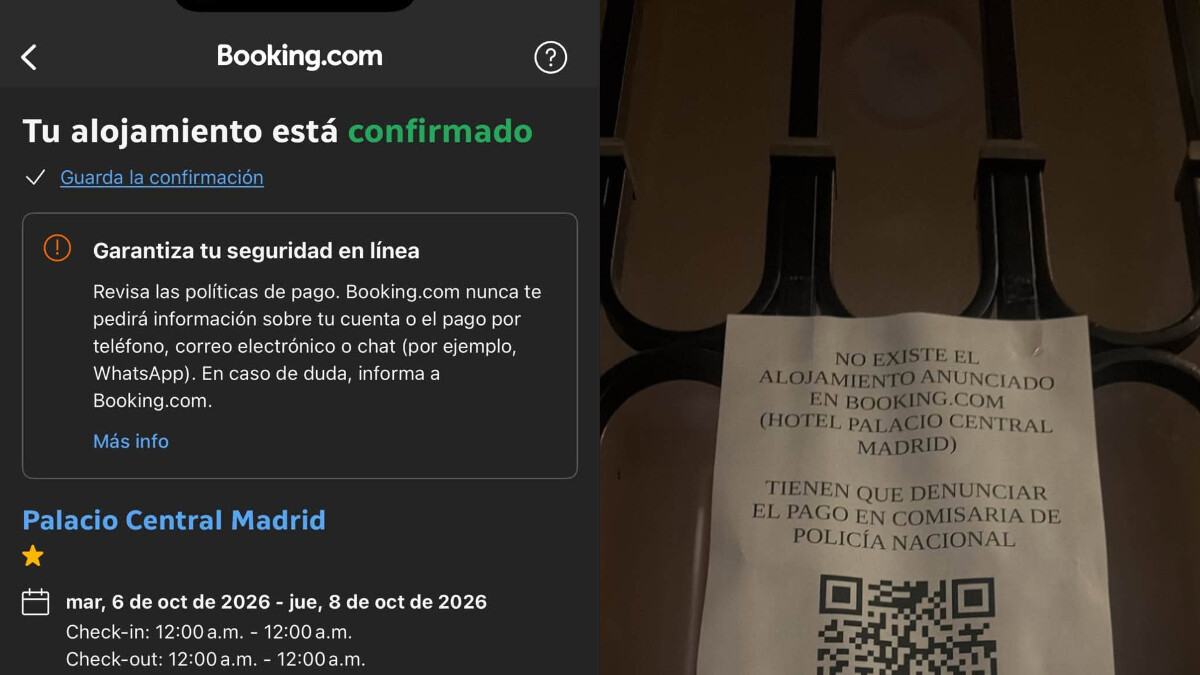
A Madrid fake rental scam has left more than 800 tourists stranded after they paid for an apartment that does not exist. The listing, which appeared on Booking.com, promised a 53-square-meter unit on Calle Menéndez Pelayo 19, complete with spa, parking, and airport transfer. But when guests arrived, they found only a sign on the gate reading “NO EXISTE EL ALOJAMIENTO ANUNCIADO” — the advertised accommodation does not exist.
According to a report by El País, the scam has been running for at least five nights, with taxis dropping off unsuspecting travelers who discover they have been defrauded. The story highlights a growing problem in the short-term rental market and raises serious questions about platform verification and consumer protection.
Find Original, High-end Home Decor that spark conversation at Grand Goldman Shop.
What Happened: The Madrid Fake Rental Scam Uncovered
The fraudulent listing advertised a 53 m² apartment in the Menéndez Pelayo area of Madrid, a popular residential neighborhood. Photos were stolen from other properties, and at least a couple were generated with AI, according to El País. The price ranged from 90 to 180 euros per day, a plausible rate for a city where short-term rentals are increasingly scarce.
In August 2024, Madrid had 22,435 tourist dwellings, but by May 2026 that number had dropped 40% to 13,431 under the Plan Reside. Only 323 unlicensed flats returned to residential use. This tightening supply has created a fertile ground for scammers: desperate travelers grab any available listing, often without verifying its legitimacy.
The Scene on Calle Menéndez Pelayo
El País describes a heartbreaking scene: taxi after taxi pulling up, tourists with luggage staring at the building facade. By 10 p.m. on Tuesday, 50 people were on the sidewalk, including a Nigerian family en route to Milan, a Moroccan family with a baby, and two retired Ecuadorians. The sign on the gate directs victims to file a police report.
Why This Scam Matters: The Rise of Fake Listings
This is not an isolated incident. The Madrid fake rental scam is part of a broader trend of fraudulent listings on major booking platforms. Scammers exploit the trust users place in established sites like Booking.com, which typically offer verified reviews and secure payment options. However, as this case shows, even reputable platforms can be gamed.
The scam also comes amid a crackdown on illegal tourist flats in Madrid. With fewer licensed properties available, travelers are more likely to fall for too-good-to-be-true offers. The fact that the listing remained live six months after a previous hack that popularized follow-up phishing suggests that platform security and verification processes are still inadequate.
Who Is Affected: Victims and Their Stories
The victims are ordinary tourists: families, retirees, and business travelers who saved up for a trip to Madrid. They paid between 90 and 180 euros per day, often for multiple nights, only to find themselves homeless in a foreign city. The financial loss is significant, but the emotional toll and disruption to travel plans are even greater. The longer history behind the story is traced in Japan's Demographic Crisis: Toyama Officials Accused of Adding 2,000 Fake.
Local residents like Maricarmen, who lives just 300 meters from the fake address, have witnessed the parade of confused and distressed visitors. The situation has become so notorious that a sign has been posted on the building's gate to warn others. The background to this story is set out in Bucharest Tourists Risk Collapse in Illegal Earthquake-Risky Rent. A related thread runs through France Wildfires Force Mass Evacuations: Tourists Describe Chaos. Earlier coverage in Denmark Wolf Encounter: Tourists Told to Stand Still and Stare shows how the argument developed.
What to Watch Next: Platform Accountability and Consumer Protection
Booking.com has not yet commented on this specific case, but the incident raises questions about how listings are verified and what recourse victims have. Under European consumer protection laws, platforms may be held liable for fraudulent listings if they fail to act after being notified. A closer look at the same subject appears in Australian Tourists Missing in Nepal Floods: Latest Updates. Anyone following the wider picture can start with Trending: latest articles. The same theme surfaces in Mexican Cartels Exploit Car Rentals to Build Fleets, which takes a different angle.
Travelers are advised to book through platforms with robust verification, pay with credit cards for chargeback protection, and always cross-check addresses with mapping services. The Madrid fake rental scam serves as a wake-up call for both platforms and consumers. Context on how this played out before sits in Spanish Island with Castle Near Madrid Lists for €3.25 Million. A companion piece, Ninja Foodi FlexDrawer Air Fryer Drops to Lowest Price, approaches the same subject from another angle.
Key Takeaways for Travelers
- Verify the address using Google Street View and cross-check with official tourism registries.
- Pay with a credit card to enable chargebacks in case of fraud.
- Be wary of too-good-to-be-true prices and listings with limited reviews.
- Contact the property directly before booking to confirm details.
- Report suspicious listings to the platform and local authorities.
Comparison: Legitimate vs. Fraudulent Listings
| Feature | Legitimate Listing | Fraudulent Listing |
|---|---|---|
| Photos | Original, high-quality, match property | Stolen or AI-generated, inconsistent |
| Reviews | Multiple, detailed, from verified guests | Few or none, generic |
| Price | Market rate | Often below market or with unrealistic amenities |
| Contact | Responsive, provides verifiable info | Evasive, pushes for off-platform payment |
| Address | Exists and matches description | Fake or mismatched |
FAQ
How many people were affected by the Madrid fake rental scam?
More than 800 people paid for the nonexistent apartment, with many showing up at the address only to find a sign saying the accommodation does not exist.
How can I avoid falling for a fake rental listing?
Always verify the address, read reviews carefully, pay with a credit card, and be suspicious of prices that seem too low for the location and amenities offered.
What should I do if I discover I've been scammed?
Immediately report the listing to the platform, file a police report, and contact your credit card company to dispute the charge. Also, warn other travelers on social media and review sites.
Is Booking.com responsible for fraudulent listings?
While platforms have policies against fraud, liability varies by jurisdiction. Under EU law, platforms may be held accountable if they fail to remove fraudulent listings after notification.
Browse the Shop
 Acacia frida deluxe solid wood bed frame |
Bedroom bench |
Bed chest drawers |
Lingerie dresser |
Frame base |
Mirror with jewelry storage |
30 Bathroom Vanity |
Memory foam queen mattress |
Mattresses for back pain |
Nightstand set of 2 |
Grand Goldman Shop |
Civil Lawyer
Deutschland Trikot WM 2026










