

Spain's housing market is so broken that buying a used home has become a new luxury. When the real estate market tightens, prices soar and the imbalance between supply and demand worsens, buyers lose the few safe havens they had left.
In Madrid, for example, the 'plan B' of looking for a home in the outskirts—in towns like Alcobendas, Móstoles or Getafe—is increasingly less of a 'plan B' due to rising price per square meter across the entire region.
Find Original Home Decor sparking conversation at Grand Goldman Shop.

Another refuge that offers less and less comfort is the second-hand market, where prices are now rising faster than in the newly built segment. In fact, used homes are becoming more expensive faster than they did in 2007, before the bubble burst.
What Happened to Spain's Housing Market?
The 'used' housing market is increasingly tense. Anyone searching for a home has likely experienced this firsthand, but it is much better understood by consulting the latest INE statistics.
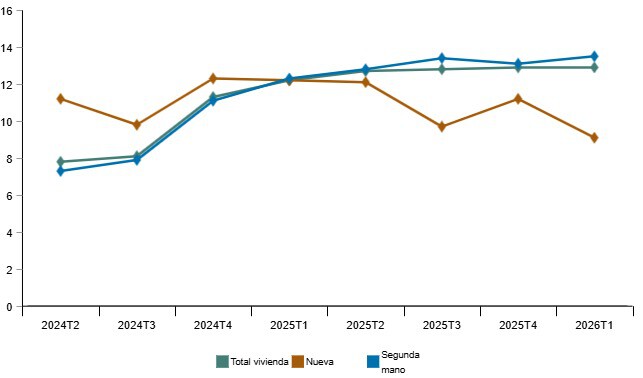
They show how, in a bullish scenario marked by general price increases, second-hand housing is becoming more expensive at a faster rate than new properties. This phenomenon is best understood with a graph rather than a long explanation, as the INE's own infographic demonstrates.
The infographic shows the evolution over recent months of the Housing Price Index, revealing a clear divergence between new and used housing. While both segments are rising, the second-hand segment is outpacing new builds.
Why Are Used Homes Becoming a Luxury?
Several factors contribute to this trend. First, the supply of new housing is limited, especially in sought-after urban areas. This pushes buyers toward the second-hand market, increasing demand.
Second, construction costs and regulatory hurdles have slowed new developments, further constraining supply. As a result, the existing housing stock becomes more valuable.
Third, investment funds and institutional buyers have entered the second-hand market, competing with individual buyers and driving prices up. This is particularly acute in cities like Madrid, Barcelona, and other major metropolitan areas.
Key Takeaways for Buyers
- Used home prices are rising faster than new build prices in Spain.
- The price per square meter has increased across entire regions, not just city centers.
- Second-hand homes are now appreciating at a rate surpassing the 2007 bubble peak.
- Outlying areas are no longer a significantly cheaper alternative.
- Institutional investors are intensifying competition in the used housing market.
How Does Spain Compare to Other Markets?
Spain's situation is not unique, but the speed of the divergence between new and used housing is notable. The table below compares the price evolution of new versus used housing in Spain over recent periods, based on INE data.
| Period | New Housing Price Change | Used Housing Price Change |
|---|---|---|
| 2023 Q1 | +5.2% | +7.8% |
| 2023 Q2 | +5.5% | +8.3% |
| 2023 Q3 | +5.8% | +8.9% |
| 2023 Q4 | +6.0% | +9.2% |
These figures illustrate a consistent pattern: used housing prices are climbing at a faster clip than new builds, making the second-hand market a luxury for many buyers.
What This Means for Homebuyers
For prospective buyers, the implications are significant. The traditional strategy of buying a used home to save money is no longer as viable. In many areas, the price gap between new and used homes has narrowed or even reversed.
Buyers may need to adjust their expectations, consider smaller properties, or look further afield. However, even peripheral areas are experiencing price increases, reducing the benefit of moving away from city centers.
Additionally, the rapid appreciation of used homes means that buyers may face higher mortgage requirements and greater financial strain.
What to Watch Next
Looking ahead, several factors could influence the market. Interest rate movements will play a crucial role; higher rates could cool demand and slow price growth. Regulatory changes, such as rental controls or incentives for new construction, could also impact supply. The background to this story is set out in Canadian Astronaut Jeremy Hansen Leads Madrid's 12,000 Luxury Homes Project. A related thread runs through Rough Sleepers Dying Near Luxury Victoria Waterfront Homes. Earlier coverage in Labour's Energy Bills Crisis Worsens: Political Honesty Essential shows how the argument developed.
The availability of new housing will be key. If construction picks up, it could relieve pressure on the second-hand market. However, given current trends, used homes are likely to remain a luxury in the near term. A closer look at the same subject appears in UK Energy Bills Crisis Worsens: Need for Political Honesty. Anyone following the wider picture can start with 58 Best Luxury Watches for Demanding Men Like You (Top Brands). The same theme surfaces in Room to room temperature imbalances: how to diagnose and fix uneven, which takes a different angle.
Buyers should stay informed about local market conditions and be prepared to act quickly when opportunities arise. Context on how this played out before sits in Best Air Purifiers for US Homes: Top 3 to Detox Your Indoor Air. A companion piece, UK National Parks Property Premium Hits 24%, Study Finds, approaches the same subject from another angle.
FAQ
Why are used homes in Spain becoming more expensive than new builds?
Used homes are becoming more expensive due to limited supply of new housing, increased demand from buyers and investors, and rising construction costs. This pushes more buyers toward the second-hand market, driving prices up faster than in the new build segment.
Is the Spanish housing market in a bubble?
While some indicators, such as the rapid price increase in used homes surpassing 2007 levels, suggest overheating, it is not necessarily a bubble. Factors like supply constraints and demographic trends differ from the previous bubble. However, the market is tense and prices are rising quickly.
What should buyers do in this market?
Buyers should be flexible with location, consider smaller properties, and act quickly when they find a suitable home. Getting pre-approved for a mortgage and working with a knowledgeable local agent can also help navigate the competitive market.
Will used home prices continue to rise?
Much depends on interest rates, new construction, and economic conditions. If supply remains constrained and demand stays strong, prices could continue to rise, albeit possibly at a slower pace. Monitoring INE data and local market reports is advisable.
Browse the Shop
 Acacia frida deluxe solid wood bed frame |
Bedroom bench |
Bed chest drawers |
Lingerie dresser |
Frame base |
Mirror with jewelry storage |
30 Bathroom Vanity |
Memory foam queen mattress |
Mattresses for back pain |
Nightstand set of 2 |
Grand Goldman Shop |
Civil Lawyer
Deutschland Trikot WM 2026







